


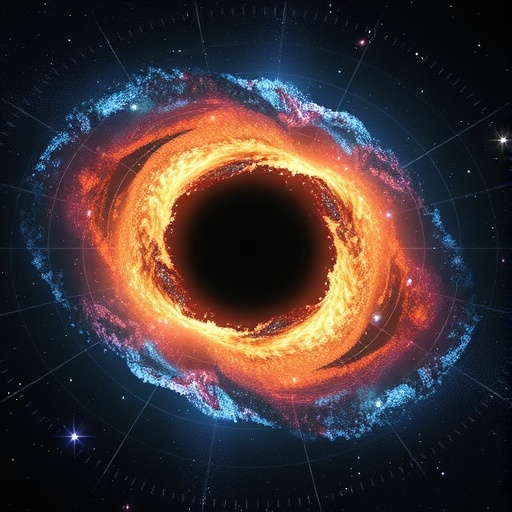
An international collaboration of researchers spearheaded by the Kavli Institute for the Physics and Mathematics of the Universe (Kavli IPMU) has unveiled groundbreaking findings regarding the early universe, utilizing the unprecedented capabilities of the James Webb Space Telescope (JWST). This remarkable study, recently published in the prestigious journal Nature Astronomy, reveals the discovery of twelve black holes dating back to a staggering 12.9 billion years ago, offering critical insights into the evolution and coalescence of black holes and galaxies amidst the cosmos’ infancy.
Since its inaugural data release in 2022, the JWST has revolutionized our comprehension of distant galaxies, providing an unprecedented look into their formation and evolution. Galaxies harbor supermassive black holes at their cores, typically weighing between hundreds of thousands to several hundred billion solar masses. The phenomenon occurs when these black holes become luminous quasars due to the intense energy emitted from matter spiraling into them, facilitating researchers in pinpointing and studying distant galaxies in their formative stages.
The intricate relationship between the mass of galaxies and their central black holes has been subject to extensive investigation. Empirical observations indicate a profound connectivity between the growth dynamics of black holes and their host galaxies, revealing a co-evolutionary trajectory influenced by the cosmic interplay of their masses over expansive timescales. However, the exact mechanisms that nurture this relationship remain elusive. To genuinely unravel these complexities, astronomers have sought to analyze galaxies from the dawn of time when the universe was relatively youthful.
At the helm of this notable study was Masafusa Onoue, a Visiting Associate Scientist at Kavli IPMU and a Lecturer at the Waseda Institute for Advanced Study. Joining him were esteemed colleagues including Professor John Silverman and Professor Xuheng Ding from Wuhan University, along with distinguished institutions such as the University of Tokyo School of Science, Ehime University, Ritsumeikan University, and the National Astronomical Observatory of Japan. The researchers focused on specific quasars, namely J2236+0032 and J1512+4422, examining them through JWST’s Near Infrared Spectrograph (NIRSpec) after their initial identification through the Hyper Suprime-Cam Subaru Strategic Program, a prominent wide-field imaging survey at the Subaru Telescope.
Astounding revelations emerged as the researchers determined that the galaxies hosting these quasars had already reached remarkable sizes, approximating 40-60 billion solar masses, a mere few hundred million years post-Big Bang. This indicates a staggering rate of growth, but not without implications — these galaxies appeared to be entering a phase characterized by a rapid cessation of star formation. The researchers hypothesized that this dramatic transformation could be precipitated by the intense emissions from the black holes located at the galaxies’ centers.
In a field where new findings are often tempered by established theories, Onoue expressed a sense of wonder at the results: “It was totally unexpected to find such mature galaxies in the Universe less than a billion years after the Big Bang. What is even more remarkable is that these ‘dying’ galaxies still host active supermassive black holes.” This unexpected discovery provides profound evidence supporting theories suggesting that the vigorous activity of immense black holes could indeed stifle further stellar growth in their host galaxies, expediting their transition from dynamic star-forming regions to quieter, more stable states.
The implications of this research extend far beyond the mere identification of distant quasars. They unveil a critical understanding of the interplay between supermassive black holes and galaxy evolution, contributing vital evidence that these colossal entities played instrumental roles in shaping the evolutionary history of the universe’s earliest and most rapidly growing galaxies. By effectively capturing this transformative process in action, the study presents novel insights into the complexities of cosmic history and the enduring mysteries surrounding the nascent universe.
The successful unification of observational strengths from the Subaru Telescope’s survey capabilities with the unparalleled sensitivity of the JWST illustrates a significant achievement within the scientific community, particularly highlighting Japan’s pivotal role in advancing our knowledge of the cosmos. Building upon these findings, the research team remains committed to further analyses of existing JWST data and is planning future observational campaigns aimed at elucidating the enigmatic relationship between galaxies and black holes.
As the astronomical community anticipates more revelations from ongoing research, the discoveries validated by JWST serve as a beacon, guiding scientists toward a deeper understanding of the formation and evolution of the universe. This meticulously executed study not only highlights the importance of interdisciplinary collaboration in scientific research but also emphasizes the significance of advanced observational tools in unraveling the universe’s most profound secrets.
Future explorations may likely expand upon the established groundwork laid by this study, as researchers delve deeper into understanding the conditions and characteristics of the universe in its infancy. The thought that galaxies such as those discovered may hold keys to understanding cosmic evolution places an invigorating understanding on the continuum of astronomical exploration. The journey of inquiry into the cosmos remains steadfast and vital, promising to yield deeper insights into the origins and complexities of our universe.
As scientific inquiries persist, the collaborative efforts of institutions worldwide continue to symbolize the quest for knowledge, driven by curiosity and the desire to unravel the universe’s mysteries, ensuring that our understanding of cosmic evolution continues to evolve. Findings such as those reported in this transformative study indeed represent a giant leap toward a comprehensive framework that might one day fully elucidate the intricate relationships governing the celestial realms.
The intricate dance between galaxies and supermassive black holes stands as one of the universe’s most intriguing narratives, prompting inquiries and igniting imaginations across generations. With each advancement, the boundaries of our cosmic understanding expand, bringing us closer to unraveling the extraordinary tales spun within the fabric of space and time.
As we continue to gaze into the night sky illuminated by the light from ancient galaxies and the echoes of their histories, we stand on the precipice of unprecedented discovery, forever driven by the pursuit of knowledge and the wonders that lie beyond.
Keywords
Supermassive black holes, galaxies, James Webb Space Telescope, cosmic evolution, quasars, co-evolution, early universe, stellar formation, astrophysics, astronomical observations.
Cite Scienmag News
Grant Pearson. (September 18, 2025). New Discoveries Illuminate Galaxy and Black Hole Growth 12.9 Billion Light Years Ago. Scienmag. https://scienmag.com/new-discoveries-illuminate-galaxy-and-black-hole-growth-12-9-billion-light-years-ago/
Grant Pearson. "New Discoveries Illuminate Galaxy and Black Hole Growth 12.9 Billion Light Years Ago." Scienmag, 18 September 2025, https://scienmag.com/new-discoveries-illuminate-galaxy-and-black-hole-growth-12-9-billion-light-years-ago/. Accessed 3 September 2026.
Grant Pearson. "New Discoveries Illuminate Galaxy and Black Hole Growth 12.9 Billion Light Years Ago." Scienmag. September 18, 2025. https://scienmag.com/new-discoveries-illuminate-galaxy-and-black-hole-growth-12-9-billion-light-years-ago/


