


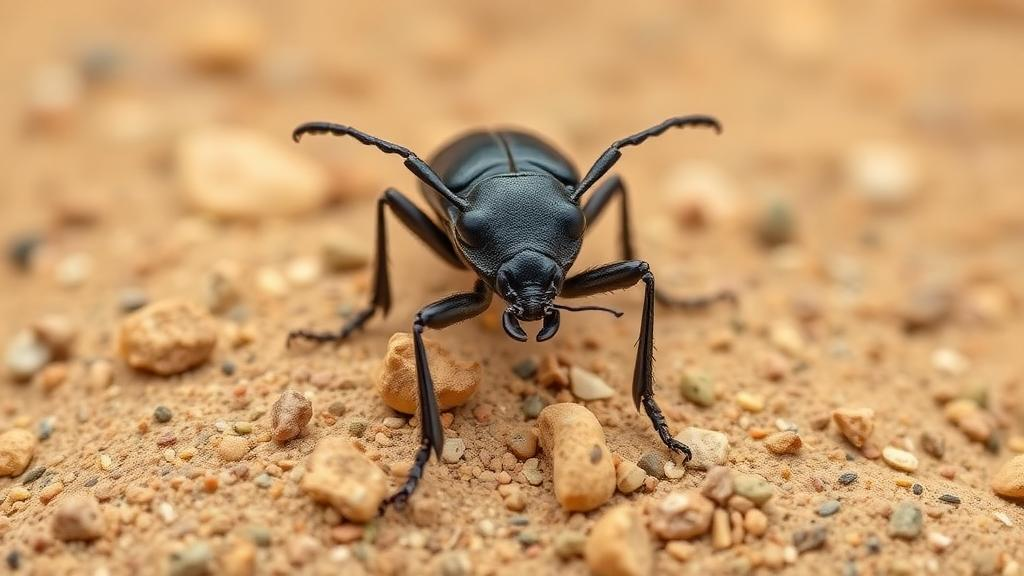
Deep in the rocky wadis of northern Oman, a small black beetle has been quietly going about its business, unnoticed by science for centuries. Now it finally has a name. A study published in the journal Evolutionary Systematics describes Thraustocolus (Prothraustocola) clypealis, a new species of darkling beetle, together with a smaller subspecies, T. clypealis minor, both collected in the Sultanate of Oman. The discovery, by an author working with specimens gathered over more than a decade, adds two formally recognized taxa to a genus that, until now, contained only twelve known species worldwide.
Darkling beetles, the family Tenebrionidae, are among the most successful animals in the world’s arid zones. In the Palearctic realm, they reach their greatest diversity in desert and semi-desert regions, where genera such as Pimelia have split into large numbers of species, each finely tuned to a particular patch of sand or stone. The genus Thraustocolus, by contrast, has remained comparatively modest, with the 2020 catalogue by Iwan and Löbl listing just twelve species. Only one of those, Thraustocolus rugosus, described by Kaszab in 1979, had been recorded from Oman. The new find suggests that even well-studied beetle groups in the Arabian Peninsula may still hold surprises.
All specimens of the newly described species were collected in Oman, which occupies the south-eastern corner of the Arabian Peninsula. The beetles were found in the northern part of the country, between latitudes 23°N and 24°N and longitudes 56°E and 59°E, a region that is hot and dry all year round, with maximum temperatures typically ranging between 30 and 40 degrees Celsius. Intriguingly, extensive searching in Dhofar in the south of Oman, around the capital Salalah at roughly 17°N and 54°E, has so far failed to turn up the new species. The reason may lie in climate: southern Oman receives regular rainfall during the monsoon season from June to September, a very different regime from the parched north, and the beetle appears to be a creature of the dry northern mountains and wadis.
The type series tells the story of patient fieldwork. The holotype, a male, was collected on 29 February 2020 at Al Heil, twelve kilometres northwest of Al Hamra, at an altitude of 1,960 metres. Paratypes span years of collecting: two males from the same site taken in March 2009, a specimen from October 2014, a female from eight kilometres northwest of Sabikah collected in March 2011, two females from Wadi Suwayh, twenty kilometres south of Quriat, from March 2009, and further specimens from Wadi Hatat at Al Amarat collected in December 2021 by J. C. Ringenbach, including one from Nizwa, Fira, dating back to 2003. The type specimens are currently kept by the author and will later be deposited in the Zoological Museum of the Museum der Natur in Hamburg.
Thraustocolus clypealis is a beetle of modest dimensions. Males measure nine to ten millimetres in length and three to four millimetres in width, while females run slightly larger at nine to twelve millimetres long and 3.6 to five millimetres wide. The general coloration is black to brown-black, the classic livery of a desert darkling beetle. But the real story is in the details, and it is those details that give the species its name.
The head is strongly punctured, with strigose, or scratch-like, sculpture on the sides of the frons and shagreened, finely textured spaces between the punctures on the anterior half, becoming smooth toward the back. The eyes are large, flat and rounded, bounded in front more or less straight by the genae, the cheek regions of the head. Between the genae and the anterior border of the clypeus, the plate at the front of the head, there is a strong, characteristic lateral emargination, a notched cut-out that makes the front of the head unmistakable. The clypeus itself is trapezoidal, with a truncated, often slightly concave anterior border, and the frons carries two strong lateral impressions. Keels run above the eyes. It is this peculiar formation of the clypeus that the species name clypealis commemorates.
The antennae offer another diagnostic signature. The third segment is remarkably long, three times as long as the second, while the fourth is half the length of the third. From the eighth to the tenth segment, the antenna becomes trapezoidally broader, and the eleventh segment is shorter than the tenth. When directed backwards, the antennae protrude beyond the base of the pronotum at about the eleventh segment. The pronotum, the plate behind the head, is very strongly convex in both length and width, shiny, with strongly and evenly rounded sides that narrow slightly more toward the base than toward the anterior border. Its right-angled anterior corners are bent down and invisible from above, while the posterior corners are obtuse and strongly rounded. Dorsally, the pronotum is covered with round punctures that do not merge, leaving shiny spaces between one third and three times the diameter of a puncture.
The elytra, the hardened forewings, are oval and less clearly punctured than the pronotum, sitting on a weakly shagreened ground and often bearing fine transverse wrinkles. A basal margin is present only on the shoulders, a character the author identifies as characteristic of the subgenus Prothraustocola. The legs are long, with slender femora and thin tibiae; the tarsi are shorter than the tibiae, which are straight in females, while in males, especially the fore tibiae, are more or less distinctly curved inwards. The first metatarsomere is longer than the next two tarsomeres together and as long as the fourth. On the underside, the gular sulcus is not furrow-like but consists of a pit in the middle that flattens out on the sides, another hallmark of Prothraustocola. The prosternum is clearly punctured, and the male carries a small deep rounded pit with a prominent bristle. The prosternal apophysis behind the procoxae first descends vertically, then protrudes briefly and horizontally as a sharp-edged, roof-like structure. The aedeagus, the male genitalia that often provide the decisive evidence in beetle taxonomy, is slender, with a basal section almost as long as the apical one, the sides of which run parallel for about a quarter of their length before tapering uniformly to a very acute tip.
The subspecies Thraustocolus clypealis minor, described from Fossil Valley, ten kilometres southwest of Mahdah, at 24°20’N and 55°54’E, is known from a male holotype and two male paratypes, all collected on 8 March 2016 by C. and G. Wagner. It resembles the nominate form but is noticeably smaller, measuring 6.6 to 7.6 millimetres in length and 2.3 to 2.8 millimetres in width, with slightly less rounded sides to the pronotum, somewhat longer and more slender fore legs, and a brown-black coloration. The subspecies name, from the Latin minor, reflects this essential difference in size. Both new taxa have been registered in the ZooBank registry, the official archive of zoological nomenclature, securing their place in the formal record of life on Earth.
What makes the discovery more than a curiosity is the rigorous comparison with the rest of the genus. Six species of Thraustocolus are currently known from the Arabian Peninsula and one from southern Iran, and the new species and subspecies are distinguished from all of them by a suite of characters. Thraustocolus rugosus, from Oman, Saudi Arabia and the United Arab Emirates, has an evenly punctured head and pronotum with wrinkled punctures on the pronotal sides and sparse, finely rasp-like granulate elytra, at 7 to 7.8 millimetres. Thraustocolus arabicus from Saudi Arabia shows evenly rough punctures with rasp-like sculpture on the pronotal sides and granulate elytra, at 6 to 10 millimetres. In contrast to both, the new species has an evenly roundly punctured pronotum, finer than the head, and elytra that are not grained. Thraustocolus catomoides from Saudi Arabia, at just 4.3 millimetres, has a third antennal segment only 1.9 times as long as the second and a very sparsely punctured pronotal disc, whereas the new species and subspecies have a third segment 2.8 times longer than the second and an evenly roundly punctured pronotum. Thraustocolus propheta, also from Saudi Arabia, has large, completely detached eyes that project significantly outwards above the level of the genae, and a third antennal segment almost twice as long as the second; the new species has flat eyes and the much longer third segment. Thraustocolus pitcheri from Saudi Arabia has bulbous, protruding eyes and, in the male, a basal pronotal margin briefly interrupted in the middle, while the new species has flat eyes and a clearly marginated pronotal base throughout. Finally, the two Iranian species, Thraustocolus hormozganus, described by Grimm and Merkl in 2018, and Thraustocolus belutschistanica from Baluchistan, differ in pronotal puncture shape, the form of the prosternal apophysis, and the relative lengths of the basal and apical sections of the aedeagus; in the new species, the pronotum bears even round punctures, the apophysis protrudes behind the procoxae as a tip, and the two sections of the aedeagus are about the same length.
For a genus with so few species, each new taxon is a meaningful addition to knowledge of Arabian desert biodiversity. The Arabian Peninsula remains one of the least thoroughly surveyed corners of the Palearctic, and its mountains and wadis, hammered by heat and scoured by wind, continue to yield animals unknown to science. The fact that the new beetle turned up in collections spanning from 2003 to 2021, gathered by several different collectors across multiple sites, shows how a single well-preserved series can crystallize into a formal description once someone takes the time to look closely. The images of the head, pronotum, prosternal structures and aedeagus published with the study are intended to make identification and discrimination of the new species easier for future workers. Whether Thraustocolus clypealis marks the beginning of a broader radiation waiting to be discovered in Oman’s dry north, or a relict lineage clinging to a few mountain wadis, only further fieldwork will tell. For now, the darkling beetles of the Sultanate have two new names in the register, and the deserts between 23°N and 24°N have revealed yet another of their secrets.
Subject of Research: Taxonomic description of a new darkling beetle species and subspecies of the genus Thraustocolus from northern Oman
Article Title: A new species and subspecies of the darkling beetle genus Thraustocolus Kraatz, 1866 from Oman ( Coleoptera , Tenebrionidae )
Article References: Wagner, G. (2023). A new species and subspecies of the darkling beetle genus Thraustocolus Kraatz, 1866 from Oman (Coleoptera, Tenebrionidae). Evolutionary Systematics, 7(2), 253-256. https://doi.org/10.3897/evolsyst.7.105423
Image Credits: AI Generated
DOI: 10.3897/evolsyst.7.105423
Keywords: Thraustocolus, darkling beetle, Tenebrionidae, Oman, new species, Coleoptera, Arabian Peninsula, taxonomy, desert biodiversity, Prothraustocola, Evolutionary Systematics, entomology
Cite Scienmag News
Gavin Prescott. (October 19, 2026). New darkling beetle species unearthed in Oman’s deserts. Scienmag. https://scienmag.com/new-darkling-beetle-species-unearthed-in-omans-deserts/
Gavin Prescott. "New darkling beetle species unearthed in Oman’s deserts." Scienmag, 19 October 2026, https://scienmag.com/new-darkling-beetle-species-unearthed-in-omans-deserts/. Accessed 19 October 2026.
Gavin Prescott. "New darkling beetle species unearthed in Oman’s deserts." Scienmag. October 19, 2026. https://scienmag.com/new-darkling-beetle-species-unearthed-in-omans-deserts/


