


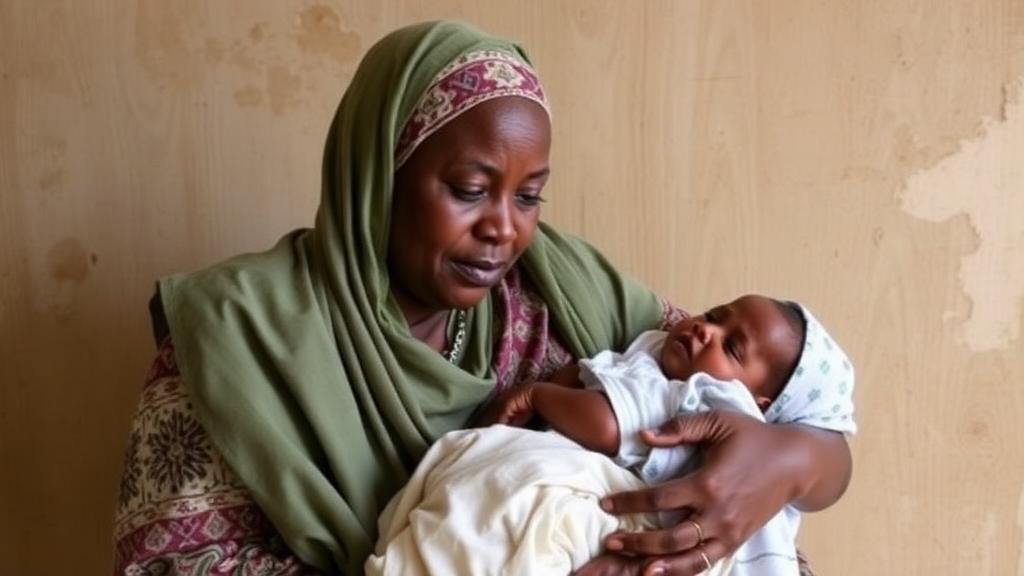
Postpartum depression is one of the most common complications of childbirth, affecting roughly 17.7 percent of women worldwide according to a major meta-analysis of 291 studies from 56 countries. Yet in Northern Nigeria, where the total fertility rate reaches an estimated 7.6 children per woman, the condition is frequently misread as a spiritual attack or a test of maternal endurance rather than a treatable mental health problem. A new study published in Frontiers in Communication suggests that the decisive factor in whether women understand postpartum depression is not the sheer volume of health messaging they encounter, but the trustworthiness and cultural legitimacy of the people and channels delivering it.
Researchers from Covenant University and Caleb University in Nigeria surveyed 519 women of reproductive age, between 18 and 49 years old, in selected urban and rural communities across Niger and Yobe States. The study sites included Bosso and Bida in Niger State and Damaturu and Machina in Yobe State, chosen to capture a range of communication environments. The sample size was calculated using the Taro Yamane formula at a 95 percent confidence level with a 5 percent margin of error, then inflated by 30 percent to guard against non-response. Participants completed a structured questionnaire translated into Hausa and independently back-translated to ensure semantic equivalence, administered face-to-face by trained bilingual field assistants.
The theoretical backbone of the study was the Health Belief Model, developed in the early 1950s by social psychologists Godfrey Hochbaum, Irwin Rosenstock, and Stephen Kegels. The model holds that health behaviour depends on perceptions of susceptibility, severity, benefits, and barriers, along with cues to action and self-efficacy. The Nigerian team extended this framework in a communication-centred direction, proposing what they call the Communication Extended Health Belief Model, in which health beliefs are treated not as purely individual cognitive processes but as socially mediated constructions shaped by family networks, religious spaces, media exposure, and healthcare encounters.
To test whether information sources actually predict postpartum depression knowledge, the researchers employed partial least squares structural equation modelling, a statistical technique well suited to prediction-oriented research with complex relationships among constructs and non-normally distributed data. They assessed reliability and validity using composite reliability, average variance extracted, and Cronbach’s alpha, applying thresholds of 0.80, 0.50, and 0.70 respectively. Factor loadings ranged from 0.747 to 0.952, and variance inflation factors stayed well below the conservative benchmark of 5.0, indicating minimal collinearity and no significant common method bias. Bootstrapping with 5,000 subsamples tested the significance of the pathways in the model.
The model fit statistics were strong across the board. The standardised root mean square residual came in at 0.078, below the 0.08 threshold for acceptable fit, while the goodness-of-fit index reached 0.929, exceeding the 0.90 benchmark. The normed fit index of 0.950 indicated a highly appropriate model, the parsimony comparative fit index of 0.647 surpassed the recommended minimum of 0.50, and the chi-square divided by degrees of freedom stood at 2.228, well under the upper limit of 3.0. The Q-squared value for postpartum depression knowledge was 0.659, well above zero, confirming the model’s predictive relevance.
The results paint a striking picture of where Northern Nigerian women actually learn about maternal mental health. Family and friends emerged as the most powerful predictor, with a path coefficient of 0.617 and an R-squared value of 0.381, both statistically significant at p equals 0.000. Medical personnel followed closely with a path coefficient of 0.688 and an R-squared of 0.473, confirming their role as expert health educators. Radio broadcasting proved significant with a coefficient of 0.331, as did religious leaders at 0.310, social media at 0.217, and websites at 0.227. Effect sizes, measured by the f-squared statistic, were large across the significant predictors, with medical personnel at 0.643 and social media at 0.672.
Just as revealing were the channels that failed to move the needle. Newspapers produced a path coefficient of only 0.033 with a p-value of 0.188, magazines managed 0.017 with a p-value of 0.452, television registered 0.088 with a p-value of 0.251, indigenous media reached 0.085 with a p-value of 0.110, and opinion leaders came in at 0.099 with a p-value of 0.078. None of these achieved statistical significance. The pattern held even though government and non-governmental organisation messages were highly recalled by respondents, with mean recall scores of 4.20 and 3.88 respectively, exposing a systemic disconnect between message dissemination and meaningful integration into women’s belief systems.
The demographic profile of the sample helps explain why. A majority of participants, 71.3 percent, came from Niger State, 88.2 percent were married, and 57.4 percent fell in the 18 to 33 year bracket, the prime reproductive years. Only 2.5 percent held a postgraduate degree, and 53.9 percent earned less than 50,000 naira per month, with 44.5 percent listing the Senior School Certificate Examination as their highest educational attainment. In such a context, family structures function more as mechanisms of survival than pathways for socioeconomic mobility, and kinship and faith-based networks become the primary decoders of maternal health experiences. The researchers note that the near-absence of divorce alongside accepted polygyny may create a socially stable but emotionally strained marital landscape that shapes how women interpret postpartum distress.
The findings carry direct implications for health policy. The authors argue that general awareness campaigns relying on formal mass media are insufficient in settings like Northern Nigeria. Instead, maternal mental health education should be embedded within the channels women already trust, pairing healthcare providers with religious leaders and community-based interpersonal networks. Training programmes should equip health workers and faith leaders with culturally sensitive communication strategies that present postpartum depression as a valid and treatable condition. Messaging delivered through antenatal and postnatal care, religious gatherings, and community meetings, calibrated to the literacy levels of the target population, could raise knowledge acquisition and reduce the stigma that keeps women from seeking professional help.
The study is not without limitations. Its cross-sectional design prevents causal inference, self-reported data may be vulnerable to recall or social desirability bias, and purposive sampling restricts generalisation beyond Niger and Yobe States. The researchers measured knowledge rather than actual help-seeking behaviour, and they recommend longitudinal or mixed-method designs to trace how communication exposure translates into behavioural change over time. Still, the core message stands: in culturally complex maternal health settings, combating postpartum depression is less a problem of information scarcity than one of communication congruency. The path forward lies in weaving biomedical knowledge into the trusted systems of family, faith, and community leadership that already shape how women understand their own minds after childbirth.
Subject of Research: The influence of information sources on postpartum depression knowledge among women in Northern Nigeria
Article Title: Information sources and postpartum depression knowledge in Northern Nigeria: extending the health belief model
Article References: Omale, G. E., Oyesomi, K. O., Oladosun, M., & Msughter Aondover, E. (2026). Information sources and postpartum depression knowledge in Northern Nigeria: extending the health belief model. Frontiers in Communication, 11, 1812199. https://doi.org/10.3389/fcomm.2026.1812199
Image Credits: AI Generated
DOI: 10.3389/fcomm.2026.1812199
Keywords: postpartum depression, maternal mental health, health communication, Health Belief Model, Northern Nigeria, information sources, PLS-SEM, religious leaders, radio, social media, help-seeking behaviour, risk communication
Cite Scienmag News
Glenn Wilkins. (October 19, 2026). Family Ties and Faith Leaders Outshine TV in Shaping Postpartum Depression Knowledge in Northern Nigeria. Scienmag. https://scienmag.com/family-ties-and-faith-leaders-outshine-tv-in-shaping-postpartum-depression-knowledge-in-northern-nigeria/
Glenn Wilkins. "Family Ties and Faith Leaders Outshine TV in Shaping Postpartum Depression Knowledge in Northern Nigeria." Scienmag, 19 October 2026, https://scienmag.com/family-ties-and-faith-leaders-outshine-tv-in-shaping-postpartum-depression-knowledge-in-northern-nigeria/. Accessed 19 October 2026.
Glenn Wilkins. "Family Ties and Faith Leaders Outshine TV in Shaping Postpartum Depression Knowledge in Northern Nigeria." Scienmag. October 19, 2026. https://scienmag.com/family-ties-and-faith-leaders-outshine-tv-in-shaping-postpartum-depression-knowledge-in-northern-nigeria/


