


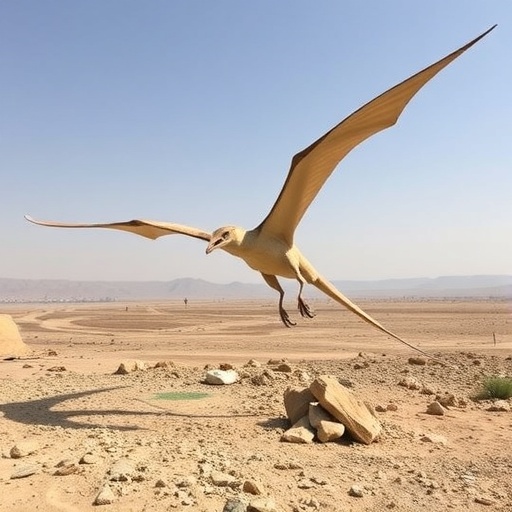
In an extraordinary discovery that impacts our understanding of the Late Cretaceous period, researchers have unearth a remarkable azhdarchid pterosaur from the heart of the Palmyrides mountain chain in Syria. This significant find sheds light on the biodiversity that existed during a critical juncture in Earth’s history and opens new avenues for studying the evolutionary adaptations of these remarkable flying reptiles. The researchers have presented a wealth of findings that not only recount the splendor of this gigantic creature but also reinterpret the ecological landscape of its time.
Ancient pterosaurs, particularly the azhdarchids, are known for their impressive morphology and ecological versatility. They were among the largest flyers to ever inhabit our planet. The newfound specimen stands out not just for its size, but also for the evolutionary insights it provides. By analyzing the fossil remains, researchers were able to estimate its wingspan, which could rival that of a modern-day small airplane. This finding goes beyond mere numbers; it tells a story of adaptation, survival, and the ecological dynamics of late Cretaceous environments.
The fossil evidence was meticulously excavated from a site that has long intrigued paleontologists but was largely overlooked due to the tumultuous socio-political landscape of modern Syria. The team, which includes leading experts in vertebrate paleontology, utilized advanced imaging techniques to examine the fossilized remains. Techniques such as CT scanning revealed intricate details of the skull and limb structure, contributing to a more detailed understanding of its anatomy and potential flight capabilities. Anomalies observed in the fossils have also sparked debates regarding the ecological role this pterosaur played in its habitat.
Moreover, the research emphasizes the impressive scale of this azhdarchid. Not only does it challenge previous notions of size limitations within pterosaurs, but it also suggests that they could adapt to various niches in the ecosystem. By examining its morphology alongside environmental data, the researchers propose that this giant pterosaur likely occupied higher trophic levels, possibly preying on larger fish or small vertebrates. Such insights provide essential context not only for the pterosaur’s lifestyle but also for the broader ecological communities in which it thrived.
The implications of this discovery also resonate strongly with the concept of “lost time.” The ongoing conflict in Syria has led to significant disruption in scientific exploration and excavation. By recovering this remarkable azhdarchid, researchers feel they are not only salvaging a lost piece of history but also reforming the narrative around paleontological studies in war-torn regions. The act of extracting scientific knowledge amidst devastation stands as a testament to the resilience of academic inquiry.
Ecologically, this specimen prompts a reevaluation of the Cretaceous ecosystems contemporaneous with the last days of the dinosaurs. With birds beginning to evolve and mammals on the rise, the role of large pterosaurs is underscored. Did they coexist with early birds in competitive environments, or did they carve out unique ecological niches of their own? The newfound data contributes to the discussion of these species interactions and competition in a rapidly evolving biosphere.
Additionally, the research team suggests that future explorations in the area could yield even more remarkable discoveries. Despite the challenges presented by the current geopolitical situation, the prospect of further excavating the Palmyrides remains tantalizing. Their plea for continued investment in scientific research underscores the importance of paleontology as a vital field that transcends borders and unites the global scientific community.
To authenticate their findings, the researchers compare their new azhdarchid with previously known species discovered in various parts of the world. This comparative analysis reveals fascinating parallels and divergences in anatomical features, enhancing our knowledge of evolutionary pathways. The research highlights how pterosaurs, despite sharing the same lineage, adapted differently to their respective environments, a phenomenon known as convergent evolution.
As the study gains traction in scientific circles, the authors are optimistic that it will inspire further research into Cretaceous pterosaurs and the environments they inhabited. By fostering collaboration amongst international scientists, the hope is to inspire new generations to delve into paleontology, especially in regions affected by conflict, where untold stories of Earth’s history lie dormant beneath the surface.
In summary, the recovery of this gigantic latest Cretaceous azhdarchid pterosaur from the Palmyrides mountain chain is not merely an academic triumph but a symbol of the enduring pursuit of knowledge. As the world grapples with the complexities of our environment and evolutionary history, discoveries like this one serve as a reminder of the dynamic and interwoven narratives that span eons of biological evolution. Knowledge forged through discovery fosters resilience and unity, even amidst division.
The research provides a fresh perspective on paleontological methodologies as well, showcasing innovative techniques employed in fossil analysis. As the team of scientists continues to refine their techniques and expand their findings, the expectation is that this azhdarchid will prompt a re-examination of many long-held beliefs regarding the life and ecology of pterosaurs. For the scientific community, this discovery not only enriches our past but also paves the way for future explorations into unknown territories, both literally and figuratively.
This monumental finding does more than expand the taxonomic record; it revitalizes interest in paleontological research within regions that have faced significant strife. By highlighting the academic and ecological relevance of such discoveries, the authors hope to cultivate a sense of urgency in safeguarding and studying such priceless scientific assets. The fossil record, though fragile, remains an invaluable resource that warrants further exploration for the enrichment of human knowledge.
Through the lens of this stellar find, researchers continue to advocate for the preservation of sites that hold invaluable historical treasures, underscoring the shared responsibility of the global community to ensure that future excavations can continue to recover lost time and lost worlds. The story of the gigantic azhdarchid from Syria is one of hope, resilience, and the enduring quest for understanding the past, ensuring that time lost can be recovered, one fossil at a time.
Alhalabi, W.A., Pinheiro, F.L., Jaoude, I.B. et al. Recovering lost time in Syria: a gigantic latest Cretaceous azhdarchid pterosaur from the Palmyrides mountain chain.
Sci Nat 112, 78 (2025). https://doi.org/10.1007/s00114-025-02032-9
Cite Scienmag News
Gavin Prescott. (October 16, 2025). New Cretaceous Azhdarchid Pterosaur Discovered in Syria. Scienmag. https://scienmag.com/new-cretaceous-azhdarchid-pterosaur-discovered-in-syria/
Gavin Prescott. "New Cretaceous Azhdarchid Pterosaur Discovered in Syria." Scienmag, 16 October 2025, https://scienmag.com/new-cretaceous-azhdarchid-pterosaur-discovered-in-syria/. Accessed 3 September 2026.
Gavin Prescott. "New Cretaceous Azhdarchid Pterosaur Discovered in Syria." Scienmag. October 16, 2025. https://scienmag.com/new-cretaceous-azhdarchid-pterosaur-discovered-in-syria/


