


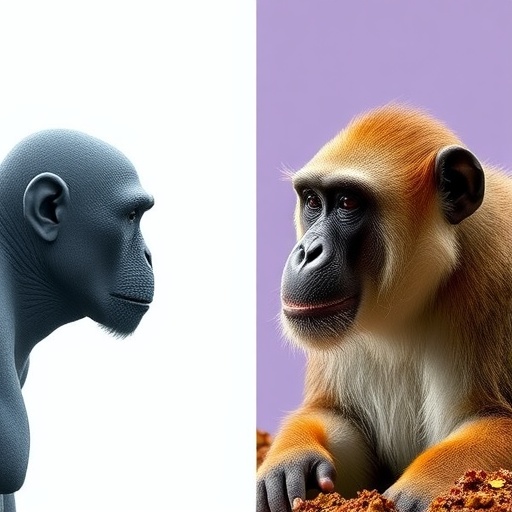
In the quest to understand the complex interplay between human cognition and artificial intelligence, researchers have unveiled a pioneering computational framework that bridges the explanatory strategies of humans, non-human primates, and AI models. This breakthrough, presented by Muzellec, Alghetaa, Kornblith, and colleagues, introduces a masked attribution-based probing method that deciphers the decision-making processes across species and artificial systems alike.
The traditional challenge in cognitive neuroscience and AI research lies in comparing how different agents—ranging from humans to primates and machines—arrive at conclusions. While behavioral outputs can be similar, the internal strategies governing these outputs often remain opaque, especially in AI systems known as large-scale neural networks. This new approach offers a unified lens to probe these hidden mechanisms by selectively masking input components and analyzing the shifts in attribution scores—metrics that highlight which features are deemed significant by the model or subject during decision making.
Masked attribution operates by systematically obscuring parts of the input data and observing how the explanatory attributions—essentially, importance weights assigned to input features—alter. Such perturbations illuminate the strategic reliance patterns of the subject or model, revealing whether decisions hinge on local details, global patterns, or complex feature interactions. By doing so, the method transcends mere output comparison and delves into the “why” and “how” behind choices.
Intriguingly, when applied to both human and non-human primate data, alongside deep neural models trained for comparable tasks, the framework uncovers overlapping strategies and divergence points. For instance, certain visual cues that drive animal behavior are mirrored in the attribution maps of AI models, suggesting convergent evolution or learning of representation. Conversely, mismatches highlight areas where AI still lacks the nuanced contextual understanding inherent in biological cognition.
This alignment of explanations is more than academic—it has profound implications for explainable AI (XAI). By tailoring AI interpretability tools to mirror human and primate reasoning, machines can provide insights more intuitively graspable to human users, improving trust and applicability in sensitive domains like healthcare and autonomous systems. Such cross-species explanatory alignment paves the way for AI that not only acts smart but explains actions in a human-comprehensible manner.
Moreover, this computational framework offers a robust platform for probing neurological and cognitive theories. Researchers can test hypotheses about attention, perception, and decision strategy by comparing evolutionary lineages and modern AI architectures, providing new interdisciplinary avenues between neuroscience, psychology, and machine learning.
The method’s scalability and adaptability stand out, as it can be employed across different tasks and modalities, from visual recognition to natural language processing. This positions masked attribution-based probing as a versatile tool for future endeavors in understanding and refining both biological and artificial intelligence.
In sum, this innovative study marks a vital step toward bridging natural and artificial minds, fostering a deeper understanding of cognition and enhancing the transparency of AI systems through shared explanatory strategies.
Cite Scienmag News
Glenn Wilkins. (July 13, 2026). New Computational Method Aligns Human and Primate Cognitive Strategies. Scienmag. https://scienmag.com/new-computational-method-aligns-human-and-primate-cognitive-strategies/
Glenn Wilkins. "New Computational Method Aligns Human and Primate Cognitive Strategies." Scienmag, 13 July 2026, https://scienmag.com/new-computational-method-aligns-human-and-primate-cognitive-strategies/. Accessed 4 September 2026.
Glenn Wilkins. "New Computational Method Aligns Human and Primate Cognitive Strategies." Scienmag. July 13, 2026. https://scienmag.com/new-computational-method-aligns-human-and-primate-cognitive-strategies/


