


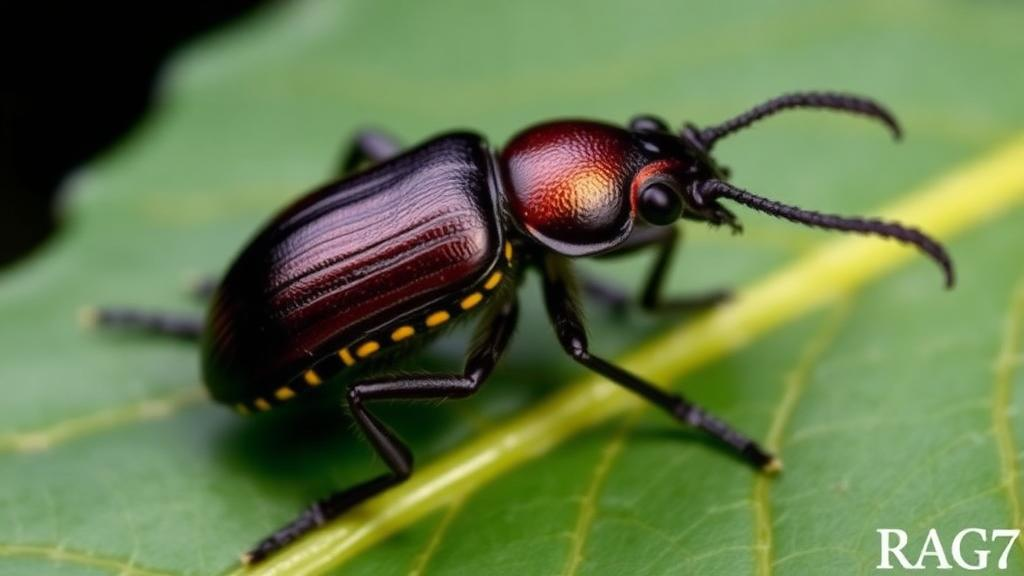
Deep in the cloud-forest belt of the Dominican Republic, entomologists have uncovered a beetle so distinct that it required not just a new species name, but an entirely new genus. The insect, now formally described as Aiyitioderus montanus, is a click beetle collected in the misty highlands of Hispaniola, and it carries a distinction no other beetle on the Caribbean islands can claim: it is the first endemic genus of the family Elateridae ever reported from the West Indies. The discovery, published in the journal Alpine Entomology, adds a striking new branch to the evolutionary tree of a family famous for the explosive clicking mechanism that lets these beetles leap out of danger.
The new genus and species were described by Paul J. Johnson, working with material gathered during entomological expeditions to the Dominican Republic in 2021, 2023, and 2024 led by Jiri Hodeček and Jiri Pirkl, along with specimens from earlier surveys by Daniel E. Perez-Gelabert, Ruth Bastardo, and their collaborators. The expeditions formed part of a broader biodiversity project studying selected insect groups across the country, conducted under permits issued by the Dominican Ministry of Environment and Natural Resources. The project has already produced a string of published results across beetles, earwigs, zorapterans, mayflies, planthoppers, and several groups of butterflies, flies, and wasps, underscoring how much of Hispaniola’s insect life remains unmapped.
The holotype, a male specimen, was collected by light trap at 1,075 meters in the Reserva Científica Ébano Verde, a protected area in the Cordillera Central of La Vega Province. The reserve lies within one of the wettest regions of Hispaniola and is recognized as a biotically rich center of endemism. It covers nearly 3,000 hectares between roughly 800 and 1,565 meters above sea level on predominantly volcanic substrates, with a documented flora exceeding 686 species of vascular plants. The vegetation at the collection site includes humid broadleaf forest mixed with the endemic Hispaniolan pine, Pinus occidentalis, just below the cloud-forest belt. Remarkably, although previous entomological work in the reserve documented 350 insect species across 254 genera, 70 families, and 12 orders, Aiyitioderus montanus appears to be the first click beetle ever reported from this protected area.
Hispaniola’s click beetle fauna has historically been poorly studied. The most recent assessment of the island’s arthropod diversity, published in 2020, counted just 15 genera and 45 species of click beetles, of which 16 species, or nearly 36 percent, were considered endemic. But two decades of biotic surveys have been steadily rewriting that picture. Earlier studies in this ongoing series added new species of Lissomus, a new species of Lacon, and a third species of Lissomus, and the researchers note that at least 15 additional undescribed species already known in collections await formal study. Once those are described, the endemism rate for Hispaniolan click beetles could exceed 50 percent, a figure suggesting a larger and likely more ancient endemic insect biota on the island than anyone had previously appreciated.
Physically, Aiyitioderus montanus is a slender, narrow beetle measuring 6.8 to 8.9 millimeters in length and only 1.7 to 2.3 millimeters across the widest part of its wing covers. Its body is a shining brown-infuscate color, with yellow-brown antennae and legs, and it bears short, pale, hair-like setae across its dorsal and ventral surfaces. The species name montanus, meaning of the mountains, reflects its habitat, while the genus name combines Aiyiti, an old indigenous name for the island of Hispaniola, with the Greek suffix deros, signaling a relationship to species groups within the Conoderus and Monocrepidius complex of the Americas.
What convinced researchers that this beetle deserved its own genus was an unusual combination of anatomical features found nowhere else in the West Indian click beetle fauna. The pronotum, the shield-like plate behind the head, is slightly longer than wide and strongly convex, with distinct hind angles marked by a sharp outer dorsal ridge close to the lateral margin and a nearly obsolete mesal ridge. The scutellar shield, a small plate between the wing bases, is strongly inclined, longer than wide, and subpentagonal in shape, a profile that immediately distinguishes the insect from its relatives. Female specimens show an equally diagnostic trait: the fifth visible abdominal segment ends in an extended, lightly sclerotized, truncate lobe with a shallow oval impression.
The internal anatomy proved just as informative. The male aedeagus, 1.25 to 1.30 millimeters long, has a spatulate median lobe that narrows abruptly toward the apex, with basal lateral hoods margined internally by a dark arcuate line, while the parameres expand ventromedially to encompass the median lobe stem and carry minute spines along their mesal margins. The female reproductive tract features a membranous bursa copulatrix armed with paired two-spined sclerites near the vaginal junction and a single spurred sclerite at midlength, together with one tightly coiled and one extremely long, thin tubular gland forming a tangled mass. These structures, illustrated in detailed photographs in the paper, provide the definitive evidence separating Aiyitioderus from every other named genus in the region.
Biogeographically, the beetle tells an intriguing story of connection and isolation. It most closely resembles species of the heterostixus-group currently assigned to the genus Heteroderes on the mainland Americas, including Heteroderes heterostixus from southern Mexico to Costa Rica, H. sordidus from northwestern Mexico and the southwestern United States, and H. suturalis from the southeastern United States. Yet the mainland species differ in having proportionately shorter and broader body outlines, and their genital structures bear wing-like expansions that the new island taxon lacks. The authors suggest the mainland trio likely form a genus-level unit of their own, leaving Aiyitioderus isolated on its Caribbean island, a living relict of ancient biogeographic ties between Hispaniola and the continental mainland.
Equally important, the description rigorously rules out closer affiliations. The new species shares the heterogeneous, double-system punctation of the head, pronotum, and ventral surfaces that nineteenth-century taxonomists once treated as the defining hallmark of Heteroderes, a character the authors argue was exaggerated in importance and uncritically accepted for more than a century. But a full assessment of the character suite demonstrates that Aiyitioderus is not congeneric with the type species of Conoderus, Heteroderes, or Monocrepidius, and hypotheses placing it with nominally African, Asian, Australian, or Pacific lineages were falsified. In taxonomy, where a single misassignment can hide a lineage for generations, this careful elimination of alternatives is what elevates the finding from a routine species description to a genuine discovery.
All known specimens of Aiyitioderus montanus come from mid-elevation and montane localities in the Dominican Republic, between about 669 and 1,075 meters, spanning Baoruco, Elías Piña, La Vega, Monseñor Nouel, and Puerto Plata provinces, including the Cordillera Central, the Sierra de Neiba, the Río Limpio area, and Pico Diego de Ocampo. Adults have been collected from late March to early December, with most records concentrated in May through July, suggesting a prolonged activity period. These records place the species in higher-elevation mesic broadleaf forest, including transitions to pine forest and lower cloud forest. The twenty-three paratypes, drawn from collections across the United States, the Dominican Republic, and Europe, now join the holotype in institutional and private repositories, securing the physical evidence for a lineage that survived on an island mountaintop, unnoticed by science until now.
Subject of Research: Taxonomic description of a new endemic click beetle genus and species from the Dominican Republic
Article Title: Aiyitioderus montanus gen. et sp. nov., an endemic click beetle ( Coleoptera , Elateridae , Oophorini ) from the mountains of the Dominican Republic
Article References: Johnson, P. J., & Hodecek, J. (2026). Aiyitioderus montanus gen. et sp. nov., an endemic click beetle (Coleoptera, Elateridae, Oophorini) from the mountains of the Dominican Republic. Alpine Entomology, 10, 137-146. https://doi.org/10.3897/alpento.10.206788
Image Credits: AI Generated
DOI: 10.3897/alpento.10.206788
Keywords: click beetles, Elateridae, Dominican Republic, Hispaniola, new genus, endemism, taxonomy, Coleoptera, cloud forest, Oophorini, biogeography, biodiversity
Cite Scienmag News
Gavin Prescott. (October 15, 2026). New Click Beetle Genus from Dominican Mountains Reveals Hidden Island Endemism. Scienmag. https://scienmag.com/new-click-beetle-genus-from-dominican-mountains-reveals-hidden-island-endemism/
Gavin Prescott. "New Click Beetle Genus from Dominican Mountains Reveals Hidden Island Endemism." Scienmag, 15 October 2026, https://scienmag.com/new-click-beetle-genus-from-dominican-mountains-reveals-hidden-island-endemism/. Accessed 15 October 2026.
Gavin Prescott. "New Click Beetle Genus from Dominican Mountains Reveals Hidden Island Endemism." Scienmag. October 15, 2026. https://scienmag.com/new-click-beetle-genus-from-dominican-mountains-reveals-hidden-island-endemism/


