


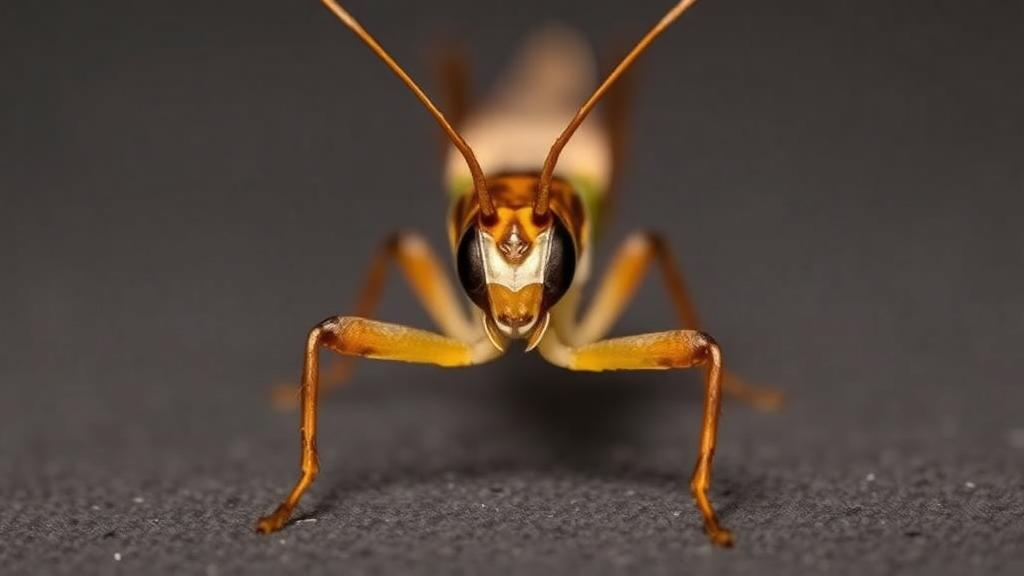
Deep in the rocky valleys of South Africa’s Eastern Cape, a small wingless cricket has been quietly hiding in plain sight. Scientists studying the region’s chevron crickets—large, flightless orthopterans known locally as king crickets—have uncovered a new genus, Minarisoma, along with a brand-new species, Minarisoma landecki. The discovery, published in the Journal of Orthoptera Research, brings the total number of king cricket genera known from South Africa to nine and reshuffles two previously described species into their proper taxonomic home.
Minarisoma landecki, the type species of the new genus, was collected by Ingmar Landeck during fieldwork at the Pure Nature Familodge Farm near Paterson in the Eastern Cape. All specimens were gathered between late February and early March 2020, a narrow window that appears to coincide with the species’ adult activity period. The crickets were found at night, moving freely among stones and boulders on exposed, litter-free soil, and hiding in crevices between large rocks and under stones at the base of valley slopes.
The new species measures around 21 millimeters in body length for males and up to 24 millimeters for females. Its coloration is yellowish with brown spots, and its face bears four greyish-brown stripes. The hind femur carries 14 distinct chevron ridges—the hallmark feature that gives chevron crickets their common name. Unlike many of its relatives, Minarisoma lacks wings entirely and shows no sexual dimorphism in the head or jaws, a trait that immediately distinguishes it from genera such as Libanasa, Henicus, and Nasidius.
What truly sets Minarisoma apart from other South African king crickets is the intricate architecture of its male genitalia. The researchers documented a shoulder blade-shaped sclerotized plate on the dorsal lobe—a structure previously unknown in African anostostomatids, having been observed only in the American subfamily Lutosinae. The genus also features conspicuous, elongated ejaculatory vesicles and a wide ejaculatory duct lacking sclerotized areas, details that proved essential for confirming its generic status.
The closest relative of Minarisoma appears to be Tryposoma, an East African genus described in 2024. Both genera share similar hind tibial spur arrangements and comparable genitalia organization. However, Minarisoma is considerably smaller—15 to 18 millimeters versus 28 to 40 millimeters for Tryposoma—and lacks the tympanum on the fore tibia that Tryposoma possesses. The tenth tergite hooks of Minarisoma are also closely positioned, while Tryposoma has a membranous space between them.
Two previously described species have been reassigned to the new genus. Minarisoma crassipes, originally described by Brunner von Wattenwyl in 1888 from a single female collected in Grahamstown, and Minarisoma tigrinum, described by Karny in 1929 from Smithfield in the Free State, were both previously placed in the genus Onosandrus. The reclassification resolves long-standing confusion about their placement, as both species differ noticeably from true Onosandrus in the thickness of their hind femora.
The discovery highlights the persistent taxonomic challenges facing South African chevron crickets. Many species were described from single specimens of one sex, often females, making it difficult to associate males with their corresponding species. Type specimens were frequently inadequately characterized and lacked sufficient imagery for comparison. These deficiencies have hampered identification efforts and impeded the precise delineation of new taxa, leaving the country’s king cricket fauna far less understood than other orthopteran groups.
The habitat where Minarisoma landecki was discovered falls within the Albany Thicket Biome, specifically the Albany Valley Thicket vegetation type. The farm’s terrain spans a rich spectrum of environments, from Fynbos vegetation on rocky upper valley edges to dense Sweet Thorn Woodland on weathered soils at the valley bottom. The researchers note that the farm borders the Greater Addo Elephant National Park, suggesting the species likely occurs within the protected area as well. Outside conservation zones, habitat destruction remains a potential threat, though the rocky crevice habitat is not extensively utilized for livestock grazing.
Field observations revealed an intriguing sex ratio of approximately one male to five females among specimens found outside crevices at night. Only two nymphs were collected during the study period, and no information is available on earlier developmental stages. The species was found alongside at least one other anostostomatid species and various crickets, including Cophogryllus and mogoplistid species, indicating a diverse nocturnal community within the valley’s rocky microhabitats.
The researchers emphasize that modern taxonomic approaches, incorporating male genitalia characters alongside external morphology, have proven invaluable for defining genera and establishing relationships among South African anostostomatids. As exploration of the region’s king crickets continues, discoveries like Minarisoma underscore how much remains to be learned about these enigmatic insects—and how critical detailed fieldwork and museum specimen comparisons are for unraveling their evolutionary story.
The family Anostostomatidae, to which Minarisoma belongs, sits within the superfamily Stenopelmatoidea, a lineage of largely flightless orthopterans distributed across the southern continents. King crickets are often ground-dwelling nocturnal omnivores, and many members of the family are noted for their powerful jaws and robust hind legs. In South Africa, the group has attracted taxonomic attention since the late nineteenth century, when Brunner von Wattenwyl produced his comprehensive worldwide treatment of the Stenopelmatoidea, documenting numerous taxa from the region. Péringuey later expanded this foundation, describing six species still recognized today and contributing three of the eight genera known before the present study. Karny, working in 1929, added eight more species along with distributional data and identification keys, although he then classified these insects within the broader Gryllacrididae rather than the modern family limits.
After a long lull in research activity, renewed interest emerged in the twenty-first century. Toms documented seven genera and 44 species in 2001, drawing on data compiled by Johns, and a 2007 review by Brettschneider and colleagues confirmed the presence of eight genera—including Bochus, which had been overlooked in the earlier tally—and provided an identification key for the country’s anostostomatid fauna. Despite this comparatively extensive attention, the taxonomy of South African chevron crickets remains notoriously perplexing. The new genus brings the national count to nine genera and 34 recorded species, a figure that continues to grow as collections and comparisons advance.
The morphological characters that define Minarisoma illustrate why genital anatomy has become so central to orthopteran taxonomy. The researchers dissected and described the male genital structures following established preparation methods, applying a standardized nomenclature that distinguishes the dorsal fold, dorsal lobe, upper and lower folds of the ventral lobe, titillatory structures, and internal components such as the ejaculatory duct and ejaculatory vesicles. In Minarisoma, the sclerotized plate of the dorsal lobe takes on a shoulder blade shape, contrasting with the thin, ribbon-shaped plate found in Tryposoma. The titillator sclerite in Tryposoma is predominantly membranous with conspicuous microstructures, whereas the new genus shows conspicuous and elongated ejaculatory vesicles alongside a rounded, small configuration of those same structures. Such fine-scale differences, invisible in the field, often carry more taxonomic weight than external features that vary with age, sex, or environment.
The genus name itself reflects one of its most obvious traits: derived from Latin roots meaning smaller and Greek soma for body, it acknowledges the modest 15 to 18 millimeter body length of its members, small even by the standards of a family that includes some of the world’s bulkiest crickets. The coloration is yellowish-brown to golden-brown with darker strips on the tergites, and females tend to be lighter than males. The head is smooth and lacks any sexual specialization of the mandibles or maxillae, and the antennae exceed the length of the body. The pronotum is smooth and does not cover the mesonotum, and the thoracic sternites bear an armature of cone-like and thorn-like processes with backward-bent tips.
The hind legs carry the signature chevron pattern: 12 to 14 distinct ridges separated by a medial groove running from the base to the distal edge of the chevron area on the hind femur. The apical spurs of the hind tibia are fully movable within their insertion rings, an arrangement remarkably similar to that of Tryposoma and one of the features that first suggested a close relationship between the two genera. Both sexes bear pegs on the first three abdominal tergites, with sparse spinules that likely function as a stridulatory area, hinting at acoustic communication whose details remain undocumented.
Specimens supporting the study are deposited in collections in Bogotá, Vienna, Cape Town, and private research collections, reflecting the international collaboration behind the work. Measurements were taken with standardized criteria—body length from frons to abdominal apex, pronotal length, hind femur and tibia lengths, subgenital plate and ovipositor dimensions—allowing future researchers to compare material directly. The ovipositor of females reaches about two-thirds the length of the hind femur, a proportion that aids identification when males are unavailable.
The reassignment of the two older species underscores a recurring theme in anostostomatid taxonomy: species described in the nineteenth and early twentieth centuries from single, often female, specimens frequently end up misplaced as related genera are defined. Only through comparison of type material, supplemented by newly collected series of both sexes, can such placements be corrected. The comprehensive identification key to the species of Minarisoma provided in the study is intended to prevent similar confusion in the future, and the authors frame the work as one installment in an ongoing series of contributions to understanding the diversity and evolutionary relationships of these distinctive southern African insects.
Subject of Research: Taxonomy and description of a new genus and species of chevron crickets (Anostostomatidae) from South Africa.
Article Title: Studies on chevron crickets: Minarisoma gen. nov. ( Orthoptera , Anostostomatidae ), a new genus and a new species from South Africa
Article References: Cadena-Castañeda, O. J., Landeck, I., & Hemp, C. (2024). Studies on chevron crickets: Minarisoma gen. nov. (Orthoptera, Anostostomatidae), a new genus and a new species from South Africa. Journal of Orthoptera Research, 33(1), 147-156. https://doi.org/10.3897/jor.33.115888
Image Credits: AI Generated
Keywords: chevron crickets, king crickets, Anostostomatidae, Orthoptera, new species, South Africa, taxonomy, biodiversity, Studies, chevron, crickets, Minarisoma
Cite Scienmag News
Gavin Prescott. (October 19, 2026). New Chevron Cricket Genus Minarisoma Discovered in South Africa. Scienmag. https://scienmag.com/new-chevron-cricket-genus-minarisoma-discovered-in-south-africa/
Gavin Prescott. "New Chevron Cricket Genus Minarisoma Discovered in South Africa." Scienmag, 19 October 2026, https://scienmag.com/new-chevron-cricket-genus-minarisoma-discovered-in-south-africa/. Accessed 19 October 2026.
Gavin Prescott. "New Chevron Cricket Genus Minarisoma Discovered in South Africa." Scienmag. October 19, 2026. https://scienmag.com/new-chevron-cricket-genus-minarisoma-discovered-in-south-africa/


