


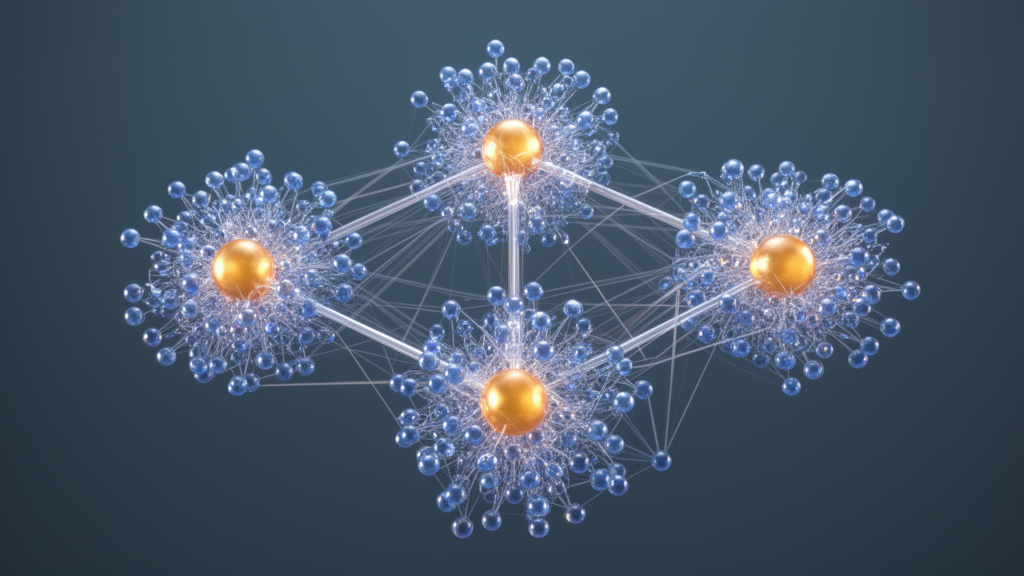
Researchers have developed a degree–distance centroid community detection technique, designated as DDC–CD, that enhances the identification of structural organization schemes within complex networks. By uniquely combining node degree metrics with shortest-path distance measurements, the computational method selects optimal centroids to guide the formation of balanced, well-separated community structures across social, biological, and communication systems.
The investigation, conducted by Srinivas Amedapu and R. Leela Velusamy and published in Applied Network Science, evaluated the newly proposed algorithm alongside four established community detection strategies. The comparative assessment benchmarked DDC–CD against the random node head technique, the highest-degree node head technique, the Louvain community detection technique, and the max–min technique across multiple network environments.
To assess structural quality and operational performance, the authors conducted empirical experiments across four real-world datasets: Facebook, Power-Grid, Wiki-Vote, and Gnutella. The evaluation focused on three primary performance metrics: average fitness values to gauge intercommunity connectivity, modularity scores to evaluate partition quality, and overall execution runtime.
In experimental evaluations, the DDC–CD method consistently produced the lowest average fitness values among the tested approaches, recording 0.240 on Facebook, 0.340 on Power-Grid, 0.190 on Wiki-Vote, and 0.280 on Gnutella, reflecting minimal connectivity between distinct communities. The approach also achieved higher modularity values across most datasets, scoring 0.531 for Facebook, 0.731 for Power-Grid, 0.141 for Wiki-Vote, and 0.227 for Gnutella, demonstrating superior structural cohesion in the detected clusters.
Regarding computational speed, the runtime of DDC–CD was marginally higher than the execution times recorded for the random node head technique and the highest-degree node head technique. However, the authors observed that the algorithm remained computationally efficient while offering a more balanced operational trade-off than the Louvain and max–min techniques, surpassing existing methods by producing compact, cohesive, and stable network communities.
The documented findings represent peer-reviewed, accepted research published under open-access terms to ensure rapid availability for researchers studying complex network systems. Issued in advance of the final Version of Record, this citable contribution provides verified access to the comparative framework, operating under standard legal disclaimers while remaining subject to final editorial modifications.
Subject of Research: Community detection in complex networks using degree-distance centroids
Article Title: Detecting communities in complex networks using a degree–distance centroid-based method (DDC–CD)
Article References: Amedapu, S., & Velusamy, R. L. (2026). Detecting communities in complex networks using a degree–distance centroid-based method (DDC–CD). Applied Network Science, 11(1), Article 66. https://doi.org/10.1007/s41109-026-00811-5
Image Credits: AI Generated
DOI: 10.1007/s41109-026-00811-5
Keywords: community detection, complex networks, degree-distance centroid, network analysis, modularity, social networks, graph algorithms, applied network science, Detecting, communities, complex, networks
Cite Scienmag News
Denise Maddox. (November 11, 2026). New Centroid-Based Algorithm Improves Community Detection in Complex Networks. Scienmag. https://scienmag.com/new-centroid-based-algorithm-improves-community-detection-in-complex-networks/
Denise Maddox. "New Centroid-Based Algorithm Improves Community Detection in Complex Networks." Scienmag, 11 November 2026, https://scienmag.com/new-centroid-based-algorithm-improves-community-detection-in-complex-networks/. Accessed 11 November 2026.
Denise Maddox. "New Centroid-Based Algorithm Improves Community Detection in Complex Networks." Scienmag. November 11, 2026. https://scienmag.com/new-centroid-based-algorithm-improves-community-detection-in-complex-networks/




