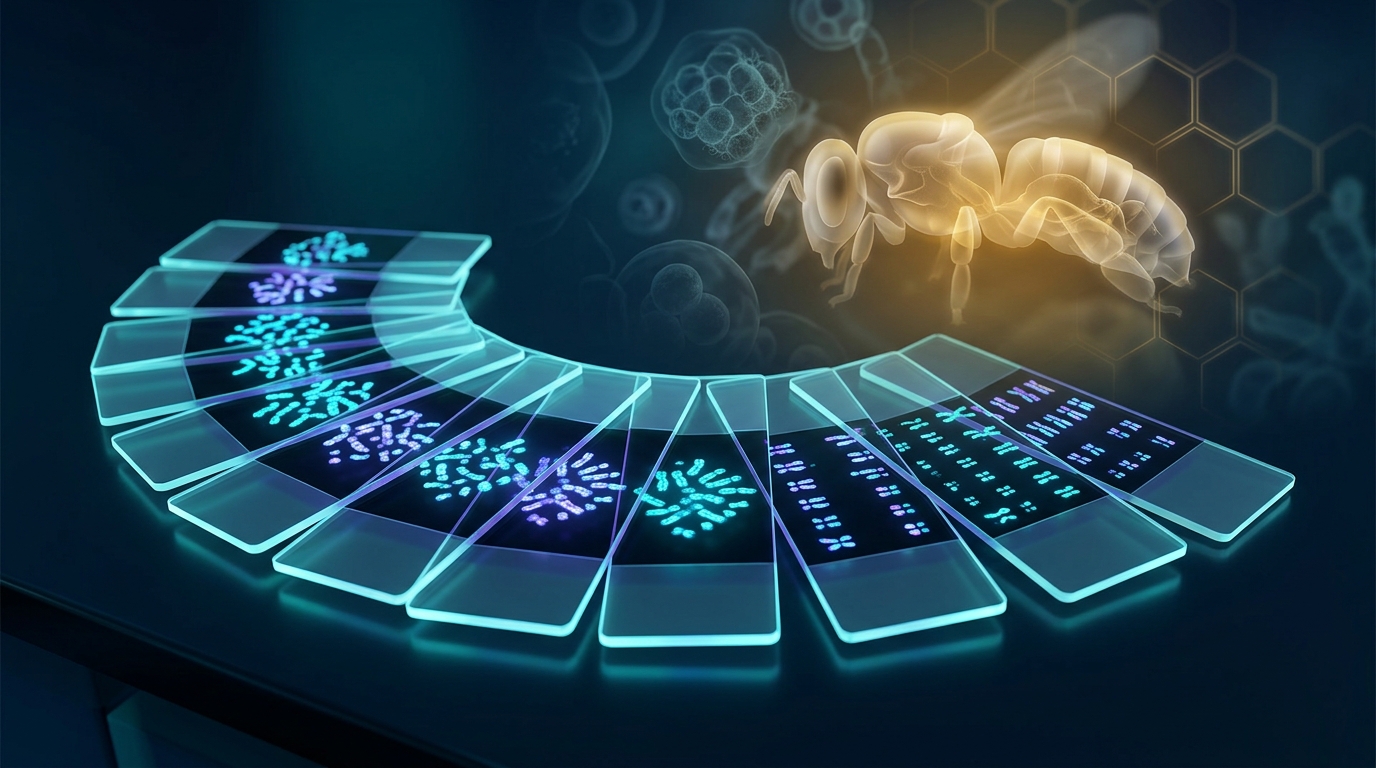
Stingless bees are among the most diverse groups of pollinating insects in the tropics, yet much of their true species richness remains unresolved, and cytogenetic tools that could help untangle their relationships have long been constrained by a practical bottleneck: each specimen typically yielded only one or a few chromosome slides. A new protocol published in Comparative Cytogenetics addresses that limitation by producing a suspension of dividing cells from a single larva that can be stored and drawn upon repeatedly, allowing researchers to prepare fresh chromosome slides whenever they are needed.
The protocol was developed by adapting an established technique first described by Imai and colleagues in 1988. In the traditional approach, chromosome preparations from insects generally produced a single slide or only a handful of slides per specimen, which restricted the number of metaphase spreads available for analysis. Because confirming chromosome numbers, detecting variation among individuals, identifying extra B chromosomes, and mapping heterochromatin patterns and ribosomal DNA sites all depend on having enough well-spread metaphases, the shortage of usable material has been a persistent obstacle for researchers working with these bees.
To demonstrate the method, the researchers applied it to six species of the tribe Meliponini collected in the state of Bahia, Brazil: three species of the genus Melipona (Melipona marginata, Melipona mondury and Melipona scutellaris) and three non-Melipona species, Frieseomelitta flavicornis (black morph), Scaptotrigona sp. and Tetragonisca angustula. The cerebral ganglia were dissected from post-defecating larvae directly in a 0.005% hypotonic colchicine solution containing 1% sodium citrate. After a species-specific incubation period in that solution, the extracted ganglia were transferred to an Eppendorf tube containing 1 mL of a first fixative mixed in a 3:3:4 ratio of 30% glacial acetic acid, 30% ethanol and 40% distilled water.
The ganglia were then macerated with a pestle for roughly one to two minutes until a homogeneous cell suspension formed. At this point the suspension can either be stored at −20 °C for later use or processed immediately. For slide preparation, clean glass slides were heated at 60 °C in a water bath for ten minutes, and three droplets of about 0.05 mL of the cell suspension were dropped onto a dry, pre-heated slide. A second fixative, a 1:1 mixture of 50% ethanol and 50% glacial acetic acid, was added, and the slides were kept vertically on the laboratory bench to drain the excess. Three additional droplets of acetic acid were applied, the slides were drained again, and after air-drying they were stained in a 5% Giemsa solution in phosphate buffer at pH 6.8 for twelve minutes before being rinsed under running tap water.
According to the authors, the cell suspension from each sample can potentially be used to prepare up to six slides per larva. The quantity and overall condition of the metaphase chromosome spreads varied among specimens and species, however. Tetragonisca angustula, the smallest species analyzed, showed a lower abundance of metaphases, suggesting that body size and the amount of available biological material influence how many slides can be effectively prepared. The number of slides may therefore need to be adjusted according to species, with fewer slides potentially being more appropriate for smaller bees, and species-specific methodological adjustments may be necessary to achieve optimal results. Even so, the protocol allowed the preparation and visualization of metaphase chromosomes in all six species evaluated, supporting its applicability across the species tested.
The diploid chromosome numbers observed in the study were consistent with values previously reported in the literature: 2n = 18 for Melipona, 2n = 34 for Scaptotrigona and Tetragonisca, and 2n = 30 for Frieseomelitta. The optimal colchicine exposure time varied considerably among species, ranging from ten minutes in Melipona to fifty minutes in Frieseomelitta, with the tested species requiring 10, 37, 40 or 50 minutes of treatment. Mean numbers of metaphases per slide also differed, from 5.8 in Tetragonisca angustula to 30.0 in Melipona mondury. Metaphase chromosomes were generally suitable for visualization, although chromosome spreading and the amount of cellular debris varied among preparations. The use of a heated water bath during slide preparation may contribute to chromosome spreading, consistent with earlier reports describing heating as a strategy for improving metaphase spreading.
To test whether the stored suspensions could support more demanding downstream applications, the researchers performed fluorescence in situ hybridization, or FISH, to map the (GA)15 microsatellite and 18S ribosomal DNA on the prepared chromosomes. The (GA)15 microsatellite probe was a synthetic oligonucleotide directly labeled with Cy3 at its 5′ end, applied following a modified version of the protocol of Pinkel and colleagues from 1986. Chromosomal DNA on the slides was denatured in 70% formamide and 2×SSC at 72 °C for five minutes, while the hybridization mixture containing the probe was denatured at 85 °C for ten minutes. The mixture was applied to the slides and incubated overnight at 37 °C in a humid chamber. The 18S rDNA probe was labeled with biotin-14-dATP using the BioNick Labeling System, and the hybridization signals were detected with FITC and avidin conjugated to FITC. After post-hybridization washes, the preparations were counterstained and mounted with DAPI in Fluoroshield. Importantly, no evidence of chromosomal changes or degradation was observed following these procedures, indicating that the stored material remained suitable for molecular cytogenetic analyses.
The broader significance of the method lies in what stored cell suspensions make possible. Because fresh slides can be prepared when needed, the same larval material can be subjected to different cytogenetic staining and banding techniques at different times, potentially expanding the range of analyses that can be performed on a single individual. This is particularly relevant for taxonomic, systematic and evolutionary studies of stingless bees, where applying several techniques to the same specimen strengthens comparisons. The approach may also reduce the number of larvae required per colony, which could minimize sampling impacts on small colonies and reduce handling-associated risks, including susceptibility to natural enemies such as phorid flies, a concern documented in earlier work on these bees.
Cytogenetics has already proven its value for this group. Studies of stingless bee chromosomes have helped discriminate species and populations, including the identification of cryptic forms, and have provided insights into chromosomal evolution when combined with molecular cytogenetics. B chromosomes, for example, have been reported in Tetragonisca fiebrigi and can serve as cytotaxonomic markers to distinguish that species from Tetragonisca angustula. Differences in karyotypic traits have also been observed among populations of the same taxon, indicating population structure that should be considered in the management and conservation of native species. More recently, microsatellite and rDNA mapping has contributed to understanding the ancestral chromosome number and chromosomal evolution in Meliponini. Yet cytogenetic data remain lacking for many taxa, limiting the comparisons that could help clarify species boundaries and evolutionary relationships, even as new species continue to be described.
The authors note that taxa traditionally studied using procedures based on the 1988 Imai method may also benefit from the new protocol, although further studies are needed to determine how widely it can be applied. Storing the suspension allows additional chromosome slides to be prepared when needed, making it possible to obtain more slides from the same larval material and use collected biological material more efficiently. The full chromosome preparation protocol is publicly available on protocols.io, and detailed metaphase counts are provided in supplementary material accompanying the paper. By turning a single dissected larva into a renewable source of dividing cells, the method offers a practical foundation for scaling up cytogenetic research on stingless bees and, potentially, for adaptation to other hymenopterans.
Subject of Research: An optimized chromosome preparation protocol for stingless bees that stores cell suspensions from single larvae for repeated cytogenetic analyses
Article Title: An optimized protocol for cytogenetics in stingless bees ( Hymenoptera , Apidae , Meliponini )
Article References: Nascimento, W. S., Louzada, B. M., Peixoto, J. A. B., & Waldschmidt, A. M. (2026). An optimized protocol for cytogenetics in stingless bees (Hymenoptera, Apidae, Meliponini). Comparative Cytogenetics, 20, 245-252. https://doi.org/10.3897/compcytogen.20.218686
Image Credits: AI Generated
DOI: 10.3897/compcytogen.20.218686
Keywords: stingless bees, Meliponini, cytogenetics, chromosome preparation, cell suspension, metaphase spreads, FISH, 18S rDNA, microsatellite mapping, diploid number, colchicine, Hymenoptera
Cite Scienmag News
Drew Townsend. (November 4, 2026). New Cell Storage Protocol Yields More Chromosome Slides from Single Stingless Bee Larva. Scienmag. https://scienmag.com/new-cell-storage-protocol-yields-more-chromosome-slides-from-single-stingless-bee-larva/
Drew Townsend. "New Cell Storage Protocol Yields More Chromosome Slides from Single Stingless Bee Larva." Scienmag, 4 November 2026, https://scienmag.com/new-cell-storage-protocol-yields-more-chromosome-slides-from-single-stingless-bee-larva/. Accessed 4 November 2026.
Drew Townsend. "New Cell Storage Protocol Yields More Chromosome Slides from Single Stingless Bee Larva." Scienmag. November 4, 2026. https://scienmag.com/new-cell-storage-protocol-yields-more-chromosome-slides-from-single-stingless-bee-larva/