


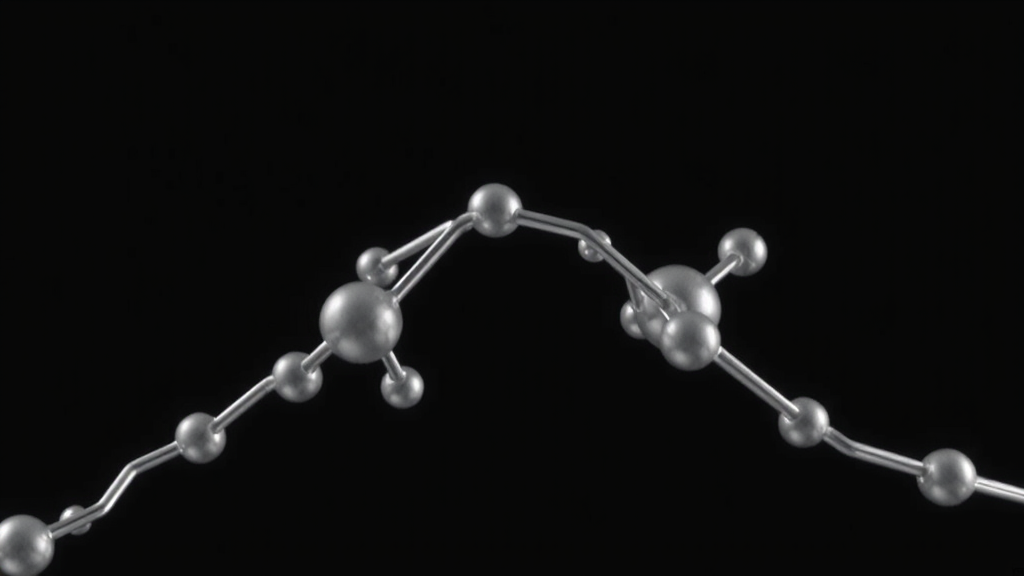
Boron has long been one of the most stubborn elements on the periodic table. It is light, abundant, and chemically versatile, yet for decades the crystalline forms of pure boron that chemists could actually make have shared a frustrating pair of traits: they are extraordinarily hard and extraordinarily brittle, and they conduct electricity poorly. Now a team at Yanshan University in China, working with collaborators at several Chinese institutions, reports in Nature Chemistry the synthesis of a boron allotrope that breaks both rules at once. The new phase, designated Imma-B60, is a highly conductive, open-framework crystal that can be plastically deformed by roughly 23 percent, a level of ductility that is essentially unheard of for an elemental solid built from covalently bonded boron.
The achievement matters because it resolves a tension that has defined boron chemistry for more than half a century. The known allotropes, including the familiar beta-rhombohedral phase and the high-pressure gamma-B28 form, are built from B12 icosahedra, cage-like clusters of twelve boron atoms that lock the structure into rigid, three-dimensional networks. That architecture delivers hardness and, in some phases, semiconducting behavior, but it also means the material has no easy way to relieve stress. When a conventional boron crystal is loaded past its elastic limit, it cracks rather than bends. Achieving a single boron phase that is simultaneously a good electrical conductor and capable of plastic flow has therefore been an explicit goal, and until now an unmet one, in the field.
The route to Imma-B60 is as interesting as the material itself. Rather than trying to crystallize pure boron directly into the desired framework, the team used a two-step precursor strategy. First, they synthesized a sodium boride, Na4B60, under high-pressure and high-temperature conditions, growing crystals large enough for single-crystal X-ray diffraction. In this compound, sodium atoms occupy channels within a boron framework, acting as a kind of structural scaffold. In the second step, the researchers removed the sodium by degassing the crystals at around 900 degrees Celsius under high vacuum for 48 hours. What remained was a pure boron framework that inherited the geometry of its sodium-containing parent, an approach the authors describe as a powerful way to access metastable materials that cannot be reached by direct synthesis.
The structure that survives the sodium extraction is remarkable in its own right. Imma-B60 adopts an orthorhombic open framework in which B12 icosahedra are interconnected by triangular B3 units through a combination of two-center and three-center sigma bonds. This is not the dense, space-filling arrangement of ordinary boron; it is a porous, cage-like architecture more reminiscent of the open-framework clathrate forms of silicon, which themselves were synthesized by a comparable precursor-removal strategy. The team confirmed the structure through a combination of single-crystal and powder X-ray diffraction, Rietveld refinement, micro-electron diffraction, and scanning transmission electron microscopy, and they benchmarked the diffraction pattern against every reported and predicted boron phase to show that Imma-B60 is genuinely new.
The electronic properties are where the material begins to look transformative. Calculations and measurements show that Imma-B60 has a narrow bandgap of less than 0.2 electronvolts, far smaller than the gap in conventional boron phases. The measured electrical conductivity is approximately 9 times 10 to the 2 siemens per meter, which the authors note is seven orders of magnitude higher than that of beta-boron. In practical terms, a material that was previously an electrical near-insulator has been restructured, without changing its chemical composition, into something approaching a conducting semiconductor. The bonding analysis, performed with a solid-state adaptation of adaptive natural density partitioning, confirms that the framework is held together by predominantly sigma-type bonding, with the open topology leaving the electronic structure in a regime where charge transport becomes facile.
Equally striking is the mechanical behavior. Using in situ uniaxial compression of nanopillars carved from the crystals, oriented along a specific crystallographic direction, the researchers observed that Imma-B60 deforms plastically to strains of about 23 percent. The deformation proceeds through a dislocation-mediated slip mechanism, meaning that planes of atoms slide past one another along defined crystallographic pathways rather than the material shattering. Video recordings of the compression experiments show the nanopillars bending and shearing in a way that looks more like a metal than a covalent nonmetal. Nanoindentation measurements on both the precursor Na4B60 and the final B60 phase provided complementary hardness and elastic modulus data, placing the new material well outside the superhard-but-brittle envelope that has characterized boron to date.
The precursor strategy itself may prove to be the study’s most consequential contribution. The idea of using a guest species, in this case sodium, to template a framework and then removing it to leave a metastable elemental structure echoes the celebrated synthesis of open-framework silicon from sodium silicide clathrates, and it has been proposed as a route to exotic phases of other elements, including polymeric nitrogen and superconducting allotropes of silicon and carbon. By demonstrating the approach for boron, the Yanshan University team adds a new entry to a growing catalog of metastable materials that are accessible only through chemical templating. The sodium diffusion pathway and its energy barrier were mapped computationally, showing how the guest atoms can migrate out of the framework without collapsing it.
The work also required considerable experimental ingenuity at the growth stage. The team found that inserting zinc interlayers between the sodium and boron starting layers in the high-pressure assembly dramatically improved crystal size and quality, a detail they verified with control experiments and scanning electron microscopy of hundreds of crystals. Residual sodium content after degassing was tracked with energy-dispersive spectroscopy and electron energy-loss spectroscopy, and the analysis revealed that lower degassing temperatures or argon-flow conditions left more sodium behind, underscoring how sensitive the final purity, and therefore the properties, are to the extraction protocol. Subtle defect motifs associated with interstitial boron sites were identified in the refined structures, and the authors show that these defects, rather than secondary phases, explain weak additional diffraction features.
For applications, the combination of high conductivity and ductility in a light-element framework opens doors that conventional boron could never approach. Thermoelectric devices, which depend on materials with unusual electronic transport and low thermal conductivity, are an obvious candidate given the narrow bandgap and porous structure; theoretical work has long suggested that doping boron icosahedra could even produce superconductivity. Flexible or deformable electronics, lightweight electrodes, and mechanically resilient semiconducting components are other directions the open framework invites. More broadly, the result is a reminder that the periodic table still holds surprises in its simplest entries: a single element, boron, whose known phases were cataloged over decades, has just yielded a form that is simultaneously transparent to none of its usual weaknesses and rich in properties its usual phases never displayed. The team, led by Xiang-Feng Zhou and Yongjun Tian, with Feng Chen, Lianfeng Zou, and Penghui Li as co-first authors, suggests that the precursor-based strategy can now be extended to hunt for further metastable frameworks, meaning Imma-B60 may be less an endpoint than a template for what comes next.
Subject of Research: Synthesis of a conductive and plastic open-framework boron allotrope via a high-pressure precursor route
Article Title: An open-framework boron allotrope exhibiting high conductivity and plasticity
Article References: Chen, F., Zou, L., Li, P., Fan, C., Liu, Y., Xu, B., Shao, X., Zhang, H., He, X.-L., Huang, M.-X., Chen, F., Nie, A., Ke, F., Zhao, Z., Dong, H., Yang, Y., Weng, X.-J., Wang, H.-T., Zhou, X.-F., & Tian, Y. (2026). An open-framework boron allotrope exhibiting high conductivity and plasticity. Nature Chemistry. https://doi.org/10.1038/s41557-026-02267-7
Image Credits: AI Generated
DOI: 10.1038/s41557-026-02267-7
Keywords: boron, allotrope, open framework, high pressure, plasticity, electrical conductivity, B12 icosahedra, sodium boride, dislocation slip, metastable materials, Nature Chemistry, bandgap
Cite Scienmag News
Bethany Barker. (September 23, 2026). New Boron Allotrope Bends Like Metal and Conducts Like a Semiconductor. Scienmag. https://scienmag.com/new-boron-allotrope-bends-like-metal-and-conducts-like-a-semiconductor/
Bethany Barker. "New Boron Allotrope Bends Like Metal and Conducts Like a Semiconductor." Scienmag, 23 September 2026, https://scienmag.com/new-boron-allotrope-bends-like-metal-and-conducts-like-a-semiconductor/. Accessed 4 October 2026.
Bethany Barker. "New Boron Allotrope Bends Like Metal and Conducts Like a Semiconductor." Scienmag. September 23, 2026. https://scienmag.com/new-boron-allotrope-bends-like-metal-and-conducts-like-a-semiconductor/


