


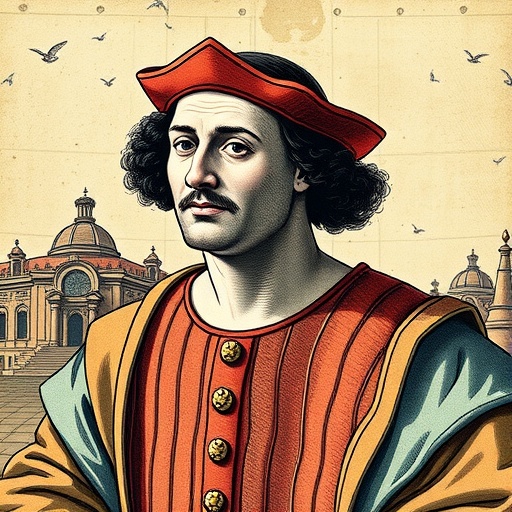
In an illuminating exploration of one of history’s most debated figures, Matthew Restall, Edwin Erle Sparks Professor of Colonial Latin American History at Penn State University, presents a groundbreaking perspective on Christopher Columbus. His latest work, “The Nine Lives of Christopher Columbus,” published by W.W. Norton & Company, ventures beyond the traditional narratives to reveal the intricate layers of Columbus’s life and the multitude of posthumous identities he has assumed in public consciousness. Restall’s innovative approach challenges long-held assumptions and offers a nuanced understanding of Columbus’s enduring legacy.
Christopher Columbus has often been relegated to the sidelines in Latin American historical studies, viewed as a figure whose story has been exhaustively told and retold with diminishing relevance. However, Restall’s unexpected encounter during a visit to Galicia, Spain, sparked a renewed interest in Columbus’s persona. Locals propagated a compelling, if historically questionable, belief that Columbus was a Galician nobleman who fabricated his death and altered his identity—a theory that captivated Restall and propelled him into a comprehensive inquiry about the origins and evolution of Columbus’s myriad interpretations.
Restall’s research unveils the complexity of Columbus’s early life, traditionally characterized by obscurity and humble beginnings in Genoa, Italy. Yet, through meticulous archival work and critical examination, he paints a portrait of a man whose relentless pursuit of status and recognition propelled him from obscurity to the forefront of global exploration. This ascent was fueled by a profound ego and an unwavering tenacity, traits that define Columbus not merely as an explorer but as a figure emblematic of social mobility during the late 15th century.
The book’s structure facilitates a dual examination: it first establishes a clear, rigorously researched biography of Columbus the person, then shifts to the study of Columbus as a mutable symbol in collective memory. Restall underscores the transition of Columbus from a historical figure to a cultural icon, whose image has been variously shaped to meet the sociopolitical needs of disparate communities over centuries, revealing that these differing interpretations serve distinct functions and ideologies.
Crucial to Restall’s analysis is the transformation of Columbus’s mythos in the context of American independence. Columbus was elevated to a patriotic emblem comparable to George Washington, a symbolic figure representing ambition, discovery, and national identity. The naming of the U.S. capital, Washington, within the District of Columbia encapsulates this intertwining of historical reverence and place-making in national consciousness. This period marked the zenith of Columbus’s glorification, a phenomenon intricately tied to nation-building processes.
The timing of Columbus’s ascendance as an American cultural hero coincided with the influx of Italian immigrants in the late 19th and early 20th centuries. Facing prejudice and social marginalization, Italian Americans found in Columbus an ancestral figure through whom they could assert pride and belonging in their adopted homeland. Organizations such as the Knights of Columbus and celebrations like Columbus Day emerged as powerful affirmations of identity and assimilation within the broader American social fabric.
However, the 500th anniversary of Columbus’s voyage in 1992 brought a critical reevaluation. Academic scholars, indigenous activists, and cultural critics foregrounded the devastating consequences of European colonization, emphasizing the violence and subjugation inflicted upon Indigenous populations. This counternarrative catalyzed movements to replace or supplement Columbus Day with Indigenous Peoples Day, highlighting the divergent memories and emotions tethered to the same historical figure.
Restall’s scholarly contribution lies in his refusal to advocate for a singular interpretation of Columbus. Instead, he argues for recognition of the multiple “Columbuses” that exist simultaneously—each a product of different historical moments, cultural perspectives, and political imperatives. This plurality invites a more empathetic and comprehensive engagement with controversial figures whose legacies are not easily categorized as wholly heroic or villainous.
The author further stresses the potential for coexistence between these conflicting commemorations. He posits that the recognition of both Columbus Day and Indigenous Peoples Day reflects the complexity of American society and the multiplicity of experiences that shape national identity. This proposition challenges the often polarizing debates surrounding public memory and encourages dialogue that acknowledges varying historical truths.
Restall’s investigation into the folklore and local beliefs surrounding Columbus in Galicia underscores the broader phenomenon of historical myth-making. Myths serve not only to preserve cultural heritage but also to negotiate contemporary identities and grievances. The Galician narrative exemplifies this dynamic, where history and legend intertwine, creating a unique regional claim on Columbus’s legacy that diverges from mainstream historiography.
Beyond its biographical and cultural analyses, “The Nine Lives of Christopher Columbus” engages with theoretical frameworks from anthropology and cultural studies. Restall utilizes ethnographic methods to dissect how collective memory is constructed and contested, employing folklore studies to deepen understanding of how historical figures are reimagined across time and space. His interdisciplinary approach enriches the discourse on the politics of history and memory.
In sum, Restall’s work disrupts simplistic narratives and unveils the stratified nature of historical memory. “The Nine Lives of Christopher Columbus” challenges readers and scholars alike to reconsider the ways in which history is lived, remembered, and instrumentalized. In doing so, it contributes meaningfully to ongoing conversations about identity, power, and the enduring influence of legendary figures on contemporary society.
By dissecting the multiple identities Florence Columbus has assumed—from obscure sailor to national hero, from immigrant symbol to condemned oppressor—Restall’s study exemplifies the cultural complexity that defines historical scholarship today. This layered portrayal not only enriches academic discourse but also resonates with a society increasingly aware of its plural histories and the contested meanings of its icons.
Cite Scienmag News
Courtney Benton. (October 10, 2025). New Book Investigates the ‘Nine Lives’ of Christopher Columbus Through a Scientific Lens. Scienmag. https://scienmag.com/new-book-investigates-the-nine-lives-of-christopher-columbus-through-a-scientific-lens/
Courtney Benton. "New Book Investigates the ‘Nine Lives’ of Christopher Columbus Through a Scientific Lens." Scienmag, 10 October 2025, https://scienmag.com/new-book-investigates-the-nine-lives-of-christopher-columbus-through-a-scientific-lens/. Accessed 3 September 2026.
Courtney Benton. "New Book Investigates the ‘Nine Lives’ of Christopher Columbus Through a Scientific Lens." Scienmag. October 10, 2025. https://scienmag.com/new-book-investigates-the-nine-lives-of-christopher-columbus-through-a-scientific-lens/


