


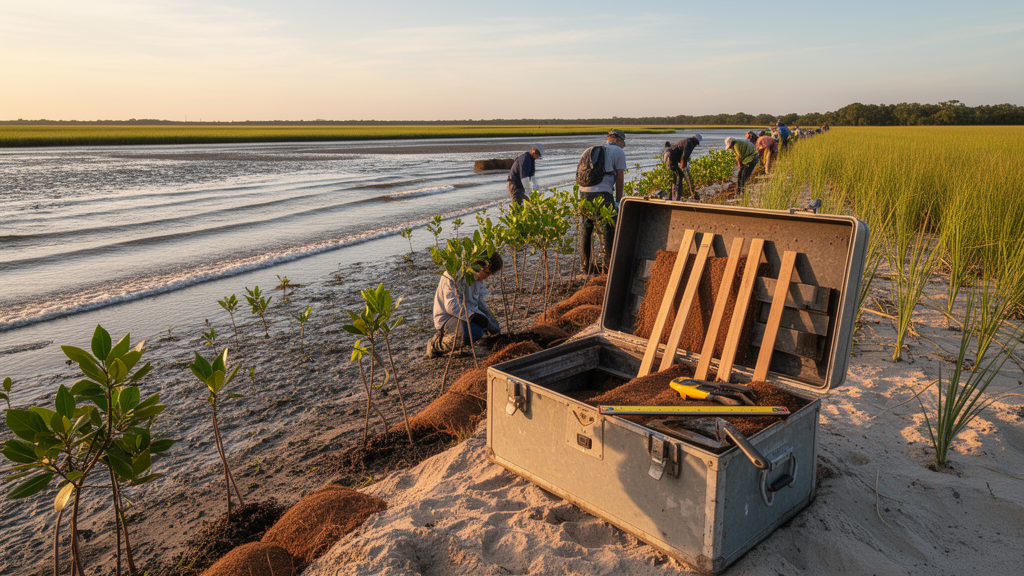
Marine and coastal ecosystems generate goods and services worth trillions of euros every year, yet the interventions designed to protect and restore them have long lagged behind their terrestrial counterparts. A team of researchers working under the European Union-funded MaCoBioS project, short for Marine Coastal Ecosystems Biodiversity and Services in a Changing World, has now unveiled a free, web-based resource built to close that gap. The MaCoBioS Blue NBS Toolbox, described in the journal One Ecosystem, gathers a set of multidisciplinary, scientifically grounded and stakeholder-informed tools that guide practitioners through the earliest and most difficult stages of implementing Nature-based Solutions in the sea.
Nature-based Solutions, commonly abbreviated NBS, are actions that protect, restore or sustainably manage ecosystems to tackle societal challenges such as climate change, biodiversity loss and food insecurity. When applied to marine and coastal environments, they are known as blue NBS. These interventions range from safeguarding existing habitats like mangrove forests and coral reefs to restorative actions such as replanting seagrass meadows and salt marshes, along with sustainable management measures that meet criteria set by the International Union for Conservation of Nature. The appeal is enormous: blue NBS can simultaneously store carbon, buffer shorelines against storms, sustain fisheries and support human health and wellbeing. One-third of the world’s population lives within 100 kilometres of the coast, and roughly 40 percent of large cities with more than one million inhabitants sit near the coastal zone, so the stakes for getting these solutions right could hardly be higher.
Despite that potential, blue NBS implementation trails terrestrial and urban applications, in part because practitioners and decision-makers have lacked tailored tools and resources for planning interventions at sea. Marine and coastal areas are notoriously difficult environments for environmental management. They host numerous human activities, diverse stakeholder interests and multiple governance levels, all combined with the high heterogeneity and dynamism of coastal ecosystems. Management interventions can also produce positive, neutral or negative outcomes depending on stakeholder perspectives and local context, which makes meaningful engagement essential rather than optional. The MaCoBioS team argues that overcoming these barriers requires coordinated action uniting researchers, practitioners, policy-makers, industries and local communities, with active knowledge exchange across the science-policy-practitioner interface.
The toolbox itself is accessible at macobios.eu/toolbox and opens with a landing page that explains its aims, introduces key concepts and summarises the context of the project. Six StoryMaps offer information on multiple marine and coastal ecosystems, including mangrove forests, coral reefs, kelp forests, maerl beds, seagrass beds and salt marshes, alongside some of the fieldwork undertaken within the project. An infographic then drives users toward the intended use of each tool through short descriptive questions, so that even newcomers can identify which resource fits their problem. Each tool also has its own subpage with more detailed guidance, and every tool can be applied as a standalone procedure even though the structure leverages the interdependencies and complementary approaches between them.
The first tool addresses a deceptively simple question: what happens to the ecosystem and its services if pressures increase or decrease? Through fuzzy cognitive mapping, the conceptual models help managers visualise the complexity of marine and coastal ecosystems and simulate cascading effects following changes in pressure, therefore revealing the potential effects of intended management measures before they are implemented. This kind of simulation matters because coastal systems respond to the interplay between climate change and human activities in ways that are rarely linear, and managers need to anticipate system changes rather than react to them after damage has occurred.
A second resource, called Coast-Adapt, asks whether a coastal community will be able to adapt to change and how its adaptive capacity can be enhanced. It provides guidance for developing and applying an index-based adaptive capacity assessment in coastal social-ecological systems, supporting future management decisions aimed at reducing social vulnerability. A third tool, MARITIME, tackles the question of where management to reduce local pressures is most needed. MaCoBioS developed a Machine Learning-Cumulative Impact Assessment model that supports the design of blue NBS by modelling the response of marine and coastal ecosystems to cumulative impacts, helping planners understand how the combined weight of climate change and human activities affects ecosystem condition across space.
Two further tools round out the planning sequence. MAS-NBS, short for Multi-tiered Approach to assess Suitability for NBS, provides a framework to identify the most favourable conditions for intervention by combining environmental, social, economic and governance dimensions, so practitioners can pinpoint areas with suitable conditions for implementing blue NBS. PBI-Support, the Potential Blue Interventions Support tool, then offers a clear and structured framework to guide decision-makers and practitioners through the initial stages of planning potential interventions. Beyond the tools, the main page describes the methods MaCoBioS employed to collect biodiversity data that can inform monitoring strategies, presents short policy-relevant thematic briefings with accompanying guidelines on innovating with nature and people, enhancing uptake of blue NBS in European policies, implementing blue NBS to tackle climate change and biodiversity loss while improving human health, and research orientations for the field, and links to a WebGIS interface that delivers ecoregional-level data through an interactive visualisation tool accessible to practitioners, researchers and the public alike.
The toolbox arrives at a moment when international and European policy frameworks are demanding exactly this kind of actionable science. Key initiatives such as the Sustainable Development Goals on climate action and life below water, the Kunming-Montreal Global Biodiversity Framework and the EU Biodiversity Strategy 2030 all emphasise the need to halt biodiversity loss and ecosystem degradation by integrating environmental considerations into policy-making to combat climate change. The European Commission and the Council of the European Union have acknowledged that protecting and restoring marine environments, along with conserving natural habitats and species, is a key priority. Yet translating scientific findings into practical real-world applications remains a persistent challenge for conservation science, and more effort is required to ensure that evidence effectively transforms into actions protecting marine and coastal biodiversity.
What distinguishes the MaCoBioS effort is its collaborative genesis. Throughout the project, active communication channels were maintained between toolbox developers and different stakeholders to identify and produce resources that support the earliest stages of blue NBS implementation. The team stresses that effective blue NBS must be grounded in evidence and embedded in social networks, legitimacy and context, which requires research and practice conducted collaboratively with a people-centric approach. Implementation should consider the local social, economic and ecological setting, be built on effective partnerships and strong stakeholder engagement, and establish clear objectives that inform design and enable evaluation. Practitioner knowledge and experience, the researchers note, is essential for advancing blue NBS at international and national levels, but stakeholder engagement is equally crucial because outcomes differ depending on perspectives and context.
The team presents the toolbox as an important initial set of resources rather than a finished product, and ongoing collaboration between researchers, practitioners and policy-makers will be essential to refine and adapt the tools to diverse social-ecological contexts. The creation of adaptive policies for managing dynamic and complex marine and coastal ecosystems requires flexible and innovative tools that address multifaceted issues, uncertainties and a wide range of future conditions. This continuous co-development of knowledge and tools, the researchers argue, will enhance the resilience and sustainability of marine and coastal ecosystems, ultimately benefiting the communities that depend on them. As societies increasingly recognise the vital role of the ocean in mitigating and adapting to climate change while supporting biodiversity, accessible and usable resources like this one could determine whether blue NBS fulfil their promise or remain an aspiration confined to policy documents.
Subject of Research: MaCoBioS Blue NBS Toolbox for marine and coastal Nature-based Solutions
Article Title: Informing implementation of Nature-based Solutions in marine and coastal environments: the MaCoBioS Blue NBS Toolbox
Article References: Casal, G., Fonseca, C., Allegri, E., Bianconi, A., Boyd, E., Cornet, C. C., de Juan, S., Espinoza Córdova, F., Furlan, E., Gil, A., Krause, T., Maréchal, J.-P., McCarthy, T., Özkiper, O., Pérez, G., Pham, H. V., Roberts, C., Simide, R., Simeoni, C., … O'Leary, B. (2025). Informing implementation of Nature-based Solutions in marine and coastal environments: the MaCoBioS Blue NBS Toolbox. One Ecosystem, 10, Article e149010. https://doi.org/10.3897/oneeco.10.e149010
Image Credits: AI Generated
DOI: 10.3897/oneeco.10.e149010
Keywords: Informing, implementation, Nature-based, Solutions, marine, coastal, environments, MaCoBioS, Blue, Toolbox, scientific research
Cite Scienmag News
Margaret Porter. (October 18, 2026). New Blue Toolbox Guides Nature-Based Solutions for Coastal Ecosystems. Scienmag. https://scienmag.com/new-blue-toolbox-guides-nature-based-solutions-for-coastal-ecosystems/
Margaret Porter. "New Blue Toolbox Guides Nature-Based Solutions for Coastal Ecosystems." Scienmag, 18 October 2026, https://scienmag.com/new-blue-toolbox-guides-nature-based-solutions-for-coastal-ecosystems/. Accessed 18 October 2026.
Margaret Porter. "New Blue Toolbox Guides Nature-Based Solutions for Coastal Ecosystems." Scienmag. October 18, 2026. https://scienmag.com/new-blue-toolbox-guides-nature-based-solutions-for-coastal-ecosystems/


