


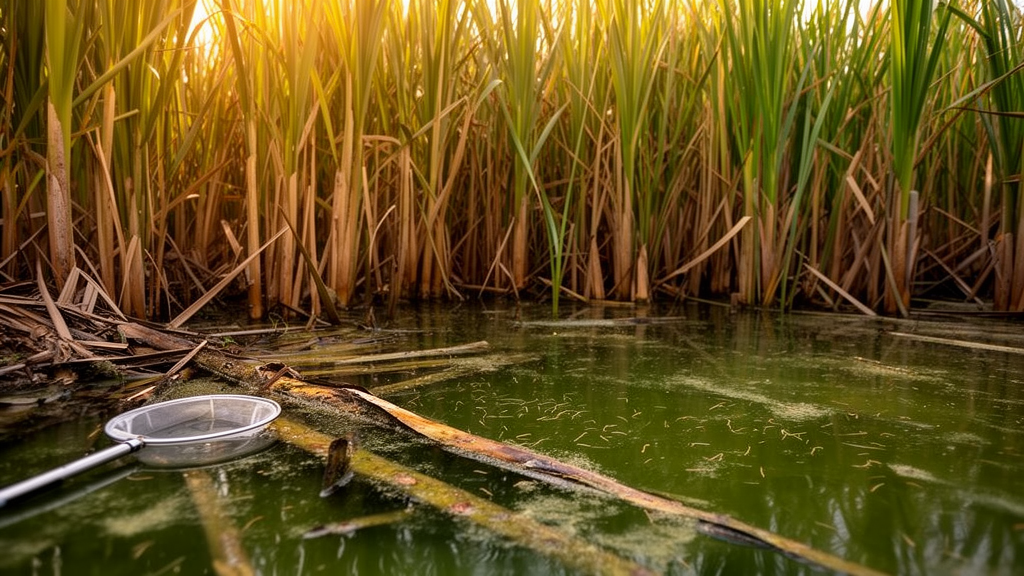
An invasive plant that lines waterways across the Mediterranean may be quietly making mosquitoes more abundant. A new experimental study published in the journal NeoBiota shows that when the invasive giant reed Arundo donax replaces the native common reed Phragmites australis along the banks of ponds, ditches and streams, the decaying leaves of the invader trigger a cascade of changes in water chemistry and microscopic life that allows Culex pipiens mosquito larvae to grow faster, survive better and emerge heavier. The findings, based on carefully controlled laboratory microcosms in northeastern Spain, suggest that even modest levels of invasion by the giant reed could tip aquatic habitats toward producing more mosquitoes, with potential consequences for public health.
The research team, working at the University of Barcelona, set out to address a persistent gap in invasion ecology. Most studies of invasive plants examine one or two links in the food web, but the impacts of a non-native species can ripple across many trophic levels at once. Leaf litter decomposition is one of the main routes through which invasive plants reshape ecosystems: as leaves break down in water, they release chemicals and nutrients that alter bacterial and fungal communities, which in turn feed the tiny animals that graze on them. Among these grazers are microeukaryotes, a catch-all group that includes protozoa such as amoebae, flagellates and ciliates, as well as small metazoans like rotifers and nematodes. Despite their central role in microbial food webs, microeukaryotes have been largely overlooked in studies of plant invasion.
The experiment focused on two morphologically similar reeds. Arundo donax, the giant reed, is considered one of the world’s worst invasive plant species and forms dense stands in Mediterranean streams, ponds and ditches, displacing natives such as Phragmites australis, the common reed. Both plants are abundant along the Delta del Llobregat near Barcelona, where the researchers collected freshly fallen leaves of both species from the same channels in June 2022. The leaves were dried, fragmented and mixed in five different proportions, ranging from microcosms containing 100 percent native reed litter to mixtures with 25, 50, 75 and 100 percent giant reed litter. Each one-litre glass jar received one gram of leaf material, ultrapure water and a splash of pond water containing a natural microbial community.
After allowing fifteen days for the leaves to leach and the microbes to colonise, the team added twenty first-instar larvae of Culex pipiens, the northern house mosquito, to each microcosm. This species was chosen deliberately: it is native to Europe, Africa and Asia, and its adults can transmit pathogens of serious human and veterinary concern, including West Nile virus, St. Louis encephalitis virus, filariasis and avian malaria. The larvae were fed exclusively by the microbial food web growing on the decaying leaves, with no artificial supplements, so that any differences in their development could be traced back to the leaf litter itself. Jars containing only water and pond inoculum, with no leaves at all, served as negative controls, and every larva in them died, confirming that leaf litter was the essential fuel for the entire system.
Before the larvae were introduced, the researchers characterised the microeukaryote communities under a phase-contrast microscope, counting and identifying organisms drop by drop. The results were striking. Leaf litter of any kind boosted microbial life compared to leaf-free controls, but increasing the share of giant reed litter significantly raised both the total density and the taxonomic richness of microeukaryotes. The composition of the community also shifted markedly: flagellates such as Peranema, planktonic ciliates like Cyclidium, lecanid rotifers and the testate amoeba Euglypha became characteristic of the giant reed treatments. Viewed through the lens of functional guilds, the densities of flagellates, planktonic ciliates and micrometazoa all climbed as the invader’s share increased, a pattern the authors interpret as evidence of enhanced bacterial productivity driven by nutrients released from the giant reed leaves.
The mosquito responses mirrored these microbial shifts, and in a direction the researchers did not expect. Because previous work had shown giant reed tissues to be unpalatable and nutritionally poor for herbivores and detritivores, the team had predicted that the native reed would best support larval development. Instead, microcosms with giant reed litter produced more pupae that were heavier and reached pupation sooner than those in jars with only native reed litter. Pupae mass increased progressively with the proportion of invasive litter, while the effects on pupae number and development time became pronounced once just a quarter of the native biomass had been replaced, and then levelled off. The proportion of females, notably, did not change across treatments.
To understand what was driving these effects, the team measured an extensive suite of water properties at the end of the experiment, including pH, dissolved oxygen, conductivity, dissolved organic carbon, ammonium and a long list of elements released during decomposition, from essential nutrients such as phosphorus, potassium and sulphur to potential pollutants such as zinc, copper, arsenic and lead. A principal component analysis revealed that microcosms with pure giant reed and pure native reed separated clearly along the first axis, which loaded heavily on conductivity, ammonium, aluminium, copper, zinc and silicon. The giant reed generally enriched the water with ions, with the notable exception of silicon, compared with the native reed at similar rates of leaf mass loss.
Statistical modelling showed that water chemistry explained mosquito performance better than the microeukaryote densities measured after pupation. Pupae numbers and total pupae mass rose with the first principal component scores, while mean development time fell with both major axes of water chemistry. Female proportion was positively related to the second axis, which captured arsenic, iron and lead, and to amoebae density. Some weaker but significant microeukaryote effects emerged as well: pupae number and mass decreased with flagellate density, hinting at either competition between larvae and nanoflagellates for bacteria or direct predation by larvae on these microbes. Fungal filaments, although more abundant with increasing giant reed litter, did not significantly explain any mosquito trait.
The abrupt, threshold-like responses in both microbes and mosquitoes point to nutrient limitation in the native reed treatments. Elements such as phosphorus, potassium, sulphur, sodium and magnesium, all higher in the giant reed microcosms, are essential for physiological regulation in mosquitoes, and their scarcity in the native litter may have constrained both microbial growth and larval development. Silicon in the native reed may also have hampered larval browsing, as it does for amphipod shredders. Although some measured concentrations of zinc and copper exceeded water quality standards, and arsenic and lead were detectable, both mosquito larvae and microeukaryotes appeared to tolerate these conditions well.
The authors argue that these findings carry practical weight for both invasion management and mosquito control. Because effects emerged when only 25 percent of the native reed biomass had been replaced, defining a safe threshold for giant reed invasion appears challenging where eradication is unfeasible. Heavier pupae imply female mosquitoes with greater reproductive potential and longevity, potentially increasing biting nuisance and disease transmission risk, while faster development narrows the window during which control services can target larvae, the most efficient stage for intervention. The researchers recommend prioritising early removal of the giant reed and restoring invaded sites with native vegetation, integrated with established tools such as Bacillus thuringiensis israelensis and natural predators. They also caution that real populations depend on factors outside the experiment, including where female mosquitoes choose to breed, and call for future work on how invasive litter reshapes the internal microbiota of mosquitoes, a key frontier in vector biology.
Subject of Research: Effects of invasive giant reed leaf litter on water chemistry, microeukaryote communities and mosquito larval development
Article Title: Invasive plant-induced shifts in water chemistry and microeukaryotes enhance mosquito development
Article References: Cano-Rocabayera, O., Bonilla, Y. Y., Salvadó, H., Garcia-Bargalló, M., Sobhy, I. S., Berry, C., Vilà, M., Sabater, F., Aranda, C., & Maceda-Veiga, A. (2026). Invasive plant-induced shifts in water chemistry and microeukaryotes enhance mosquito development. NeoBiota, 106, 265-286. https://doi.org/10.3897/neobiota.106.167149
Image Credits: AI Generated
DOI: 10.3897/neobiota.106.167149
Keywords: invasive species, Arundo donax, Phragmites australis, leaf litter, microeukaryotes, Culex pipiens, mosquito development, water chemistry, trophic cascade, freshwater ecosystems, public health, NeoBiota
Cite Scienmag News
Morgan Morrow. (October 18, 2026). Invasive Giant Reed Supercharges Mosquito Growth by Rewiring Aquatic Microbial Food Webs. Scienmag. https://scienmag.com/invasive-giant-reed-supercharges-mosquito-growth-by-rewiring-aquatic-microbial-food-webs/
Morgan Morrow. "Invasive Giant Reed Supercharges Mosquito Growth by Rewiring Aquatic Microbial Food Webs." Scienmag, 18 October 2026, https://scienmag.com/invasive-giant-reed-supercharges-mosquito-growth-by-rewiring-aquatic-microbial-food-webs/. Accessed 18 October 2026.
Morgan Morrow. "Invasive Giant Reed Supercharges Mosquito Growth by Rewiring Aquatic Microbial Food Webs." Scienmag. October 18, 2026. https://scienmag.com/invasive-giant-reed-supercharges-mosquito-growth-by-rewiring-aquatic-microbial-food-webs/


