


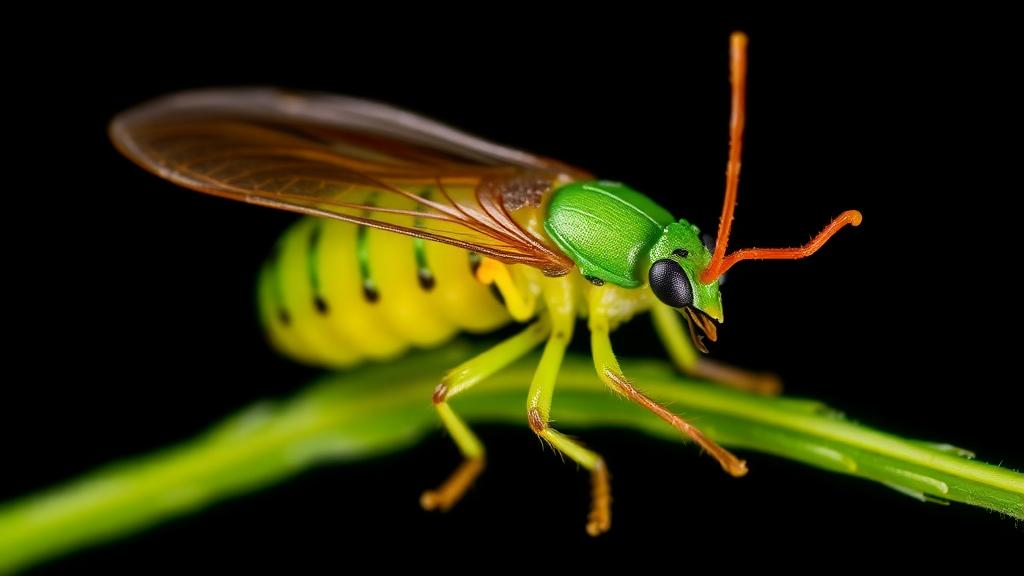
A tiny, pale green insect barely two and a half millimeters long has just been added to the official roster of South Korean wildlife. Researchers surveying aphids across the country between 2023 and 2025 collected specimens of Eutrichosiphum sinense, a species first described from India in 1956, from the evergreen oak Castanopsis sieboldii in Jinju, in the southern part of the peninsula. The find, published in the Biodiversity Data Journal, marks the first time this aphid has been recorded in South Korea and brings the national count of Greenideinae species to eight.
Greenideinae is a distinctive subfamily within the aphid family Aphididae, comprising roughly 180 species in 16 genera worldwide. Taxonomists currently divide the group into three tribes: Cervaphidini, Greenideini, and Schoutedeniini, with the bulk of the diversity concentrated in Greenideini. What sets these aphids apart morphologically is a combination of unusual features: their dorsal body setae are pointed or forked into two branches, and their siphunculi, the paired tubes projecting from the rear of the abdomen, are elongated and swollen in the wingless forms, bristling with remarkably long, hair-like setae. These are not the drab, featureless aphids most people picture on garden roses.
Ecologically, the subfamily is closely tied to woody plants. Most greenideine species feed on trees and shrubs in the orders Fagales, Sapindales, and Malvales, drawing sap from oaks, chestnuts, and their relatives in the beech family, as well as from sabias, myrtles, lindens, and birches. This host specialization makes them sensitive indicators of forest composition, and it also means that changes in vegetation, whether through climate shifts or land use, can reshape their distributions in ways that are only now being documented with modern survey effort.
Before this study, South Korea’s Greenideinae fauna consisted of seven species in four genera. Cervaphidini was represented by a single species, Cervaphis quercus, an odd little aphid whose pale yellow body carries ten pairs of branched, projecting processes along its margins, giving it an almost crustacean silhouette. The remaining six species belonged to Greenideini: three species of Greenidea, one species of Mollitrichosiphum, and one species of Eutrichosiphum. That inventory has now grown, and the researchers behind the discovery have paired the new record with something the field has long needed: a fully illustrated identification key covering all eight Korean species.
The new country record came from fieldwork conducted in May 2025, when five apterous, that is wingless, viviparous females were hand-collected from Castanopsis sieboldii at Samgye-ri in Jinju, at coordinates 35.1477 degrees north, 128.0448 degrees east. The specimens were preserved in 95 percent alcohol and later mounted as slide preparations in Canada balsam, following standard techniques, and deposited in the insect collection of the Institute of Agriculture and Life Science at Gyeongsang National University. Under the microscope, the aphids revealed a suite of characters that confirmed their identity as E. sinense rather than the superficially similar E. pasaniae, which was already known from Korea.
The morphological evidence is detailed and diagnostic. The apterous viviparous females of E. sinense measure 2.22 to 2.51 millimeters in body length and are pale yellowish green in life, with dark brown markings on the antennae: the tip of the third segment, the distal half of the fourth, the base of the fifth, and the processus terminalis. The five-segmented antennae run 1.21 to 1.40 millimeters long, with the third segment bearing 15 to 19 setae and measuring 1.23 to 1.34 times the width of the head across the eyes. The ultimate rostral segment, the piercing tip of the feeding mouthparts, is 0.17 to 0.19 millimeters long and carries 8 to 12 accessory setae, and it falls short of reaching the hind coxae, a key separation from E. pasaniae, whose rostrum extends past that point.
Perhaps the most striking measurements concern the siphunculi. In E. sinense these dark brown tubes are exceptionally slender and long, spanning 0.45 to 0.53 times the body length and 15.10 to 19.08 times their own basal width, clothed in many long setae and spinulose but lacking reticulation at the base. The cauda, the tail-like structure behind the siphunculi, carries 7 to 10 setae, most often nine. The legs add further confirmation: the hind coxae and femora are spinulose, the femur is reticulated distally, and the hind tibia is smooth except for spinules on the distal third. Together, these characters distinguish the species from every other greenideine aphid known in Korea.
The known distribution of E. sinense now stretches from India through China and Japan to the Indonesian island of Java, with South Korea as the latest addition. Its host plants are similarly broad across its range, including several Castanopsis oak relatives such as C. eyrei, C. ferox, C. javanica, and C. mollissima, the stone oak Lithocarpus ovalis, and a species of Pterospermum in the mallow family. In Korea, it has so far been found only on Castanopsis sieboldii, an evergreen southern species whose presence on the warmer margins of the peninsula likely explains why the aphid has gone unnoticed until now. Similar logic applies to E. pasaniae, which the same team collected on the same host plant on Jeju Island in 2023 and 2024.
The paper does more than add one species. It provides full morphological descriptions, measurements, and illustrations of the apterous viviparous females of all eight Greenideinae species now known from South Korea, along with documented host plant associations and updated distributional data. The new dichotomous key walks a user through the fauna step by step: Cervaphis quercus is immediately separable by its pale yellow body and branched marginal projections; species with five-segmented antennae and non-reticulated siphunculi split between the dark brown E. pasaniae and the yellow-green E. sinense; and among the six-segmented species, characters such as ventral abdominal spinulation, transverse ridges on the hind tibia, siphunculus length relative to body length, and whether dorsal setae are pointed or bifurcated separate Greenidea nipponica, Mollitrichosiphum luchuanum, G. kuwanai, G. nigra, and G. prunicola.
Why does a single new aphid record matter? Aphids are among the most closely monitored insect groups in temperate Asia because of their agricultural importance, yet their taxonomy still depends on careful morphological work, and country-level checklists remain incomplete. Each new record refines our picture of how these sap-feeding insects track their host plants across East Asia’s forests, and each illustrated key lowers the barrier for future surveys. The voucher specimens, slide preparations, and occurrence data published with the study, including precise coordinates and collection dates, give other researchers the raw material to verify the record and to test whether E. sinense is expanding northward, perhaps in step with a warming climate, or has simply been overlooked among the evergreen oaks of Korea’s southern coast.
Subject of Research: First record of the aphid Eutrichosiphum sinense in South Korea with an illustrated taxonomic key to Korean Greenideinae
Article Title: First record of Eutrichosiphum sinense Raychaudhuri ( Hemiptera , Aphididae , Greenideinae ) from South Korea, with an illustrated key to the Korean Greenideinae species
Article References: Kang, Y., & Lee, W. (2026). First record of Eutrichosiphum sinense Raychaudhuri (Hemiptera, Aphididae, Greenideinae) from South Korea, with an illustrated key to the Korean Greenideinae species. Biodiversity Data Journal, 14, Article e190624. https://doi.org/10.3897/bdj.14.e190624
Image Credits: AI Generated
Keywords: aphids, Greenideinae, Eutrichosiphum sinense, Hemiptera, Aphididae, taxonomy, new record, South Korea, Castanopsis sieboldii, identification key, biodiversity, entomology
Cite Scienmag News
Gavin Prescott. (October 19, 2026). New Aphid Species Turns Up in South Korea, Doubling Down on Greenideinae Diversity. Scienmag. https://scienmag.com/new-aphid-species-turns-up-in-south-korea-doubling-down-on-greenideinae-diversity/
Gavin Prescott. "New Aphid Species Turns Up in South Korea, Doubling Down on Greenideinae Diversity." Scienmag, 19 October 2026, https://scienmag.com/new-aphid-species-turns-up-in-south-korea-doubling-down-on-greenideinae-diversity/. Accessed 19 October 2026.
Gavin Prescott. "New Aphid Species Turns Up in South Korea, Doubling Down on Greenideinae Diversity." Scienmag. October 19, 2026. https://scienmag.com/new-aphid-species-turns-up-in-south-korea-doubling-down-on-greenideinae-diversity/


