


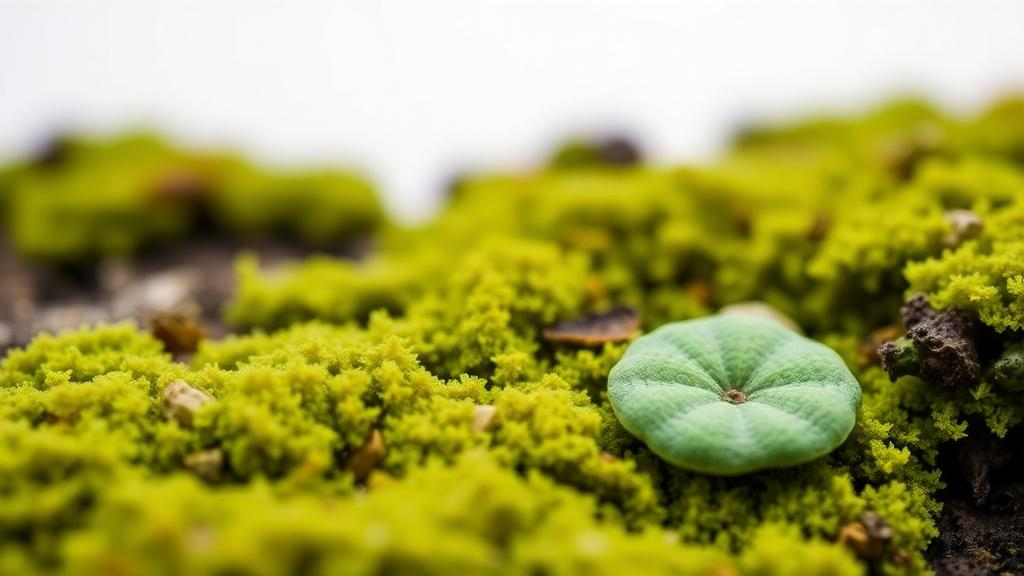
Italy’s botanical census just got a substantial update. The seventeenth instalment of the Notulae to the Italian flora series, published in Italian Botanist, documents dozens of new records, confirmations and rediscoveries spanning four often-overlooked kingdoms and groups: algae, bryophytes, fungi and lichens. The contribution compiles fieldwork from the Alps to Sicily, from mountain lakes at 2,600 metres to garden ponds at 4 metres, and reveals how much of Italy’s cryptogamic diversity still escapes formal documentation.
The algal records centre on the Characeae, the stoneworts, a family of macroscopic green algae whose calcified bodies resemble miniature aquatic plants. In Abruzzo, surveyors working in the Parco Nazionale del Gran Sasso e Monti della Laga and the Parco Nazionale d’Abruzzo Lazio e Molise found Chara contraria and Chara globularis on lake bottoms between 0.5 and 8 metres deep in Campotosto, Scanno, Barrea and Montagna Spaccata. Both species are new for the regional flora of Abruzzo. Chara contraria has been reported from only a few Italian administrative regions, probably because it is difficult to distinguish from the common Chara vulgaris. Genetic analyses by Schneider and colleagues showed that C. contraria belongs to a distinct lineage with a diplostichous and tylacanthous cortex, more closely related to the Chara hispida group than to the Chara vulgaris group. In the Campotosto reservoir it occasionally dominates the submerged vegetation, while in the natural lake of Scanno it is very rare and only associated with communities dominated by Chara vulgaris.
Chara globularis, the most frequently reported stonewort in Italy after Chara vulgaris, was recorded as the dominant species of submerged vegetation at depths of 3 to 6 metres in Campotosto and Scanno, and less commonly in the artificial basins of Barrea and Montagna Spaccata. A separate collection from Lago Pantano in Pignola, Potenza, at 0.7 metres depth, is new for the flora of Basilicata, where the Characeae occur only as small patches interspersed within Ceratophyllum demersum vegetation. The team also confirmed Chara gymnophylla for Abruzzo, a controversial taxon that some authors treat as merely a variety of Chara vulgaris and others as a good species. It can be distinguished by its ecorticated branchlets, or branchlets with only one to two corticated basal segments, plus completely ecorticate fertile segments. Notably, the specimen illustrating this taxon in the standard Italian flora was collected in 2008 from Lecce nei Marsi, in Abruzzo, even though the region was not previously listed for the species.
In Toscana, a shallow pond of about 850 square metres in a Quercus cerris coppice near Chiusdino yielded a consistent fertile population of Nitella tenuissima, new for the regional flora, together with an even larger population of Chara globularis. Both are indicator species of the Habitat Directive habitat 3140, hard oligo-mesotrophic waters with benthic vegetation of Chara species. The populations were found near the pond bank, reflecting a consistent ecological pattern: small species like Nitella tenuissima occupy the shallow margins of wetlands, while larger species such as Chara globularis extend into deeper water. In Italy, Nitella tenuissima had previously been recorded only in Lombardia, Veneto, Lazio and Sicilia.
The bryophyte records tell a story of rediscovery as much as novelty. Brachythecium albicans, a boreo-temperate moss with pale whitish-green, string-like shoots typical of sandy or gravelly acid soils, was confirmed for Basilicata at Piano Iannace on open soil at the border of a beech wood at 1,705 metres. The confirmation arrives more than 80 years after the last reports, which were published in 1913 and 1938, and after decades in which southern regions such as Campania, Calabria and Basilicata had exclusively old records predating 1968. Didymodon sinuosus, a moss of damp calcareous rocks along watercourses, is new for Trentino-Alto Adige, found along a five-metre section of a limestone stone irrigation gully in the Guerrieri-Gonzaga Park at Villa Lagarina, one of the best-preserved historical parks in Trentino, built together with the garden about two centuries ago. The species is common in central-southern Italy but quite rare in the northern regions.
Fissidens osmundoides, a circumpolar boreo-arctic montane moss of wet rocks and stream beds, was confirmed for Toscana in the rocky bed of a stream in a deciduous forest near Chiusdino; its presence in the region had been considered doubtful, based on a record published in 1942. Physcomitrium patens, a short-lived Eurosiberian pioneer that colonizes wet mud and sediment, is new for Toscana, found in the muddy bed of a dried-up pond with abundant capsules. The liverwort Riccia ciliifera was confirmed for Toscana in the Botanical Garden of Pisa, on damp clay along the paths separating the flowerbeds at just 4 metres above sea level. The species was first recorded for Toscana in 1901 by Attilio Tassi in the Botanical Garden of Siena, and can be distinguished from other members of Riccia subgenus Riccia by its wide thallus and violet-purple thallus margins, differing from the closely related Riccia gougetiana in thallus colour, lobe size, ventral scale cells and spore ornamentation.
Among the fungi, the most striking novelty is Biatoropsis hafellneri, a lichenicolous fungus newly recorded for Italy and for the Mediterranean flora. Found on thalli of Usnea cornuta growing on branches and trunks of Quercus ilex in a dense mature forest on Monte di Seneghe in Sardegna, this recently described species is confined to Usnea hosts, where it causes the formation of typical pale to medium orange galls containing one-septate basidia with laterally elongating cells. Cantharellus pallens, very similar to the better known Cantharellus cibarius but producing smaller and more strongly yellow pilei without pruina on the upper surface, is new to Calabria, detected in the Botanical Garden of the University of Calabria in a coppice stand dominated by Quercus pubescens. Two Coprinellus species, C. domesticus near the butt of a cut Italian poplar and C. silvaticus in oak litter, are also new to Calabria, as is Dacrymyces capitatus, a rarely observed jelly fungus whose gelatinous orange discoid structures on dead oak wood revealed septate, clampless, thick-walled hyphae and cylindrical three-to-four-septate spores measuring 12 to 15 by 4 to 6 micrometres under the light microscope. Inosperma quietiodor, an ectomycorrhizal fungus distinguished from its relative I. cookei mainly by a smell resembling Lactarius quietus in young specimens rather than honey-like, is new to Liguria, with spore dimensions fitting published European descriptions.
The lichenicolous and fungicolous records include Nigropuncta rugulosa, widely distributed in the Holarctic but previously known in Italy from a single collection in Trentino-Alto Adige, now documented on the thallus of Bellemerea cinereorufescens from alpine boulder fields and rock faces in Lombardia, Val d’Aosta and Piemonte at roughly 1,950 to 2,630 metres. Urocystis eranthidis, a smut fungus on the petioles of Eranthis hyemalis, is new to Calabria and extremely localized there; the species is included in the Berlin Red List as threatened with extinction due to the rarefaction of its host plant. Xanthoriicola physciae, a conspicuous fungus on the apothecia of the common lichen Xanthoria parietina, is new to Friuli-Venezia Giulia, Veneto and Piemonte, filling a curious gap: in northern Italy it had been reported only for Lombardia, and there is no historical record of this otherwise common species.
The lichen records carry particular conservation weight. Usnea cornuta, found on twigs of Erica arborea in Sardegna and on the bark of Quercus ilex at Monte di Seneghe, is restricted to humid-temperate, oceanic areas and is included in the Italian red list of epiphytic lichens as Endangered. Its Sardinian population grows in a mature Quercus ilex forest characterised by numerous Lobarion community species such as Lobaria pulmonaria, Ricasolia virens and Sticta limbata, an assemblage that signals long ecological continuity and clean air. Parmelia discordans, a foliose lichen of siliceous rocks known only from Europe, mainly coastal in Scandinavia and restricted to upland areas in central and southern Europe, is new to Italy on granite boulders in pastures near Fonni in Sardegna, differing from its close relative Parmelia omphalodes mainly in the content of protocetraric acid. Arthonia phlyctiformis, an epiphytic lichenized species seemingly not rare along the eastern coast of the Iberian Peninsula on acid-barked trees, is new to Italy from fallen branches in a public garden in Lecce, Puglia.
Other lichen novelties extend the known ranges of alpine and Mediterranean elements. Bellemerea alpina, a bipolar species common in the Alps from the treeline ecotone to the alpine belt, is new to Toscana from siliceous boulders in the northern Apennines at about 1,730 metres, the first record outside the Alps in Italy, since a historical record from Sicilia is regarded as doubtful. Circinaria nimisii, recently described from Mount Olympus in Greece as a vagrant lichen of steppe-like vegetation over calcareous substrata, is new to Italy from vertical faces of calcareous rocks below Corno Piccolo in the Gran Sasso Massif at 2,350 metres; specimens collected there in 1996 had been provisionally assigned to other taxa before matching the description of C. nimisii, with thalli very easily detachable but not truly vagrant. Peltigera lepidophora, diagnostic for its peltate isidia and slightly tomentose upper surface, easily overlooked because of its small size, is new to Liguria from calcareous schist outcrops in subalpine pasture at 1,850 metres. Porpidia tuberculosa, usually found as a sterile saxicolous crust on persistently moist siliceous rocks and therefore often overlooked, is new to Calabria and Sicilia and confirmed for Lombardia. Mycobilimbia sphaeroides is new to Campania on trunks of Alnus cordata along the river Calore in the Parco Nazionale del Cilento, where it colonizes large portions of alder bark together with fertile thalli of Lobaria pulmonaria and other Lobarion species. Naetrocymbe rhododendri, identifiable by its club-shaped bicellular spores with one cell larger than the other, is new to Lombardia from dead stems of dwarf shrubs in a high-altitude open limestone habitat at 1,980 metres. Lecanora horiza, a mainly Mediterranean member of the morphologically variable Lecanora subfusca group, is new to Piemonte from the bark of Acer in a university campus garden, much rarer in the northern than in the Mediterranean parts of the country.
Together, the records illustrate both the richness and the fragility of Italy’s cryptogamic flora. Several confirmations arrive after gaps of 80 to 150 years, reflecting the scarcity of targeted surveys rather than genuine rarity. The series, coordinated by regional editors for each group, accepts contributions of up to 1,000 characters per record, a format designed to accelerate the flow of floristic data into the formal record. As this seventeenth instalment shows, from endangered epiphytic lichens in Sardinian holm oak forests to stoneworts in Abruzzo reservoirs and smut fungi on rare woodland plants in Calabria, the map of Italian cryptogamic diversity is still being drawn, one verified specimen at a time.
Subject of Research: New floristic records of algae, bryophytes, fungi and lichens across Italian regions
Article Title: Notulae to the Italian flora of algae, bryophytes, fungi and lichens: 17
Article References: Ravera, S., Vizzini, A., Puglisi, M., Totti, C., Angiolini, C., Azzella, M. M., Bacilliere, G., Boccardo, F., Bonini, I., von Brackel, W., Brusa, G., Cavallaro, V., Cancellieri, L., Cannucci, S., Cantonati, M., De Giuseppe, A. B., Di Nuzzo, L., Dovana, F., Fanfarillo, E., … Zedda, L. (2024). Notulae to the Italian flora of algae, bryophytes, fungi and lichens: 17. Italian Botanist, 17, 23-41. https://doi.org/10.3897/italianbotanist.17.123283
Image Credits: AI Generated
DOI: 10.3897/italianbotanist.17.123283
Keywords: Italian flora, algae, bryophytes, fungi, lichens, Characeae, biodiversity, conservation, Italy, floristic records, Notulae, Italian
Cite Scienmag News
Roger Howard. (October 19, 2026). New algae, mosses, fungi and lichen records expand Italy’s botanical map. Scienmag. https://scienmag.com/new-algae-mosses-fungi-and-lichen-records-expand-italys-botanical-map/
Roger Howard. "New algae, mosses, fungi and lichen records expand Italy’s botanical map." Scienmag, 19 October 2026, https://scienmag.com/new-algae-mosses-fungi-and-lichen-records-expand-italys-botanical-map/. Accessed 19 October 2026.
Roger Howard. "New algae, mosses, fungi and lichen records expand Italy’s botanical map." Scienmag. October 19, 2026. https://scienmag.com/new-algae-mosses-fungi-and-lichen-records-expand-italys-botanical-map/


