


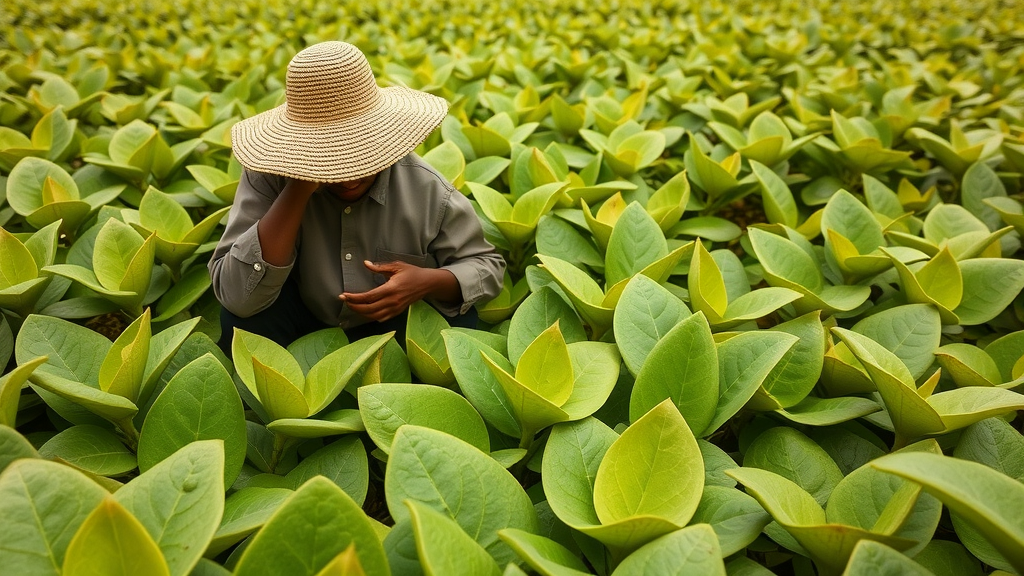
Tea is more than a beverage in China; it is a pillar of the rural economy. As the world’s largest tea producer, China depends on the crop to raise agricultural efficiency and lift farmers’ incomes, yet the plantations that supply the global market are under constant threat from disease. Frequent infections erode both yield and leaf quality, and the tools used to fight them have changed little in decades. Manual scouting is slow and error-prone, while conventional plant protection still leans heavily on blanket pesticide sprays that drive up costs and pollute soil and water. Now, a research team at Fujian Agriculture and Forestry University believes it has built the missing piece for the smart tea plantation: a deep learning model that can identify leaf diseases accurately in real time, even in the messy, unpredictable conditions of a working field.
The team, led by Shuhe Zheng and Wuxiong Weng, has published its work in the journal Engineering Agriculture under the title “GDE-YOLO: a robust and accurate method for real-time tea leaf disease detection in complex plantation environments.” Built on the lightweight YOLOv8n architecture, the new model achieves an overall detection accuracy of 91.7 percent, 3.1 percentage points above its baseline, while sustaining a processing speed of 80 frames per second. Those numbers matter because they represent a rare combination: precision and robustness delivered by a model small enough to run on hardware that can actually be carried into a tea field.
The difficulty of disease detection in plantations is easy to underestimate. In laboratory settings, photographs of diseased leaves are often well-lit, well-framed and unambiguous. In a real plantation, none of that holds. Disease targets are small, and early symptoms of different infections look strikingly similar. Backlighting, deep shadows, overlapping leaves and rainy weather all conspire to obscure the weak visual features that a detector relies on, causing general-purpose models to miss infections or flag healthy tissue as diseased. At the same time, there is an uncomfortable trade-off at the heart of agricultural AI: lightweight models lack the capacity for high accuracy, while high-accuracy models demand so much computation that they cannot run in real time on the edge devices — cameras, robots, drones — where they would actually be deployed. A third problem compounds the first two: many existing methods generalize poorly, showing a wide gap between laboratory performance and field performance, and therefore cannot provide reliable perception for intelligent agricultural machinery.
The Fujian researchers attacked these weaknesses with three targeted modifications to the YOLOv8n backbone. First, they introduced a global attention mechanism, known as GAM, into the neck network of the model. Attention mechanisms allow a neural network to weigh some regions of an image more heavily than others; by placing GAM in the neck, where features from different scales are fused, the model learned to amplify disease-related features and suppress the background noise produced by foliage, glare and shadow. Second, the team redesigned the C2f feature-extraction module by incorporating a diverse branch block, or DBB, a structure that enlarges the model’s multi-scale feature representation during training without adding to the computational cost at inference time. Third, they replaced the commonly used complete intersection over union (CIoU) loss function with the efficient intersection over union (EIoU) loss, which more precisely measures the discrepancy between predicted and true bounding boxes and, in doing so, improves both regression accuracy and convergence speed during training.
Each modification addresses a specific failure mode, but the sum proved greater than the parts. To evaluate the model honestly, the researchers constructed a field dataset covering multiple disease types captured across complex environmental conditions, rather than relying on curated laboratory images. Under those demanding scenarios, GDE-YOLO reached an overall accuracy of 91.7 percent, outperforming the baseline model by 3.1 percentage points. The gains were most dramatic where they were most needed: detection of tea white scab, one of the harder-to-spot infections in the dataset, improved by a remarkable 12.4 percentage points. Meanwhile, the model maintained a speed of 80 frames per second, comfortably clearing the threshold for real-time detection.
The real test, however, came outside the laboratory. The team deployed the model on an NVIDIA Jetson Orin Nano, an embedded computing platform small and power-efficient enough to be mounted on agricultural equipment. On that hardware, GDE-YOLO achieved a field inference speed of 18 frames per second — slower than on a desktop GPU, as expected, but fast enough for practical inspection work. More importantly, when conditions turned hostile, with strong light, occluding foliage or post-rain wetness degrading image quality, the model continued to output stable detection results with confidence scores greater than 0.8. That consistency marks what the researchers describe as the leap from a laboratory algorithm to a field-ready system, and it is precisely the quality that previous detectors lacked.
The implications extend well beyond tea. The study breaks through a stubborn technical limitation — accurate crop disease perception in complex natural scenarios — and offers an efficient solution for monitoring tea plants throughout their entire growth cycle. Because the model is lightweight, highly accurate and strongly generalizable, the authors argue it can be integrated into a broad ecosystem of smart farming equipment: plantation inspection robots that patrol row by row, unmanned aerial vehicles that survey whole hillsides, and precision sprayers that treat only the plants that need treatment. In each case, the detector serves as the perception layer, telling the machine where the disease is and, implicitly, where it is not.
That shift has practical and environmental consequences. When diagnosis moves from manual judgment to real-time online sensing, control strategies can move from large-scale blanket prevention to precise, site-specific pesticide application. Farmers spray only infected plants or hotspots rather than entire fields, cutting pesticide use, lowering agricultural non-point source pollution and improving both tea quality and production efficiency. For an industry under pressure to reduce its chemical footprint while maintaining output, the economics of such a change are significant. Reduced input costs and cleaner production are not merely technical conveniences; they shape the competitiveness of tea growers in markets increasingly sensitive to sustainability.
Perhaps the most lasting contribution of the work is its demonstration that lightweight deep learning models can be genuinely deployed on agricultural edge devices without sacrificing reliability. For years, the gap between what algorithms achieved in papers and what hardware achieved in fields has been the key bottleneck in the development of smart plantations. By showing a replicable technical path — a compact base architecture, attention-enhanced feature fusion, efficient loss design and embedded deployment — the Fujian team has provided a template that other researchers working on cash crops, smart plant protection and precision management can follow. As agriculture’s digital transformation accelerates, tools like GDE-YOLO suggest that the intelligence once confined to laboratory servers is now ready to walk the rows of the plantation itself, spotting disease at a glance where human eyes and older machines both fail.
Subject of Research: A deep learning model for real-time detection of tea leaf diseases in complex plantation environments
Article Title: 91.7% accuracy! Tea plantation diseases in complex environments can also be “seen through at a glance”
Article References: 91.7% accuracy! Tea plantation diseases in complex environments can also be “seen through at a glance”. (n.d.). Original publication
Image Credits: AI Generated
DOI: Not provided
Keywords: tea plantation, disease detection, deep learning, GDE-YOLO, YOLOv8n, precision agriculture, edge computing, smart farming, plant protection, attention mechanism, real-time detection, pesticide reduction
Cite Scienmag News
Alan Morgan. (September 22, 2026). New AI Model Spots Tea Leaf Diseases With 91.7% Accuracy in Tough Field Conditions. Scienmag. https://scienmag.com/new-ai-model-spots-tea-leaf-diseases-with-91-7-accuracy-in-tough-field-conditions/
Alan Morgan. "New AI Model Spots Tea Leaf Diseases With 91.7% Accuracy in Tough Field Conditions." Scienmag, 22 September 2026, https://scienmag.com/new-ai-model-spots-tea-leaf-diseases-with-91-7-accuracy-in-tough-field-conditions/. Accessed 4 October 2026.
Alan Morgan. "New AI Model Spots Tea Leaf Diseases With 91.7% Accuracy in Tough Field Conditions." Scienmag. September 22, 2026. https://scienmag.com/new-ai-model-spots-tea-leaf-diseases-with-91-7-accuracy-in-tough-field-conditions/


