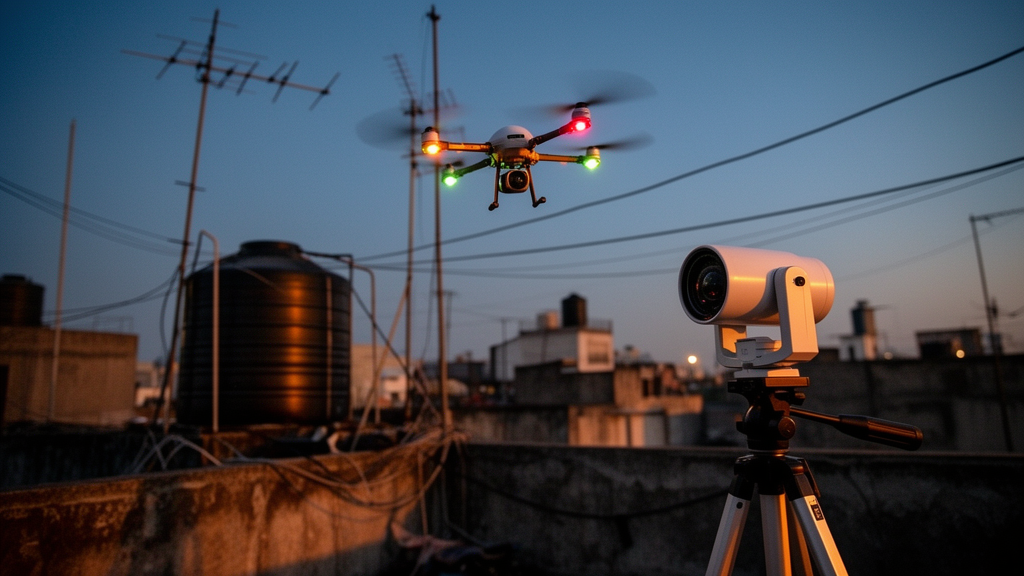
Illegally operated drones have become one of the most stubborn detection problems in low-altitude airspace. They are small, fast, and often indistinguishable from the cluttered world around them: clouds, tree branches, building edges, road textures, and even birds can overwhelm the few pixels a distant UAV occupies in a surveillance frame. A newly published study in Autonomous Intelligent Systems proposes a detector built specifically for this regime, and its reported numbers suggest that careful architectural design, rather than sheer model size, can go a long way toward stabilizing small-target detection.
The model, called UAV-SGDFNet, was developed by Yang Yu, Kuixian Cai, Rui Fan, Brian C. W. Kei, and Bohuan Xue, and published as an open-access original article on 26 August 2026. It is a one-stage visual detector designed to localize small, illegally operated UAVs in complex low-altitude surveillance scenarios. Rather than deepening the network or adding extra scale branches, the authors concentrate on two stages of the pipeline: how features are represented during extraction, and how features from different levels of the network are fused together.
In the feature extraction stage, the model incorporates a spatial and channel synergistic attention mechanism, SCSA, which was first introduced by Si and colleagues. The module jointly reweights feature responses along spatial locations and channel semantics, so that the network focuses more on target-relevant regions while preserving global semantic awareness. In the published implementation, SCSA replaces the original C2PSA module in the backbone. According to the paper’s ablation results, adding SCSA alone raised mAP@0.5 to 0.73 and mAP@0.5:0.95 to 0.353 on the authors’ dataset, indicating stronger discriminative features for the target, although the authors note that handling of complex backgrounds and missed detections of small targets still had room to improve at that stage.
The second and more novel component is the Structured Guided Dual-level Fusion module, SGDF. Conventional multi-scale fusion can dilute information: shallow features carry rich spatial detail but respond strongly to background textures, while high-level features carry semantics but weaken small-target geometry. SGDF restructures cross-level interaction into two parallel flows. A guided path generates an attention map from the joint response of low- and high-level features, enhancing responses that are consistent across both levels and suppressing background-dominated responses such as tree branches or building edges, which lack stable semantic support. A fidelity path, by contrast, preserves features that have not undergone strong re-calibration, retaining weak but potentially useful small-target cues that aggressive attention might over-suppress.
A learnable gating parameter balances the two paths. The gate is initialized to favor the fidelity path, with a default setting corresponding to a weight of roughly 0.88, which the authors say reduces the risk of over-suppressing weak small-target cues early in training. A sensitivity analysis over different initial values showed that the balance matters: equal initialization of the two paths produced relatively high recall but lower mAP@0.5, while a strong bias toward fidelity improved mAP@0.5:0.95 but reduced precision. The best mAP@0.5 was obtained with the default setting, which the paper adopts as standard. Component-level ablations reinforced the design logic: removing the fidelity path dropped recall from 0.692 to 0.617 and mAP@0.5 from 0.748 to 0.721, while removing the guided path caused mAP@0.5 to fall to 0.683, and a fixed gate also degraded performance.
The evaluation dataset was self-collected from fixed surveillance viewpoints using a Hikvision iDS-2DY5432IXR-A/BO camera, with a DJI Matrice 4D flying under real low-altitude conditions. It contains 559 images at 1080 by 1920 pixels, split 7:2:1 into training, validation, and test sets of 391, 112, and 56 images. Under a 640 by 640 input scale, small targets account for 86.58 percent of all instances, and no large targets are present, making the dataset a deliberately demanding test of small-object detection. All models in the comparisons were trained for 300 epochs with AdamW, a cosine annealing schedule, and identical augmentation and input settings on an NVIDIA RTX 5080 GPU.
With both modules combined, UAV-SGDFNet reached an mAP@0.5 of 0.748 and a recall of 0.692, the highest among all methods compared in the study. Against YOLOv11n, mAP@0.5 improved from 0.723 to 0.748 and recall from 0.632 to 0.692. Against the transformer-based RT-DETR-R18, mAP@0.5 rose from 0.715 to 0.748 while computational load fell from 36.80 to 8.55 GFLOPs. The model also outperformed UAV-oriented detectors: compared with UAV-DETR, recall increased from 0.682 to 0.692 and mAP@0.5 from 0.740 to 0.748, while parameters dropped from 11.84 million to 2.71 million and inference speed rose from 35.82 to 111.54 FPS. The added modules are not free, however: relative to the baseline, GFLOPs increased by 2.11 and FPS fell from 127.55 to 111.54, a cost the authors describe as manageable.
The attention comparison experiments add a further layer of evidence. When SCSA was benchmarked against mainstream attention mechanisms including ESC, CBAM, and EMA, its precision of 82.7 percent was slightly lower than ESC’s 89.9 percent and CBAM’s 85 percent, but its recall of 0.67 clearly exceeded ESC’s 0.582 and CBAM’s 0.637, and its mAP@0.5 of 0.73 surpassed EMA’s 0.687 and CBAM’s 0.691. Feature response heatmaps showed SCSA producing more concentrated, continuous high-response regions at UAV locations while suppressing surrounding background activations. The module ran at 128.39 FPS with a computational cost of 6.4 GFLOPs, comparable to EMA and CBAM and well ahead of ESC’s 87.52 FPS.
Generalization and deployment were tested as well. On an external Vehicle-Drone dataset, the model achieved an mAP@0.5 of 0.778 and mAP@0.5:0.95 of 0.535, slightly above the YOLO11 baseline’s 0.772 and 0.533, with recall improving from 0.727 to 0.736, at the cost of a modest increase from 2.59 million to 2.71 million parameters and from 6.4 to 8.6 GFLOPs. On an NVIDIA Jetson Xavier NX Developer Kit running TensorRT, UAV-SGDFNet sustained 32.68 FPS with 30.6 milliseconds of end-to-end latency at 640 by 640 input and batch size 1, clearing the basic 30 FPS real-time threshold. Transformer-style detectors fared far worse on the same edge hardware: RT-DETR-R18 and UAV-DETR managed only 12.26 and 10.17 FPS respectively.
The authors are careful about scope. The network itself contains no recurrent units or temporal feature aggregation; in video-stream deployment, temporal consistency would be handled through lightweight output-level association and confidence smoothing, with alarms triggered only when a target appears in consecutive frames. Within those limits, the study makes a focused case: for the specific and increasingly urgent problem of spotting a few-pixel drone against a busy sky, structured attention and disciplined feature fusion may matter more than raw model capacity.
Subject of Research: A deep learning model for detecting small unauthorized drones in complex low-altitude surveillance scenes
Article Title: UAV-SGDFNet: structured guided dual-level feature fusion for low-altitude anti-UAV detection
Article References: Yu, Y., Cai, K., Fan, R., Kei, B. C. W., & Xue, B. (2026). UAV-SGDFNet: structured guided dual-level feature fusion for low-altitude anti-UAV detection. Autonomous Intelligent Systems, 6(1), Article 17. https://doi.org/10.1007/s43684-026-00141-4
Image Credits: AI Generated
DOI: 10.1007/s43684-026-00141-4
Keywords: drone detection, UAV, computer vision, deep learning, attention mechanism, feature fusion, surveillance, edge computing, object detection, real-time inference, counter-UAV, small target detection
Cite Scienmag News
Blake Davidson. (October 28, 2026). New AI detector spots small rogue drones in cluttered low-altitude skies. Scienmag. https://scienmag.com/new-ai-detector-spots-small-rogue-drones-in-cluttered-low-altitude-skies/
Blake Davidson. "New AI detector spots small rogue drones in cluttered low-altitude skies." Scienmag, 28 October 2026, https://scienmag.com/new-ai-detector-spots-small-rogue-drones-in-cluttered-low-altitude-skies/. Accessed 29 October 2026.
Blake Davidson. "New AI detector spots small rogue drones in cluttered low-altitude skies." Scienmag. October 28, 2026. https://scienmag.com/new-ai-detector-spots-small-rogue-drones-in-cluttered-low-altitude-skies/