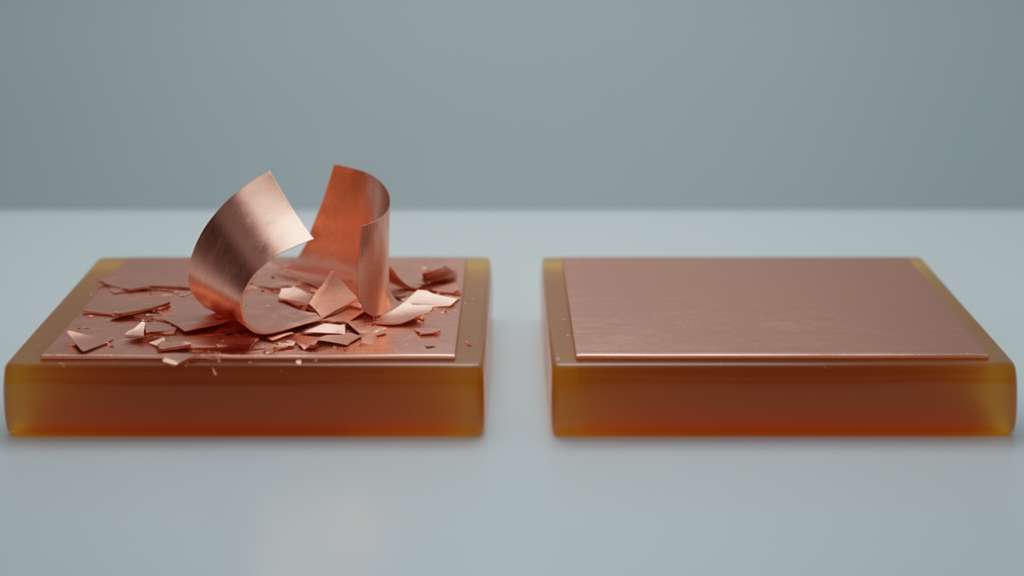
Copper films stick to polyimide with wildly different strength even when the plastic surface is engineered to have essentially the same energy, according to a new study from researchers at the Southwestern Institute of Physics and the University of Electronic Science and Technology of China. Writing in Frontiers in Materials, the team reports that carbon-ion, nitrogen-ion, and combined carbon/nitrogen ion implantation of polyimide produced surface free energies within a narrow band of 46.43 to 47.22 millijoules per square meter, yet the peel strength of the copper films deposited on top ranged from 0.14 to 1.63 newtons per millimeter, a more than tenfold difference.
The finding matters because reliable metallization of polymer substrates underpins flexible electronics, advanced packaging, and high-frequency systems, and insufficient copper/polyimide interfacial adhesion remains a central challenge for high-reliability flexible devices. In most previous surface-treatment studies, plasma processing raised roughness, surface energy, and chemical functionality all at once, making it impossible to tell which factor actually controlled adhesion. By deliberately tuning the ion energy and fluence of each implantation condition until the resulting surface energies matched, the researchers built a controlled platform in which the conventional wettability descriptor was essentially neutralized.
The experimental design compared four conditions: untreated commercial 25-micrometer polyimide film, polyimide implanted with carbon ions at 20 kiloelectronvolts, polyimide implanted with nitrogen ions at 25 kiloelectronvolts, and polyimide co-implanted with carbon and nitrogen at 15 and 8 kiloelectronvolts respectively, each at fluences of 5 × 10^15 ions per square centimeter. Because the implantation parameters were deliberately different among the three modified samples, the authors caution that the comparison should not be read as a strictly single-variable ion-species study; the focus is on the final reconstructed surface states rather than on the elemental identity of the incident ions alone.
After implantation, copper films 2 micrometers thick were deposited by direct-current magnetron sputtering under identical conditions for all samples. Peel tests following the IPC-TM-650 2.4.9 E standard, performed on five specimens per condition after electroplating the copper to 18 micrometers to prevent tearing, gave mean peel strengths of 0.14 newtons per millimeter for carbon implantation, 0.20 for nitrogen implantation, and 1.63 for carbon/nitrogen co-implantation. Untreated polyimide managed only about 0.06 newtons per millimeter. The dual-ion condition thus delivered roughly 11.6 times the adhesion of the carbon-treated surface and 8.2 times that of the nitrogen-treated surface.
Electrical performance told a different story. Four-point-probe sheet-resistance measurements, taken at five positions per sample, yielded 20 milliohms per square for the carbon-treated copper film, 14 for the nitrogen-treated film, and 17 for the carbon/nitrogen-treated film, with untreated polyimide at 15. The nitrogen-implanted surface, which produced only moderate adhesion, gave the most electrically continuous copper film, while the strongest-bonding dual-ion surface did not. The authors conclude that interfacial adhesion and copper-film electrical continuity are associated with different features of the implantation-induced reconstructed surface state, and should be treated as partially decoupled optimization targets.
Morphology helped explain part, but not all, of the pattern. Scanning electron microscopy showed that all four surfaces remained continuous after implantation, without large cracks, severe etching pits, or other signs of catastrophic irradiation damage, indicating that the principal morphological differences occur at the nanoscale. Atomic force microscopy over 10-by-10-micrometer scan areas revealed distinct nanoscale roughening: the root-mean-square roughness rose from 1.90 nanometers on untreated polyimide to 4.61 nanometers after carbon implantation, 2.89 after nitrogen implantation, and 5.34 after carbon/nitrogen co-implantation. Yet roughness alone could not account for the adhesion trend, since the carbon-treated surface was nearly as rough as the dual-ion surface but bonded far more weakly. The authors describe nanoscale roughness as a contributing but non-sufficient condition for strong adhesion.
X-ray photoelectron spectroscopy exposed sharply different chemical outcomes. Carbon implantation left elemental composition essentially unchanged from untreated polyimide. Nitrogen implantation, despite injecting nitrogen, raised the surface carbon concentration from 89.34 to 94.09 atomic percent while oxygen fell from 5.01 to 1.59 atomic percent, and the fitted imide-carbonyl fraction of the carbon 1s spectrum dropped by roughly 43 percent, indicating substantial degradation of imide structures, decarbonylation, and reconstruction toward a carbon-enriched near-surface environment. The dual-ion surface, by contrast, retained elemental concentrations close to untreated polyimide, including 5.52 atomic percent oxygen and a comparatively carbonyl-rich oxygen 1s distribution, demonstrating that the dual-ion response is not a simple additive superposition of the two single-ion treatments.
Complementary spectroscopies reinforced this picture. Attenuated-total-reflection Fourier-transform infrared spectra retained the principal aromatic polyimide fingerprint for all samples, with the characteristic imide carbonyl bands near 1774 and 1710 centimeters to the minus one still identifiable, but nitrogen implantation caused the strongest attenuation of these molecular bands while carbon implantation produced the smallest change. Raman spectra required careful interpretation because pristine polyimide itself shows strong vibrations overlapping the conventional graphite-like D- and G-band region, so the authors compared composite envelopes rather than applying a universal defect-ratio criterion. Carbon implantation produced the strongest Raman-active narrowing and shifting, which the team interpreted as local aromatic rearrangement rather than graphitization, and notably the Raman trend did not follow the adhesion trend either.
The strongest chemical modification therefore did not produce the strongest interface. The nitrogen-treated surface underwent the largest overall transformation yet reached only 0.20 newtons per millimeter, while the lightly modified carbon-treated surface bonded even more weakly. The authors propose that excessive decarbonylation and heteroatom depletion may reduce the integrity of the near-surface polymer layer, though they stress that their spectroscopy and microscopy were performed on the polyimide surfaces before copper deposition and therefore do not directly resolve the buried interface. Possible copper-oxygen or copper-nitrogen interfacial interactions, and the nucleation, island-coalescence, and grain-connectivity processes that may govern sheet resistance, remain plausible interpretations rather than verified mechanisms, and would require depth-resolved XPS, cross-sectional TEM, or other interface-sensitive techniques to confirm.
What the study does establish, under matched wettability, is that no single surface descriptor predicts copper/polyimide adhesion. The highest-adhesion dual-ion condition combined the greatest nanoscale roughness with retained oxygen- and nitrogen-containing chemical environments and comparatively preserved polymer-network integrity, a balance the authors call a cooperative reconstructed state. The key implication for flexible electronics is that maximizing surface free energy, roughness, or the extent of chemical modification individually is not the route to strong metal-polymer bonding; instead, adhesion and electrical performance may be tailored through deliberate control of the implantation-induced reconstructed near-surface state, with future work needed to optimize implantation parameters and directly characterize the buried interface.
Subject of Research: Ion implantation of polyimide and its effect on copper film adhesion and electrical performance
Article Title: Ion-implantation-induced polyimide reconstruction and Cu interfacial adhesion
Article References: Chen, M., Zhang, Y., Liu, X., Yao, K., Geng, X., Ou, J., Tang, D., Jin, F., & Zhou, J. (2026). Ion-implantation-induced polyimide reconstruction and Cu interfacial adhesion. Frontiers in Materials, 13, Article 1972906. https://doi.org/10.3389/fmats.2026.1972906
Image Credits: AI Generated
DOI: 10.3389/fmats.2026.1972906
Keywords: polyimide, ion implantation, copper metallization, interfacial adhesion, surface free energy, surface reconstruction, flexible electronics, peel strength, sheet resistance, XPS, AFM, Raman spectroscopy
Cite Scienmag News
Denise Maddox. (October 29, 2026). Matched Surface Energies, Wildly Different Copper Adhesion on Implanted Polyimide. Scienmag. https://scienmag.com/matched-surface-energies-wildly-different-copper-adhesion-on-implanted-polyimide/
Denise Maddox. "Matched Surface Energies, Wildly Different Copper Adhesion on Implanted Polyimide." Scienmag, 29 October 2026, https://scienmag.com/matched-surface-energies-wildly-different-copper-adhesion-on-implanted-polyimide/. Accessed 29 October 2026.
Denise Maddox. "Matched Surface Energies, Wildly Different Copper Adhesion on Implanted Polyimide." Scienmag. October 29, 2026. https://scienmag.com/matched-surface-energies-wildly-different-copper-adhesion-on-implanted-polyimide/