


Osaka, Japan – From LEDs to batteries, our lives are full of electronics, and there is a constant push to make them more efficient and reliable. But as components become increasingly sophisticated, getting reliable temperature measurements of specific elements inside an object can be a challenge.

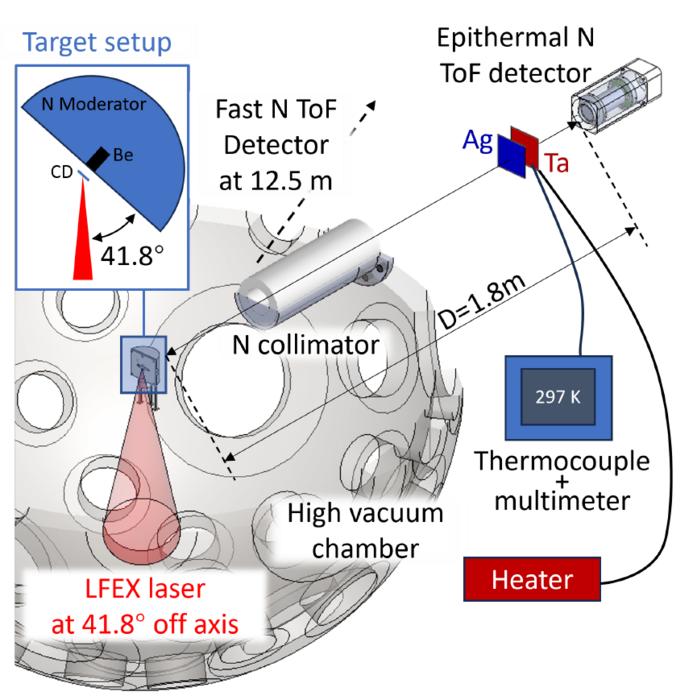
Credit: 2024 Yogo et al., Single-Shot Laser-Driven Neutron Resonance Spectroscopy for Temperature Profiling. Nature Communications (10.1038/s41467-024-49142-y)
Osaka, Japan – From LEDs to batteries, our lives are full of electronics, and there is a constant push to make them more efficient and reliable. But as components become increasingly sophisticated, getting reliable temperature measurements of specific elements inside an object can be a challenge.
This is problematic because measuring a device’s temperature is vital for monitoring its performance or designing the materials from which it’s manufactured. Now, in a new study led by Osaka University, neutrons have been used to measure temperatures quickly and accurately, which could eventually lead to improved performance for all kinds of electronics.
There have been a few ways to estimate the temperature inside an electronic device, but none have been able to give a fast, direct measurement. This new method uses a technique called ‘neutron resonance absorption’ (NRA): by examining neutrons being absorbed by atomic nuclei at certain energy levels, the properties of the material can be deduced.
The neutrons in this study were generated using high-intensity laser beams. The neutrons are then decelerated to a very low energy level before being passed through a sample. The technique was tested using plates of tantalum and silver, successfully returning details about the materials and temperatures with exceptional speed.
The researchers could determine the temperature of the samples because the temporal signal of the NRA was altered in a predictable manner when the sample material’s temperature was changed.
“This technology makes it possible to instantaneously and accurately measure temperature,” explains Zechen Lan, lead author. “As our method is non-destructive, it can be used to monitor devices like batteries and semiconductor devices.”
As the NRA measurement is performed with a single pulse of neutrons, the newly developed technique can acquire temperature data in a window of 100 nanoseconds, i.e., one ten-millionth of a second. This near-instant result means changes within a material can be measured in close to real time, allowing detailed analysis.
“Using lasers to generate and accelerate ions and neutrons is nothing new, but the techniques we’ve developed in this study represent an exciting advance,” says senior author Akifumi Yogo. “We expect that the high temporal resolution will allow electronics to be examined in greater detail, help us to understand normal operating conditions, and pinpoint abnormalities.”
As an additional accomplishment, the measurement device developed by the research team is about a tenth of the size of other similar equipment, meaning that it will be easy for laboratories elsewhere to install their own versions.
Being able to quickly and accurately measure the operating temperatures of devices, and the materials from which they are made, can advance our understanding of how they function and can be further improved in the future.
###
The article, “Single-Shot Laser-Driven Neutron Resonance Spectroscopy for Temperature Profiling” was published in Nature Communications at DOI:
About Osaka University
Osaka University was founded in 1931 as one of the seven imperial universities of Japan and is now one of Japan’s leading comprehensive universities with a broad disciplinary spectrum. This strength is coupled with a singular drive for innovation that extends throughout the scientific process, from fundamental research to the creation of applied technology with positive economic impacts. Its commitment to innovation has been recognized in Japan and around the world. Now, Osaka University is leveraging its role as a Designated National University Corporation selected by the Ministry of Education, Culture, Sports, Science and Technology to contribute to innovation for human welfare, sustainable development of society, and social transformation.
Website:
Journal
Nature Communications
Method of Research
Experimental study
Subject of Research
Not applicable
Article Title
Single-Shot Laser-Driven Neutron Resonance Spectroscopy for Temperature Profiling
Article Publication Date
12-Jul-2024
Cite Scienmag News
Reid Dalton. (July 12, 2024). Neutrons give a hot new way to measure the temperature of electronic components. Scienmag. https://scienmag.com/neutrons-give-a-hot-new-way-to-measure-the-temperature-of-electronic-components/
Reid Dalton. "Neutrons give a hot new way to measure the temperature of electronic components." Scienmag, 12 July 2024, https://scienmag.com/neutrons-give-a-hot-new-way-to-measure-the-temperature-of-electronic-components/. Accessed 3 September 2026.
Reid Dalton. "Neutrons give a hot new way to measure the temperature of electronic components." Scienmag. July 12, 2024. https://scienmag.com/neutrons-give-a-hot-new-way-to-measure-the-temperature-of-electronic-components/

