


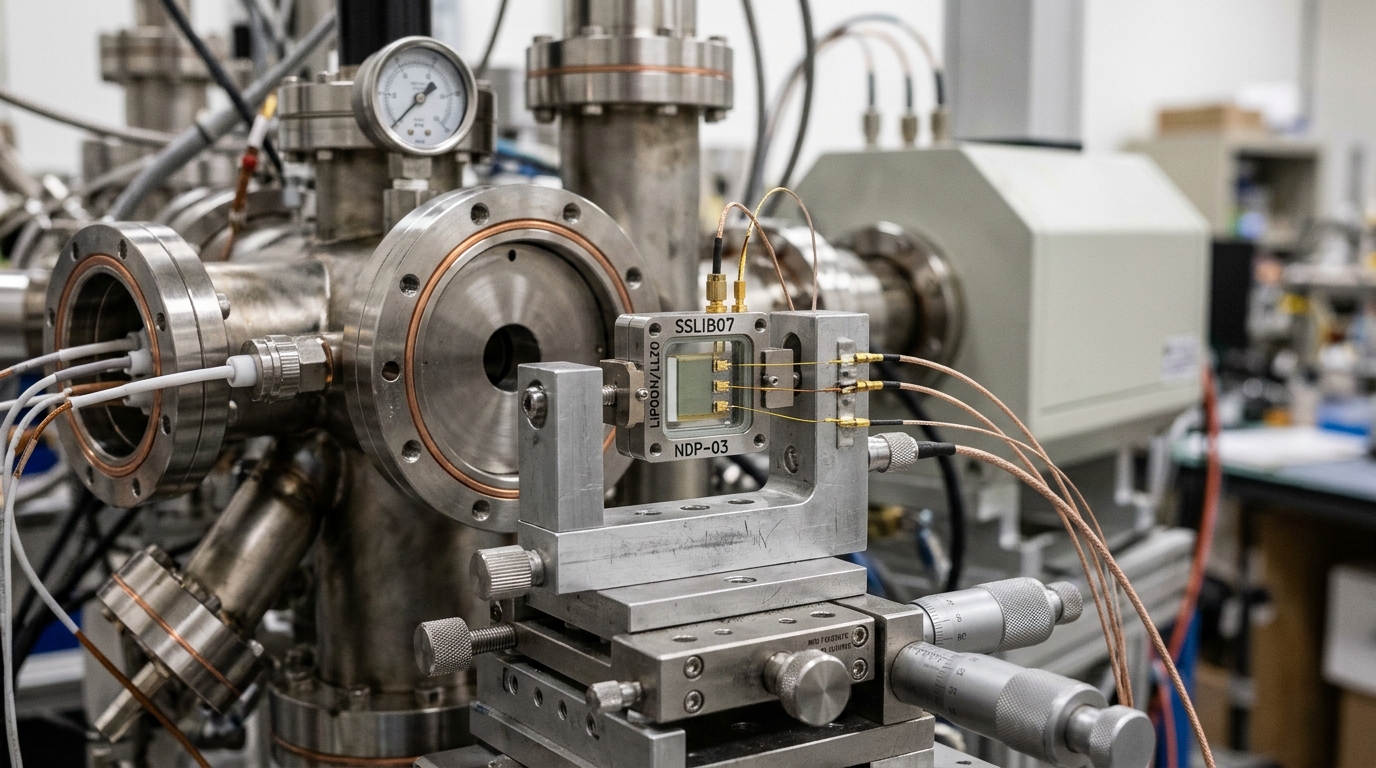
Neutron Depth Profiling (NDP) has emerged as a critical diagnostic tool for resolving the microscopic mechanisms governing lithium-ion battery performance. By leveraging the high neutron capture cross-section of the lithium-6 isotope, NDP provides quantitative, depth-resolved data that traditional electrochemical methods cannot supply, offering a direct link between internal ionic behavior and battery design.
The fundamental limitation of conventional techniques like cyclic voltammetry and electrochemical impedance spectroscopy is their provision of volume-averaged, macroscopic information. These methods do not directly resolve the real-time spatial distribution of lithium ions within electrode materials or their migration dynamics. Under specific conditions, such as low temperatures or high-rate charging, lithium ions may fail to intercalate into the graphite anode in time, instead plating as metallic lithium. This leads to the formation of dendrites, which consume active lithium and can puncture the separator, causing internal short circuits and thermal runaway. NDP addresses this by allowing researchers to visualize the underlying lithium dynamics inside the battery without destroying the sample.
The physical basis of NDP relies on nuclear reactions between thermal neutrons and specific isotopes. For lithium-ion batteries, the core reaction involves the capture of thermal neutrons by lithium-6, a process with a cross-section of 940 barns. This reaction emits tritium and alpha particles in opposite directions, carrying a total kinetic energy of approximately 4780 keV. As these charged particles traverse the material, they lose energy through electronic interactions. This energy loss encodes the depth of the originating reaction site into the measured residual energy, allowing for the reconstruction of the lithium concentration profile from the surface to the maximum probing depth.
NDP possesses a unique isotopic specificity that distinguishes it from other characterization methods. It is sensitive only to lithium-6, which has a natural abundance of approximately 7.5%, while remaining transparent to lithium-7. This characteristic enables isotope tracing, where researchers can use lithium-6-rich electrolytes and lithium-6-depleted cathodes to determine the source of lithium during cycling. Such isotopic resolution is inaccessible to techniques relying on electronic interactions, such as Energy Dispersive Spectroscopy, and allows for the precise quantification of lithium migration paths and final distributions from different sources.
The resolution of NDP is a dynamic function of probing depth, particle species, and sample matrix. Near the surface, the depth resolution is on the order of tens of nanometers, approximately 50 nm. This resolution degrades to 100–200 nm at a depth of 1 micrometer and reaches the micrometer scale at the maximum probing depth. For alpha particles, the effective detection depth is about 5 micrometers, while for tritium nuclei, it can extend to 30 micrometers, albeit with reduced resolution. Lateral resolution is determined by the neutron beam spot and detector pixel size, typically around 130 micrometers for position-sensitive detectors. These parameters set the boundaries of what NDP can reliably resolve, particularly for interface layers thinner than 100 nm, where characteristic signals may be difficult to distinguish.
Global neutron facilities, including NIST in the United States, FRM-II in Germany, and CARR in China, have advanced NDP capabilities through sophisticated spectrometers. The N4DP instrument in Germany, for instance, utilizes a double-sided silicon strip detector to provide simultaneous particle-energy and impact-position information, supporting two- and three-dimensional imaging. These instrumental advances have enabled the tracking of lithium migration during battery cycling in real time. Data analysis has also evolved from traditional linear inversion to intelligent algorithm-driven methods, such as the particle swarm optimization maximum likelihood expectation maximization hybrid algorithm, which improves the accuracy and reliability of depth profile reconstruction.
Applications of NDP in battery research have revealed critical insights into electrode kinetics and failure modes. In alloy anodes such as tin and aluminum, NDP has visualized the two-stage lithiation mechanism and the self-discharge behavior that occurs under open-circuit potential. In silicon-graphite composites, the technique has shown that even at 20 wt% silicon, the electrode bulk maintains a uniform lithium distribution, challenging previous views that high-silicon electrodes are limited by lithium diffusion kinetics. These findings highlight the ability of NDP to separate reversible lithiation from side reactions, providing a quantitative basis for understanding capacity decay.
The study of lithium dendrites has been significantly advanced by NDP, which has revealed the statistically non-uniform nature of dendrite nucleation in solid-state electrolytes. NDP maps the resulting lithium distribution as a statistical signature of nucleation, showing that the process is governed by local defects, electronic conductivity, and current-density focusing. In garnet electrolytes, NDP has identified a “reversible short circuit” phenomenon where a lithium-rich phase accumulates at the interface, causing a short circuit that can be reversed when the current is reduced. This discovery has shifted the paradigm from passive mitigation of short circuits to the active design of controllable lithium dynamics at the interface.
Despite its strengths, NDP faces practical constraints that limit its application to practical battery formats. The technique is most reliable in model and thin-film systems, where neutron scattering is minimized and the lithium signal remains within the probe depth. Extending NDP to thick, high-loading electrodes or commercial-format cells introduces challenges related to porous electrode heterogeneity and the need for low-atomic-number windows that preserve electrochemical function. The small beam footprint relative to a full-size cell also raises questions of statistical representativeness, requiring careful interpretation of results from practical architectures.
Looking forward, the integration of NDP with multimodal characterization and artificial intelligence offers a pathway toward intelligent battery design. A proposed closed-loop framework combines NDP with electrochemical calorimetry and acoustic transmission techniques, using physics-informed machine learning to interpret multi-source datasets. This approach aims to transform battery development from trial-and-error optimization to rational design, where quantitative lithium profiles serve as inputs for predictive models. While most integrated workflows remain at the proof-of-concept stage, the development of standardized benchmark datasets and improved operando cell architectures will be essential for realizing the full potential of NDP in next-generation battery systems.
Quantitative kinetic investigations illustrate how neutron depth profiling resolves specific transport parameters in alloy systems that bulk measurements obscure. In tin anodes, time-lapse monitoring revealed that during initial lithiation, lithium concentrates heavily within the first two micrometers of the surface, reaching 1.9×10²² atoms per cubic centimeter before diffusing deeper into the bulk. Modeling the relationship between passed charge and detected atoms showed that parasitic side reactions consumed roughly 50 percent of the charge during the initial 230 minutes of charging, while the apparent Fickian diffusion coefficient declined from 1.5×10⁻⁷ to 0.7×10⁻⁷ square centimeters per second. At the dendrite front, experimental comparisons revealed that dendrite initiation occurred 37 to 52 percent earlier than predicted by classical Sand’s time theory. This divergence stems from unmodeled stress-coupled transport, current constriction at interfacial hotspots, and non-uniform ion flux. Elevating temperatures to 60 degrees Celsius increased lithium transport by approximately 3.7 times and dendrite penetration depth by 42 percent, motivating interface engineering strategies like adding lithium nitrate or constructing lithium nitride buffer layers to stabilize cycling. While titration gas chromatography quantified bulk inactive lithium inventories reaching up to 78.3 percent, depth profiling uniquely mapped the spatial distribution of this dead lithium.
Complementary mechanistic studies in ceramic electrolytes clarify the quantitative thresholds of interfacial failure and the percolation nature of short circuits. In lithium-garnet cells subjected to current densities exceeding 0.2 milliamperes per square centimeter, the detected lithium signal deviated from charge-integral predictions by up to 37 percent, yet reducing the current to 0.1 milliamperes per square centimeter restored 82 percent of the short-circuit-induced lithium. Before electrical failure occurs, depth profiling detects non-zero particle counts that serve as an early warning signal for interfacial short-circuit hazards. This dynamic behavior corresponds to an electronic percolation process where isolated lithium precipitates accumulate along grain boundaries until exceeding the threshold required to form a conductive network, which subsequently dissolves upon current reduction. Defining the physical boundaries of depth profiling, comparative evaluations with neutron reflectometry on buried lithium-electrolyte interfaces demonstrate that depth profiling requires a lithium-rich layer thickness of 50 to 100 nanometers to produce identifiable signals, whereas reflectometry captures sub-30-nanometer interfacial gradients, establishing a clear division of analytical scale.
Technological implementations and analytical refinements further illustrate the practical framework of neutron profiling. The method operates effectively under inert atmospheres of argon or helium at one atmosphere, allowing liquid electrolyte batteries to be examined while maintaining operational radiation exposures of only several to tens of rad, far below the 2.7-megarad damage threshold that causes electrolyte discoloration. Demonstrating multimodal synergy, combining neutron depth profiling with Rutherford backscattering spectroscopy on hybrid cathodes directly aligned near-surface lithium enrichment with the depth distributions of cobalt, carbon, and oxygen. However, analytical precision remains bounded by dynamic physical properties: composition changes during cycling alter material stopping powers, introducing potential calibration errors of 15 to 30 percent. To resolve low-energy background interference in solid electrolytes, artificial neural networks trained with injected white noise improve pulse-shape discrimination, increasing the receiver operating characteristic curve area by 77 percent over conventional rise-time methods.
Subject of Research: Neutron Depth Profiling for lithium-ion battery characterization
Article Title: Neutron Depth Profiling: The Core Link Connecting the Microscopic Mechanisms of Lithium‐Ion Batteries With Intelligent Design
Article References: Zhang, Y., Yue, C., Liu, S., Chen, M., Shi, X., Tan, R., Hao, H., Yang, J., & Liu, X. (2026). Neutron Depth Profiling: The Core Link Connecting the Microscopic Mechanisms of Lithium‐Ion Batteries With Intelligent Design. Advanced Science, Article e78467. https://doi.org/10.1002/advs.78467
Image Credits: AI Generated
DOI: 10.1002/advs.78467
Keywords: Neutron Depth Profiling, Lithium-ion batteries, Solid-state batteries, Lithium dendrites, Isotope tracing, In situ characterization, Battery safety, Machine learning, Electrochemistry, Advanced Science, Neutron, Depth
Cite Scienmag News
Katie Riggs. (November 8, 2026). Neutron Depth Profiling Maps Lithium Dynamics in Batteries. Scienmag. https://scienmag.com/neutron-depth-profiling-maps-lithium-dynamics-in-batteries/
Katie Riggs. "Neutron Depth Profiling Maps Lithium Dynamics in Batteries." Scienmag, 8 November 2026, https://scienmag.com/neutron-depth-profiling-maps-lithium-dynamics-in-batteries/. Accessed 10 November 2026.
Katie Riggs. "Neutron Depth Profiling Maps Lithium Dynamics in Batteries." Scienmag. November 8, 2026. https://scienmag.com/neutron-depth-profiling-maps-lithium-dynamics-in-batteries/




