


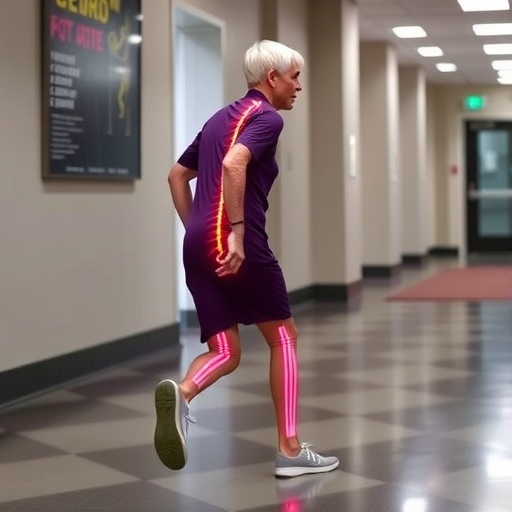
Gait impairments have long stood as some of the most disabling features associated with a broad spectrum of neurological disorders. Despite decades of research and clinical interventions, abnormalities such as freezing of gait, muscle weakness—manifesting as paresis or paralysis—and balance deficits remain particularly recalcitrant to conventional therapeutic strategies. These dysfunctions not only impede basic mobility but also severely curtail individuals’ autonomy and overall quality of life. The impact of these gait disturbances transcends mere physical limitation, often leading to increased falls, hospitalizations, and profound psychosocial consequences.
Historically, deep brain stimulation (DBS) has emerged as a breakthrough modality for managing several motor symptoms related to disorders like Parkinson’s disease. Highly efficacious in addressing tremors and rigidity, DBS has nonetheless yielded uneven results when it comes to ameliorating the more complex landscape of gait and postural instability problems. This inconsistency underscores a fundamental gap in therapeutic strategies that has driven researchers to explore more nuanced and adaptive neuromodulation techniques. The underlying neural control of locomotion is multifaceted, engaging widespread distributed circuits dynamically orchestrated across spatial and temporal scales, a complexity that previous interventions have failed to fully harness.
Responding to these challenges, the field is witnessing a paradigm shift toward integrated, network-centric neuromodulation methodologies that extend beyond isolated brain targets. Emerging approaches increasingly emphasize modulation of both brain and spinal cord circuits concomitantly, optimizing interaction with the neural substrates integral to locomotor control. These next-generation therapies integrate advanced algorithms capable of processing multivariate feedback streams—ranging from anatomical and electrophysiological data to real-time movement patterns. Such closed-loop systems enable precise contact selection and adapt stimulation parameters dynamically, tailoring intervention to the fluctuating needs of the patient’s gait patterns.
Technological innovations underpinning this transformation are noteworthy. Sophisticated sensor arrays and implantable devices now support continuous monitoring of electrophysiological signals from target regions, while simultaneously gathering biomechanical data. This synergy facilitates closed-loop stimulation platforms that can modulate neural circuits with exquisite temporal precision. Advances in machine learning and computational modeling further enhance the system’s capacity to distinguish pathologic gait signatures from normal variability, fine-tuning neuromodulatory output to achieve optimized motor outcomes on a moment-to-moment basis.
This approach embraces a growing body of mechanistic insights, which has revealed that gait impairments arise from discrete but interconnected disruptions across hierarchical neural nodes. For instance, freezing of gait—a debilitating phenomenon characterized by episodic inability to initiate or maintain walking—can be traced back to aberrant activity in basal ganglia-thalamocortical circuits and their functional coupling with brainstem locomotor regions. Likewise, weakness resulting from stroke or spinal cord injuries implicates compromised descending motor tracts and spinal interneuronal networks. Balance deficits often stem from cerebellar dysfunction or impaired sensory integration. By precisely mapping these subcomponents and their neural substrates, clinicians and researchers can deploy spatiotemporally targeted stimulation to re-engage dormant or maladaptive pathways.
Recent preclinical and clinical studies spotlight remarkable successes achieved through this multifocal strategy. In Parkinsonian disorders, combined brain-spinal stimulation paradigms have demonstrated improved gait initiation and reduced freezing episodes beyond the benefit of standard DBS alone. Similarly, neuromodulation targeted to the spinal cord in spinal cord injury patients has facilitated functional ambulation and partial restoration of voluntary muscle activity. Stroke survivors, traditionally limited by hemiparesis and postural instability, have shown enhanced recovery trajectories when neuromodulation protocols are designed to synchronize stimulation with movement phases detected by integrated sensors.
Cerebellar ataxia, a disorder marked by profound imbalance and incoordination, has also emerged as a promising target for neuromodulatory interventions. Although cerebellar circuits are notoriously complex, adaptive stimulation approaches informed by real-time feedback are beginning to unravel new therapeutic avenues. These advances are emblematic of an overarching principle: effective rehabilitation for gait disorders necessitates a comprehensive understanding that marries underlying pathophysiology with cutting-edge neuroengineering.
This convergence of disciplines is not without its challenges. The heterogeneity of gait impairments, even within a single diagnostic category, demands highly personalized approaches to neurotechnology deployment. Electrical stimulation parameters optimized for one patient may be suboptimal for another, necessitating ongoing recalibration. Moreover, sustained engagement with multidisciplinary clinical teams is crucial to translate these promising experimental results into routine clinical practice. Integration with physical therapy and behavioral rehabilitation remains paramount to consolidate neural gains into functional walking improvements.
Ethical and logistical considerations also warrant attention, ranging from device implantation risks to long-term data privacy concerns linked to continuous monitoring systems. Equally important is the development of user-friendly interfaces that empower patients and clinicians to participate actively in managing adaptive neuromodulation devices. These considerations highlight the need for robust clinical trials and real-world evidence gathering to ensure safe, equitable, and effective dissemination of these innovations.
Looking forward, the future of gait neuromodulation appears poised for significant breakthroughs, propelled by a virtuous feedback loop between mechanistic neuroscience and technological innovation. Emerging tools such as optogenetics, closed-loop brain–spine interfaces, and AI-driven predictive algorithms promise further precision and adaptability. Furthermore, the integration of neuroplasticity principles may unlock synergistic effects where stimulation is paired with task-specific training to reinforce beneficial neural reorganization.
This evolving landscape calls for a conceptual framework that integrates mechanistic understanding with personalized stimulation protocols tailored according to disrupted gait subcomponents and their neural substrates. Such a framework must reconcile spatial and temporal dynamics, account for diverse etiologies, and embrace adaptability as a core feature. By mapping these complex interrelations, the field can move closer to realizing targeted, effective interventions that restore not only movement but also the independence and dignity of individuals afflicted by gait disorders.
As the clinical translation of these approaches gains momentum, key priorities include refining biomarker selection for monitoring intervention efficacy, enhancing implantable device longevity and compatibility, and expanding accessibility to underserved populations. Collaboration across academia, industry, and patient communities will be essential to accelerate progress while addressing cost-effectiveness and scalability. Ultimately, the promising horizon of adaptive neuromodulation for gait disorders inspires renewed optimism for alleviating one of the most challenging barriers to mobility in neurological disease.
In sum, the trajectory of research and development in neuromodulation for gait dysfunction exemplifies a broader shift towards precision bioengineering in neurorehabilitation. By leveraging anatomical, electrophysiological, and biomechanical insights in concert with next-generation technologies, it is becoming increasingly feasible to devise tailored, dynamic interventions. Such strategies hold unprecedented promise to transform the lives of millions living with parkinsonian disorders, spinal cord injury, stroke, cerebellar ataxia, and beyond—ushering in a new era of empowered movement and restored autonomy.
Cite Scienmag News
Cassandra Pierce. (April 20, 2026). Neuromodulation Advances Transform Gait Disorder Treatments. Scienmag. https://scienmag.com/neuromodulation-advances-transform-gait-disorder-treatments/
Cassandra Pierce. "Neuromodulation Advances Transform Gait Disorder Treatments." Scienmag, 20 April 2026, https://scienmag.com/neuromodulation-advances-transform-gait-disorder-treatments/. Accessed 4 September 2026.
Cassandra Pierce. "Neuromodulation Advances Transform Gait Disorder Treatments." Scienmag. April 20, 2026. https://scienmag.com/neuromodulation-advances-transform-gait-disorder-treatments/


