


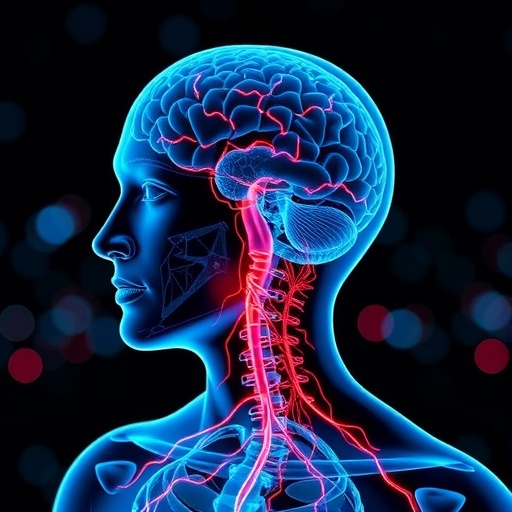
A newly uncovered neuronal framework is set to revolutionize therapeutic approaches to autonomic dysreflexia, a life-threatening condition frequently afflicting individuals with spinal cord injuries. Recent research reveals that specific spinal cord neurons, precisely targeted via epidural electrical stimulation, can not only elevate blood pressure beneficially but also counteract the pathological neuronal activity that triggers autonomic dysreflexia. This groundbreaking insight opens promising avenues for sustained neuromodulation therapies aimed at restoring autonomic stability in affected patients.
Autonomic dysreflexia is a dangerous syndrome characterized by sudden, uncontrolled hypertension and other autonomic symptoms, typically resulting from spinal cord injury at or above the thoracic level. The condition arises due to maladaptive remodeling within the spinal neuronal networks, leading to aberrant signaling and exaggerated sympathetic responses. Until now, comprehensive understanding of the exact neuronal architectures facilitating both the onset and potential reversal of this syndrome remained elusive, stymieing the development of targeted interventions.
The latest investigations have delineated two competing neuronal circuits within the spinal cord that converge on a shared neuronal population: the SC^THORACIC::Vsx2 neurons residing in the lower thoracic spinal segments. On one hand, these neurons mediate beneficial pressor responses when activated by epidural electrical stimulation (EES) targeting the so-called haemodynamic hotspot. On the other, they serve as critical nodes where disruptive activity from aberrant axonal projections originating from SC^LUMBAR::Vsx2 neurons manifests, driving autonomic dysreflexia.
Drawing on these observations, researchers hypothesized that sustained modulation of SC^THORACIC::Vsx2 neurons through EES could competitively inhibit the pathological input from SC^LUMBAR::Vsx2 aberrant fibers. To test this concept, they implemented a rigorous autonomic neurorehabilitation protocol comprised of daily EES sessions targeting the haemodynamic hotspot in the thoracic spinal cord over the course of a month in mice models with chronic spinal cord injury.
Remarkably, this autonomic neurorehabilitation regimen resulted in a complete abolition of autonomic dysreflexia episodes across all treated subjects. Quantitative assessments demonstrated significant attenuation of pressor responses elicited by autonomic challenges, indicating that long-term EES not only modulated but recalibrated the underlying neuronal circuitry. These findings suggest that neuromodulatory interventions can exert lasting corrective effects on autonomic control mechanisms impaired by spinal injury.
To understand the cellular and synaptic underpinnings of these effects, the investigators employed sophisticated intersectional viral tracing strategies. This approach enabled simultaneous labeling of SC^THORACIC::Vsx2 and SC^LUMBAR::Vsx2 neuronal populations, permitting high-resolution mapping of their axonal projections and synaptic interactions within the thoracic spinal cord. Quantitative synaptic analyses revealed a pivotal shift induced by autonomic neurorehabilitation.
Specifically, the density of aberrant axonal projections from SC^LUMBAR::Vsx2 neurons onto SC^THORACIC::Vsx2 neurons was significantly reduced following neurorehabilitation. Concurrently, there was an increase in synaptic appositions marked by vGLUT1-positive puncta originating from large-diameter proprioceptive afferents, known as PV^ON fibers, onto SC^THORACIC::Vsx2 neurons. This synaptic reorganization implies a competitive advantage of physiological inputs over pathological remodeling, facilitating restoration of normative autonomic output.
The mechanistic model posited by the authors envisions two overlapping, adversarial neuronal architectures competing for synaptic dominance upon SC^THORACIC::Vsx2 neurons. Aberrant SC^LUMBAR::Vsx2 projections disrupt autonomic homeostasis by establishing maladaptive excitatory inputs leading to dysreflexia, whereas large-diameter fiber synaptic contacts can restore functional equilibrium through EES-driven neuroplasticity. Autonomic neurorehabilitation, therefore, shifts the balance in favor of beneficial network activity.
Further experiments examined whether daily application of EES targeted to the lumbosacral spinal cord would similarly mitigate autonomic dysreflexia. The results paralleled those from thoracic stimulation, underscoring the broad therapeutic potential of site-specific EES interventions. Mice subjected to this peripheral stimulation protocol exhibited markedly reduced pressor responses and dysreflexia severity, reinforcing the concept of targeted neuromodulation as a versatile strategy.
These findings collectively emphasize the profound plasticity within spinal autonomic circuits and highlight the critical role of SC^THORACIC::Vsx2 neurons as pivotal integrators of competing synaptic inputs. The ability to therapeutically harness and rewire these circuitries through non-invasive neuromodulation represents a paradigm shift in managing autonomic complications following spinal cord injury.
Clinically, these discoveries could transform the prognosis for patients suffering from autonomic dysreflexia, a condition notoriously difficult to control with pharmacological therapies alone. By capitalizing on electrical stimulation-induced synaptic remodeling, future interventions might offer durable relief while minimizing systemic side effects common with current drug regimens.
Moreover, the advanced viral tracing techniques used provide a powerful blueprint for dissecting complex neuronal networks involved in other autonomic and motor disorders. The approach demonstrates how mapping the topology and dynamics of competing neural inputs can inform precision therapies aimed at restoring physiological balance within dysfunctional circuits.
Future research will need to address the translational feasibility of these findings, optimizing stimulation parameters, duration, and anatomical targeting to maximize clinical benefits. Additionally, elucidating the molecular signaling cascades mediating synaptic competition and remodeling could unveil novel molecular targets to augment neuromodulatory treatments.
In conclusion, this pioneering work illuminates a competitive spinal neuronal architecture underlying autonomic dysreflexia and introduces autonomic neurorehabilitation via epidural electrical stimulation as a transformative strategy to restore regulatory control over aberrant sympathetic activation. The convergence of cutting-edge viral tracing and electrophysiological modulation augurs well for the development of next-generation therapies addressing the unmet needs of spinal cord injury patients worldwide.
Cite Scienmag News
Cassandra Pierce. (September 17, 2025). Neural Circuitry Driving Autonomic Dysreflexia Unveiled. Scienmag. https://scienmag.com/neural-circuitry-driving-autonomic-dysreflexia-unveiled/
Cassandra Pierce. "Neural Circuitry Driving Autonomic Dysreflexia Unveiled." Scienmag, 17 September 2025, https://scienmag.com/neural-circuitry-driving-autonomic-dysreflexia-unveiled/. Accessed 4 September 2026.
Cassandra Pierce. "Neural Circuitry Driving Autonomic Dysreflexia Unveiled." Scienmag. September 17, 2025. https://scienmag.com/neural-circuitry-driving-autonomic-dysreflexia-unveiled/


