


Wireless Internet of Things networks have quietly become the nervous system of modern industry. Sensors on factory floors, smart meters in power grids, and connected devices in hospitals all stream data continuously, feeding real-time automation systems that cannot afford to go dark. Yet these networks live in a hostile world: environmental interference, hardware faults, and deliberate attacks can degrade performance or sever connections at any moment. When a node fails in a conventional IoT deployment, human operators or rigid failover rules must diagnose and fix the problem, a process that is slow, costly, and often blind to the underlying cause. A new study published in Neural Computing and Applications proposes something more ambitious—a network that behaves less like a machine and more like a living organism, detecting its own injuries, explaining what went wrong, and healing itself before humans even notice.
The research, authored by Pawan Kumar Badhan of Pyramid College of Business and Technology in Punjab, India, presents a closed-loop framework that fuses three previously separate strands of work: graph neural networks for fault detection, explainable AI modules for interpretability, and bio-inspired algorithms for autonomous repair. The core insight is that integration, not any single component, is the breakthrough. Anomaly detection systems built on black-box models have long been able to flag suspicious behavior in IoT traffic, and nature-inspired routing protocols such as ant-colony optimization have been explored for resilient communication. But, as the author notes, the combination of explainable graph-based detection with adaptive biological repair mechanisms remained largely unexplored. The new framework closes that gap, creating a pipeline in which diagnosis, reasoning, and recovery inform one another continuously.
The detection layer is built on graph neural networks, a class of deep learning models designed to operate on data structured as graphs rather than fixed grids of pixels or sequences of text. This choice is natural for IoT systems, where devices are vertices and communication links are edges, and where the topology itself carries diagnostic information. A failing sensor does not merely produce anomalous readings; it changes the pattern of traffic flowing through its neighbors, alters packet delivery statistics, and shifts the local geometry of the network graph. GNNs excel at capturing exactly this kind of relational signal, propagating information across the network structure to distinguish a genuinely faulty node from a transient burst of noise elsewhere in the system.
What elevates the framework beyond earlier GNN-based security work is its commitment to transparency. The system incorporates GNNExplainer, a technique that identifies which nodes, edges, and features contributed most to the network’s decision that something is wrong. Instead of a cryptic alarm—an unexplained probability score that operators must reverse-engineer—the framework delivers an interpretable map of the anomaly: this device, these links, these traffic patterns. In industrial settings, where safety regulations and audit requirements demand accountability, this explainability is not a luxury. An engineer who can see why the system concluded that a gateway is compromised can validate the diagnosis, prioritize the response, and trust the automated recovery actions that follow. The study reports that this reasoning achieves localization fidelity above 0.85, meaning the framework reliably pinpoints the true source of a fault rather than merely raising a general alarm.
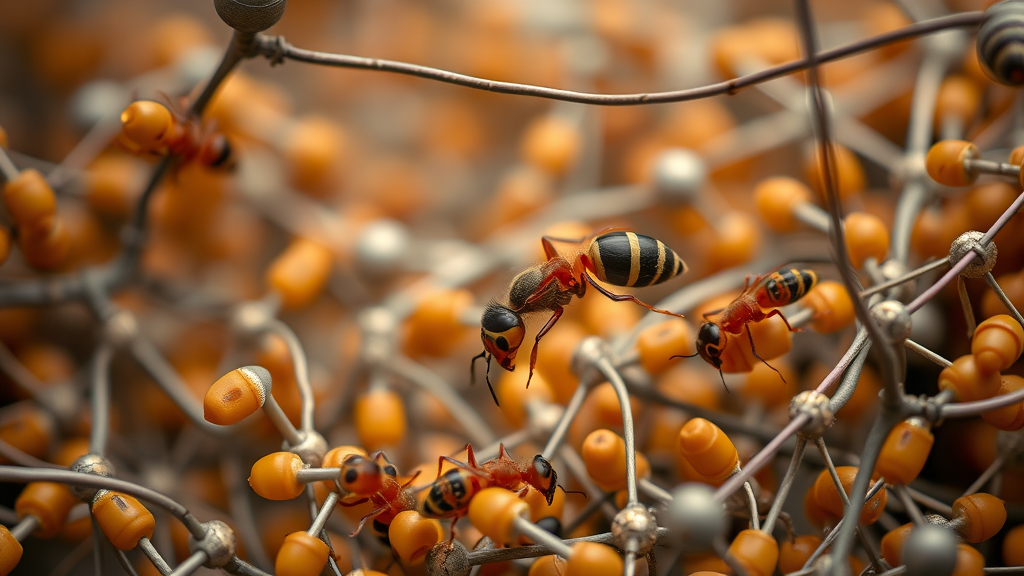
Once a fault is detected and localized, the repair phase begins, and this is where the biological inspiration takes center stage. The framework deploys immune-inspired reconfiguration, borrowing from the adaptive strategies of the vertebrate immune system, which learns to recognize threats and coordinate targeted responses without centralized control. Complementing this is swarm-based rerouting, a technique modeled on the collective intelligence of ant colonies. Real ants find efficient paths to food by laying pheromone trails that strengthen with use; the algorithmic analogue lets network packets reinforce successful routes dynamically, so when a node dies, traffic naturally reorganizes around the damaged region. Rather than waiting for a centralized controller to compute a new routing table, the network’s individual devices cooperate locally, producing a repair that emerges from many simple decisions.
The quantitative results are striking. Tested on the Edge-IIoTset dataset—a widely used, publicly available benchmark containing realistic industrial IoT communication patterns and labeled attack scenarios—the framework achieved 96.3 percent fault detection accuracy. Throughput restoration reached at least 92 percent after faults were injected, indicating that the healed network recovers nearly all of its original data-carrying capacity. Most importantly for time-critical applications, recovery latency dropped by 25 to 40 percent compared with baseline strategies. In an industrial IoT context, where a stalled production line or a delayed safety sensor reading can translate into physical and financial damage, shaving seconds or minutes off recovery time is a meaningful operational advantage.
The choice of Edge-IIoTset is itself part of the methodology. Many fault-detection studies rely on synthetic traffic or generic datasets that fail to capture the peculiar rhythms of industrial environments—periodic machine telemetry, bursty control commands, and protocol-specific signaling. Edge-IIoTset provides labeled attack scenarios alongside benign traffic, which allows the framework’s dynamic graph construction to be benchmarked against ground truth. The dataset’s realism makes the reported accuracy figures more credible than results obtained on idealized data, and because it is publicly available on Kaggle, other researchers can reproduce and extend the experiments.
The deeper significance of the work lies in the closed-loop interaction among its three components. Detection without explanation leaves operators helpless; explanation without recovery merely documents failure; recovery without detection fires blindly at imagined faults. By wiring all three together, the framework creates something genuinely adaptive: the GNN watches the network’s graph structure, the explainer converts anomalies into actionable diagnoses, and the bio-inspired algorithms translate those diagnoses into concrete reconfiguration and rerouting actions, after which the detector verifies that the network has returned to health. This continuous cycle resembles biological homeostasis more than traditional network management, and it points toward infrastructure that maintains itself under changing environmental conditions and device faults rather than degrading until a human intervenes.
Challenges remain before such systems reach widespread deployment. The study demonstrates the framework on a benchmark dataset, and translating graph-based detection and swarm-based repair into production networks will require careful validation across heterogeneous device fleets, varying radio conditions, and adversarial actors who may deliberately manipulate network topology to deceive the detector. Scalability is a further question: large industrial sites may contain thousands of nodes, and the computational cost of running GNN inference and explanation in near real time at the network edge must be managed. The author describes the solution as near real-time deployable and scalable, but independent field trials will be the ultimate test.
Still, the direction is clear and timely. As billions of devices come online—in factories, energy systems, agriculture, and smart cities—the economics of manual network administration become untenable, and the security stakes rise with every connection. Self-healing networks that can detect, explain, and repair their own faults offer a path to infrastructure that is simultaneously more resilient and more transparent. The marriage of explainable graph intelligence with algorithms borrowed from ant colonies and immune systems may sound like science fiction, but the results suggest it is rapidly becoming an engineering reality, one that could redefine what operators expect from the networks beneath the Internet of Things.
Subject of Research: Explainable graph neural networks and bio-inspired algorithms for self-healing IoT networks
Article Title: Self-healing IoT networks using explainable graph neural networks and bio-inspired repair algorithms
Article References: Self-healing IoT networks using explainable graph neural networks and bio-inspired repair algorithms. (n.d.). https://doi.org/10.1007/s00521-026-12475-4
Image Credits: AI Generated
DOI: 10.1007/s00521-026-12475-4
Keywords: Internet of Things, graph neural networks, explainable AI, self-healing networks, bio-inspired algorithms, fault detection, ant-colony optimization, immune-inspired computing, Edge-IIoTset, recovery latency, industrial IoT, network resilience
Cite Scienmag News
Josephine Dean. (September 26, 2026). Networks That Heal Themselves: Explainable AI Meets Ant Colonies to Repair the Internet of Things. Scienmag. https://scienmag.com/networks-that-heal-themselves-explainable-ai-meets-ant-colonies-to-repair-the-internet-of-things/
Josephine Dean. "Networks That Heal Themselves: Explainable AI Meets Ant Colonies to Repair the Internet of Things." Scienmag, 26 September 2026, https://scienmag.com/networks-that-heal-themselves-explainable-ai-meets-ant-colonies-to-repair-the-internet-of-things/. Accessed 4 October 2026.
Josephine Dean. "Networks That Heal Themselves: Explainable AI Meets Ant Colonies to Repair the Internet of Things." Scienmag. September 26, 2026. https://scienmag.com/networks-that-heal-themselves-explainable-ai-meets-ant-colonies-to-repair-the-internet-of-things/


