


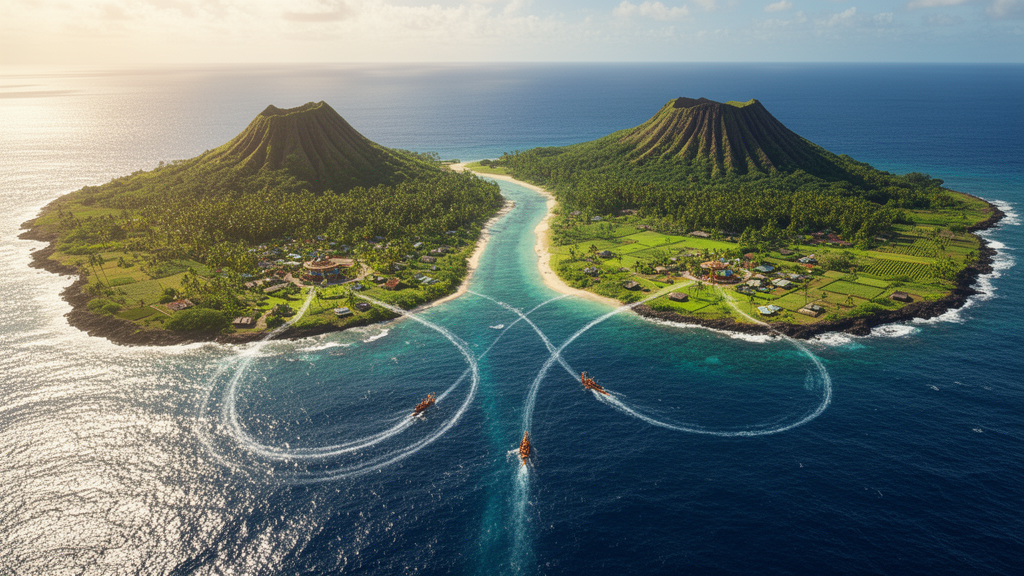
A comparative network analysis of the Society and Gambier archipelagos found that two Polynesian communities sharing similar ancestry developed markedly different relationships with island species and, by European contact, different levels of political complexity. The study reconstructed how people used native organisms and species introduced by Polynesian voyagers, finding that ecological differences shaped subsistence, material production and social organization, while cultural choices and local social dynamics mediated those constraints. It did not show that the environment alone determined the outcome.
Instead, the results support a coupled account in which biodiversity, resource availability, social hierarchy and resource-management practices could reinforce one another over centuries. The Society and Gambier Islands are unusually useful for comparison because both were settled by voyaging societies derived from a common Polynesian background and experienced broadly comparable cultural sequences before European contact. The researchers describe these as approximately 800 to 900 years long.
The pre-contact societies nevertheless differed substantially. The Society Islands supported hierarchical “complex” chiefdoms, an estimated population of 100,000 to 200,000 or more and a settlement pattern with five tiers of sites. The less hierarchical Gambier Islands probably had fewer than 10,000 people in aggregate and lacked strong centralized political authority.
The study compared the two archipelagos as whole historical socioecological systems, aggregating evidence from across the pre-contact era rather than tracking each interaction through time. Physical differences were equally pronounced. The Society archipelago consists of volcanic high islands with an aggregate area of 132.5 square kilometres and elevations reaching 2,241 metres.
Orographic rainfall and varied elevation create terrestrial habitats that support relatively high biodiversity. The Gambier Islands have one-fifth the aggregate land area, 24.3 square kilometres, and a maximum elevation of 441 metres. Their land-to-reef ratio of 1:7.2 provides extensive surrounding marine habitat, but fewer terrestrial species, limited productivity of some Polynesian cultigens and fewer opportunities for intensive husbandry of animals such as pigs and dogs.
The authors therefore treated the Gambiers as ecologically poorer on land but richer in marine surroundings. Earlier archaeo-ecological modeling cited by the study estimated that marine foods supplied only 15–18 percent of the Gambiers’ pre-contact diet, illustrating that access to a large marine area did not necessarily translate into a dominant subsistence contribution. Jennifer G.
Kahn, Stefani A. Crabtree, Patrick V. Kirch, Abigail Buffington, Spencer A.
Wood, Dieta Hanson, Evan Holt and Jennifer A. Dunne jointly compiled the underlying “Human Interactions with Other Species,” or HIOS, datasets from archaeological, archaeobotanical and zooarchaeological studies, modern botanical and ecological surveys, ethnographies, historical accounts, oral traditions and genealogies. The team first established a list of taxa known from each archipelago and resolved each identification to the finest taxonomic level supported by multiple sources.
Some records remain identified at genus, family or order level. Taxa were classified as native or as Polynesian introductions, while organisms introduced after European contact were excluded. Each documented interaction was assigned to one of 13 categories: artifact, clothing, companion, cosmology, food, fuel, housing, medicinal, ornamental, ritual, structural, trade and transportation.
Unlike a food web, which principally records feeding relationships, a HIOS network includes material, social, symbolic and relational uses. A species can therefore be represented not only as food but also as raw material for tools, an ingredient in housing, a companion, a component of cosmology, an ornament, a ritual offering or a means of transportation. The Society system included 1,749 taxa in total: 624 with documented human uses and 1,125 without them.
The corresponding Gambier totals were 850, comprising 252 taxa with documented uses and 598 without them. Native taxa greatly outnumbered Polynesian introductions among documented resources in both systems. In the Society Islands, 578 native taxa and 41 introduced taxa had recorded uses; in the Gambiers, the corresponding numbers were 224 and 28.
Bipartite network analysis converted the evidence into systems linking taxa to interaction categories. The Society network contained 690 nodes and 1,100 links, with an average of 1.6 links per taxon. The Gambier network contained 309 nodes and 393 links, averaging 1.3 links per taxon.
Food was the most connected category in both: 566 taxa linked to food in the Society system and 254 in the Gambier system. This high connectivity is consistent with the capacity to switch among food resources when availability changes, although the aggregated dataset does not directly measure how often such prey switching occurred. Most taxa used in either system had only a food relationship, with food accounting for approximately 84 percent of used taxa in the Society Islands and 93 percent in the Gambiers.
The network also distinguished taxa with many kinds of use from those serving only one or a few functions. Detrended correspondence analysis broadly reproduced the groupings identified by the networks, separating food from many other activities and clustering construction-related uses. It also showed that Polynesian introductions were associated with more interaction types in the Gambiers than in the Society Islands, consistent with the Gambiers’ lower native diversity.
Network analysis supplied additional structural information that the ordination did not reveal, including the positions of individual taxa and categories within the overall system. Introduced plants occupied especially central positions in both networks: breadfruit and coconut ranked among the most connected taxa in the Society Islands, while turmeric and noni were prominent in the Gambiers. The green sea turtle and screw pine were also highly ranked in their respective systems.
These central taxa often had ritual or cosmological importance, showing that network prominence was not confined to food production. Archaeological evidence indicates that pigs and dogs had been extirpated from the Gambiers by the time of European contact in 1797. In the HIOS records, turtles occupied a relatively larger role in the Gambiers than in the Societies, with uses including food, artifact production, ornament and cosmology.
The authors interpret the functional overlap between turtles and pigs as resource switching: replacing one taxon with another across food and non-food uses as environmental and cultural constraints changed. This interpretation is provisional. No turtle remains were recovered from ritual contexts in the Gambier archaeological record, so the comparison relies partly on ethnohistoric evidence rather than direct ritual assemblages.
Social hierarchy appears to have become more closely linked to ecological management in the Society Islands. Sixty-seven percent of mammal taxa in the Society HIOS dataset had ritual uses. Medium-sized terrestrial mammals, including pigs and dogs, served as tribute to chiefs and gods, objects of sacrifice and divination, and raw materials for prestige goods.
Pre-contact assemblages dated to 1650–1767 disproportionately contained pigs in elite ritual settings associated with temples. No Gambier mammal taxon had a recorded ritual use. The researchers propose that the larger, richer and more productive terrestrial environment facilitated animal husbandry and surplus production, after which specialized elites increasingly controlled access to valuable animals, resources and ceremonial roles.
The network pattern is consistent with feedback among ecological potential, status competition, restricted access and landscape management, but the static analysis cannot establish a direct causal sequence or show that environmental abundance alone produced social complexity. Several limitations constrain what the networks can reveal. They aggregate relationships across centuries, so they cannot establish when a particular species, use or social practice became important.
Interaction categories are discrete and unweighted, meaning that differences in the frequency, intensity or cultural salience of uses are not captured. The evidence base is also uneven: introduced and culturally prominent organisms are often more thoroughly documented, potentially increasing their apparent connectivity and centrality, while taxonomic resolution varies where multiple sources do not support species-level identification. These limitations prevent the study from separating environmental and cultural contributions cleanly.
The authors note that the comparative networks nevertheless provide a quantitative foundation for subsequent work, including analyses using 200-year chronological blocks, models that separate ecological, material and symbolic layers, and tests across additional Polynesian archipelagos. The present evidence supports a history of divergence shaped jointly by biodiversity, resource use, social decisions and changing ecological conditions, not a single prime mover.
Subject of Research: Comparative socioecological network analysis of human interactions with species in Eastern Polynesian chiefdoms
Article Title: Emergent socioecological dynamics in Eastern Polynesian chiefdoms: a comparative network analysis of the Society and Gambier Islands
Article References: Kahn, J. G., Crabtree, S. A., Kirch, P. V., Buffington, A., Wood, S. A., Hanson, D., Holt, E., & Dunne, J. A. (2026). Emergent socioecological dynamics in Eastern Polynesian chiefdoms: a comparative network analysis of the Society and Gambier Islands. Frontiers in Complex Systems, 4, Article 1887490. https://doi.org/10.3389/fcpxs.2026.1887490
Image Credits: AI Generated
DOI: 10.3389/fcpxs.2026.1887490
Keywords: Polynesian chiefdoms, socioecological networks, archaeology, Eastern Polynesia, biodiversity, resource switching, social complexity, network analysis, species interactions, landscape management, Emergent, socioecological
Cite Scienmag News
Margaret Porter. (October 20, 2026). Network analysis reveals divergent paths of two Polynesian chiefdoms. Scienmag. https://scienmag.com/network-analysis-reveals-divergent-paths-of-two-polynesian-chiefdoms/
Margaret Porter. "Network analysis reveals divergent paths of two Polynesian chiefdoms." Scienmag, 20 October 2026, https://scienmag.com/network-analysis-reveals-divergent-paths-of-two-polynesian-chiefdoms/. Accessed 20 October 2026.
Margaret Porter. "Network analysis reveals divergent paths of two Polynesian chiefdoms." Scienmag. October 20, 2026. https://scienmag.com/network-analysis-reveals-divergent-paths-of-two-polynesian-chiefdoms/


