


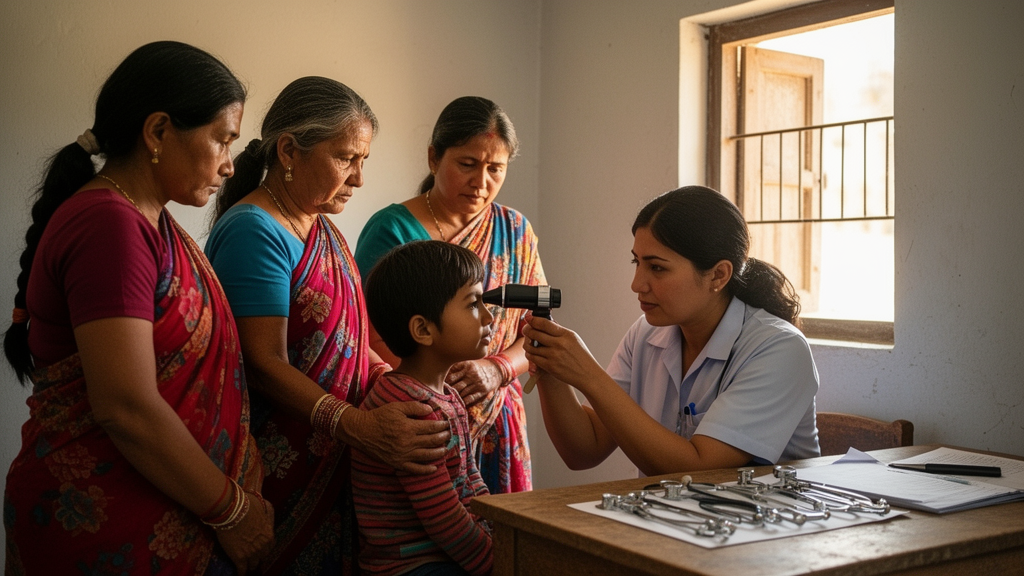
Caregivers of children referred after school-based eye screening in Eastern Nepal described indirect communication, low perceived urgency, logistical constraints, long waiting times and concerns about provider communication as influences on whether they sought follow-up care. A qualitative descriptive study conducted in 2023 interviewed 17 primary caregivers in Sunsari District and Biratnagar Metropolitan City. Participants were purposively recruited to include both referral-compliant and non-compliant caregivers, providing detailed accounts of the factors that shaped their decisions.
The study examined experiences within the referral pathway rather than evaluating a screening or communication intervention. Uncorrected refractive error is a major cause of visual impairment among school-aged children worldwide and is an important public-health concern, according to the study background. School-based vision screening programs aim to facilitate early detection and treatment, but their effectiveness depends on caregivers following referral recommendations.
Researchers conducted semi-structured, face-to-face interviews in Nepali with 17 primary caregivers whose children had been referred through school eye-screening programs. The interviews were audio-recorded, transcribed verbatim, translated into English and analyzed using inductive thematic analysis. The analysis identified five thematic domains: caregiver awareness of referral, perceived motivators for compliance, perceived barriers to compliance, caregivers’ views on child eye health and treatment, and experiences with eye-care services.
Referral information was commonly communicated to families indirectly through children. Caregivers said this approach sometimes limited their understanding of the referral and the urgency of follow-up care. The interviews indicate that the clarity and route of communication were perceived influences on referral behavior, although the qualitative design cannot establish a required causal sequence or determine how common each experience was in the wider population.
Caregivers of children who did not comply with referrals described several reasons for deprioritizing follow-up. Some perceived their children’s visual problems as mild or asymptomatic and did not regard them as requiring attention. Misconceptions about hereditary eye conditions also shaped some responses, while travel distance and time constraints created practical obstacles.
In contrast, recognition of children’s visual difficulties motivated some caregivers to seek care. Concerns about academic performance and perceived benefits from treatment were also associated with compliance in the interviews. These contrasting accounts show how symptom interpretation, expectations about learning and the perceived value of treatment intersected with referral decisions.
They do not show that any single factor determined non-compliance or quantify its effect among all children screened in the study settings. Structural features of eye-care services also figured in caregivers’ accounts. Participants reported long waiting times and expressed concerns about communication with providers, both of which they perceived as barriers to care-seeking.
The authors concluded that referral compliance after school vision screening reflects an interplay of behavioral, informational and health-system factors. They recommend strengthening direct communication between schools and caregivers, improving caregiver health literacy about childhood eye conditions and addressing structural barriers in eye-care services as strategies that may enhance compliance and support screening initiatives in low-resource settings. These are implications drawn from the interviews, not outcomes of an intervention tested in this study.
The findings offer a focused view of the transition between identifying a possible vision problem and following through with eye care. They show that referral compliance was not described solely as an individual choice: it emerged from the way families received information, interpreted their children’s symptoms, weighed possible benefits of treatment and encountered eye-care services. At the same time, the scope of the evidence must be considered.
The sample was small and purposively selected, and the two settings do not represent all of Eastern Nepal or other resource-limited health systems. Its conclusions therefore concern perceived influences recorded in 17 interviews, rather than population-level referral patterns or measured changes in visual outcomes. Within that scope, the accounts identify practical points at which communication and service delivery may influence whether a referral becomes an eye-care visit.
Subject of Research: Caregiver-reported influences on referral compliance after school eye screening in Eastern Nepal
Article Title: Primary caregivers’ perspectives on referral compliance following school eye health screening in Eastern Nepal: a qualitative study of behavioral and health system barriers
Article References: Karki, B., Shrestha, G. S., Karn, R. R., Bhagat, D., Pirthu, K., & Thakur, S. K. (2026). Primary caregivers’ perspectives on referral compliance following school eye health screening in Eastern Nepal: a qualitative study of behavioral and health system barriers. BMC Public Health. https://doi.org/10.1186/s12889-026-29720-z
Image Credits: AI Generated
DOI: 10.1186/s12889-026-29720-z
Keywords: school eye screening, referral compliance, childhood vision, primary caregivers, Eastern Nepal, qualitative study, health-system barriers, uncorrected refractive error, caregiver health literacy, eye-care access, Primary, caregivers
Cite Scienmag News
Ophelia Keating. (October 22, 2026). Nepal caregivers describe barriers to school eye-screening referrals. Scienmag. https://scienmag.com/nepal-caregivers-describe-barriers-to-school-eye-screening-referrals/
Ophelia Keating. "Nepal caregivers describe barriers to school eye-screening referrals." Scienmag, 22 October 2026, https://scienmag.com/nepal-caregivers-describe-barriers-to-school-eye-screening-referrals/. Accessed 22 October 2026.
Ophelia Keating. "Nepal caregivers describe barriers to school eye-screening referrals." Scienmag. October 22, 2026. https://scienmag.com/nepal-caregivers-describe-barriers-to-school-eye-screening-referrals/


