


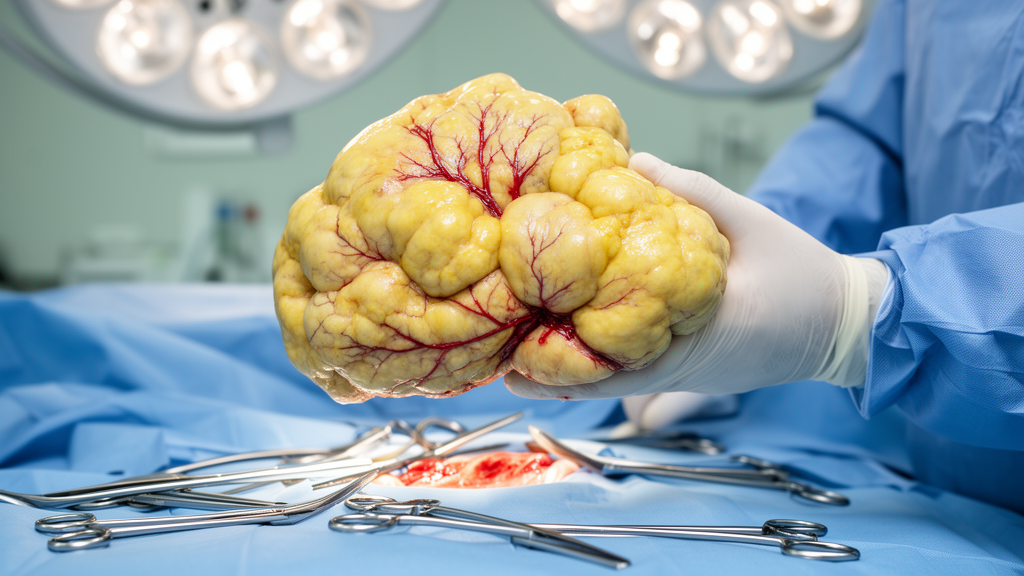
A 62-year-old man underwent removal of a giant, highly vascular atypical lipomatous tumor/well-differentiated liposarcoma (ALT/WDLPS) from the cervicodorsal region, according to a case report published in Frontiers in Medicine. The mass had been present for more than 17 years, growing slowly at first but enlarging substantially during the two years before admission. Computed tomography angiography identified an extensive lesion with marked vascularity and feeding branches from both subclavian arteries. Surgeons removed the tumor en bloc, closed the resulting defect with local advancement flaps and reported favorable short-term healing without a definite local recurrence.
The tumor measured approximately 20.9 by 28.6 by 25.4 cm on preoperative imaging and extended from the posterior neck to the upper back. It produced a pronounced hump-like contour and was associated with a pulling sensation in the occipital scalp and cervicodorsal skin. Despite its size, the patient reported no definite airway compression, dysphagia, hoarseness, sensory disturbance, weakness or other major neurologic symptoms. Physical examination found a soft, poorly defined mass with limited mobility, scattered pigmentation, small papules and a few superficial varicosities, but no ulceration, erythema or clear adhesion to the skin.
Preoperative imaging showed that the mass was predominantly fat density but contained internal septa, patchy hazy areas, nodular soft-tissue components and focal uneven thickening of the overlying skin. CTA revealed numerous tortuous vessels and a rich arterial supply, principally involving the right deep cervical artery, the right superficial cervical artery and branches of the left superficial cervical artery. The limited preoperative biopsy did not establish the diagnosis: two skin samples showed no specific abnormality, while the third consisted mainly of mature adipose tissue. The findings initially permitted consideration of an ordinary lipoma, although the tumor’s accelerated growth, enormous size, indistinct margins and non-fatty components raised concern that the small biopsy might not represent the lesion’s internal heterogeneity.
The surgical strategy combined vascular assessment, hemostatic planning and reconstruction design. The operation was performed under general anesthesia with endotracheal intubation and the patient in the prone position. Because the tumor’s weight and volume restricted access and increased pressure on the neck and face, the surgeons initially approached from below and then changed the dissection direction. This was an intraoperative adjustment rather than a maneuver dictated by CTA. No gross muscle invasion or firm adhesion to major neurovascular structures was observed, but multiple large feeding vessels and a broad oozing surface were present at the tumor base.
Following the vascular map obtained with CTA, the bilateral main feeding arteries were exposed when roughly two-thirds of the tumor had been dissected and ligated individually. Bleeding at the base was controlled with electrocautery and suture ligation, and the mass was ultimately removed en bloc while capsular continuity was maintained as far as possible. The operative specimen measured approximately 37 by 25 by 8.5 cm and weighed 6.01 kg. Excision left an irregular defect of about 15 by 11 cm. The operation lasted nearly six hours, and estimated blood loss was approximately 700 mL; no transfusion was required.
Local advancement flaps were designed before surgery according to the tumor’s extent, the skin available for preservation and the anticipated defect, with attention to maintaining flap perfusion. After meticulous hemostasis, reserved local skin and soft tissue were advanced into the wound and redundant edges were trimmed to achieve apposition. A drain was placed beneath the flap, and postoperative drainage with adjunctive local negative-pressure wound therapy was used to limit dead space and fluid accumulation. The patient recovered without an acute complication and was discharged 12 days after surgery, providing a favorable early result for reconstruction of an unusually large cervicodorsal defect.
Pathologic examination of the complete resection specimen established the basis for the ALT/WDLPS diagnosis. The mass consisted mainly of mature adipocytes of varying size separated by widened fibrous septa. Scattered atypical stromal cells with enlarged, hyperchromatic nuclei were present in the septa, alongside focal spindle-cell proliferation and myxoid stromal change. Immunohistochemical testing was positive for S-100, p16, MDM2 and CDK4. It was negative for CD34, RB1 expression was retained and the Ki-67 proliferative index was approximately 5%. These findings supported ALT/WDLPS rather than an ordinary lipoma or a spindle-cell/pleomorphic lipomatous tumor, while focal myxoid change without the characteristic cellular and vascular pattern of myxoid liposarcoma made that diagnosis less likely.
The case nevertheless has an important diagnostic limitation: MDM2 fluorescence in situ hybridization, which can provide molecular confirmation of gene amplification, was recommended but not performed. The diagnosis therefore rests on the morphology of the entire specimen and its immunohistochemical profile rather than molecular testing. Margin assessment also showed a narrow result. Tumor tissue approached the inked deep margin at a closest distance of approximately 0.5 mm, but no tumor cells touched the ink, and the deep margin was classified as negative but close. These features reinforce the need for continued surveillance, particularly because the short observation period cannot establish long-term recurrence outcomes.
At six months, the patient remained in good general condition. The cervicodorsal incision and advancement flaps had healed without necrosis, dehiscence, infection, hematoma or significant fluid collection. The cervicodorsal contour and performance of daily activities improved relative to the preoperative state, while shoulder and neck range of motion was not significantly limited. Color Doppler ultrasonography of the bilateral cervical scars revealed no definite abnormal echogenicity or abnormal blood-flow signals, and physical examination found no clear evidence of local recurrence. The authors recommended regular follow-up focused on recurrence, wound and flap status and shoulder-neck function.
The report illustrates how imaging, pathology and surgery can converge in a difficult case, but it does not establish that any single test or treatment improves outcomes. CT and MRI can define the extent of a lipomatous tumor and raise suspicion through features such as thick septa, enhancement and non-fatty components, yet their appearances overlap with those of ordinary lipoma. CTA cannot replace MRI for tissue characterization, and this single case does not show that vascular mapping reduced blood loss or improved oncologic outcomes. Its practical value is instead to demonstrate a coordinated approach: targeted assessment of unusually abundant vascular supply, preparation for major hemorrhage, en bloc resection, reconstruction planned before removal, careful analysis of the entire specimen and long-term follow-up of a close deep margin.
Subject of Research: A case report of a giant hypervascular atypical lipomatous tumor/well-differentiated liposarcoma in the cervicodorsal region.
Article Title: Giant hypervascular atypical lipomatous tumor/well-differentiated liposarcoma of the cervicodorsal region: a case report
Article References: Liao, Z., Qin, F., Wang, S., Wan, X., & Li, H. (2026). Giant hypervascular atypical lipomatous tumor/well-differentiated liposarcoma of the cervicodorsal region: a case report. Frontiers in Medicine, 13, Article 1925841. https://doi.org/10.3389/fmed.2026.1925841
Image Credits: AI Generated
DOI: 10.3389/fmed.2026.1925841
Keywords: ALT/WDLPS, liposarcoma, cervicodorsal tumor, hypervascular mass, soft tissue sarcoma, CT angiography, MDM2, CDK4, surgical reconstruction, case report, Giant, hypervascular
Cite Scienmag News
Ophelia Keating. (October 22, 2026). Giant Hypervascular Liposarcoma Removed From Cervicodorsal Region. Scienmag. https://scienmag.com/giant-hypervascular-liposarcoma-removed-from-cervicodorsal-region/
Ophelia Keating. "Giant Hypervascular Liposarcoma Removed From Cervicodorsal Region." Scienmag, 22 October 2026, https://scienmag.com/giant-hypervascular-liposarcoma-removed-from-cervicodorsal-region/. Accessed 22 October 2026.
Ophelia Keating. "Giant Hypervascular Liposarcoma Removed From Cervicodorsal Region." Scienmag. October 22, 2026. https://scienmag.com/giant-hypervascular-liposarcoma-removed-from-cervicodorsal-region/


