


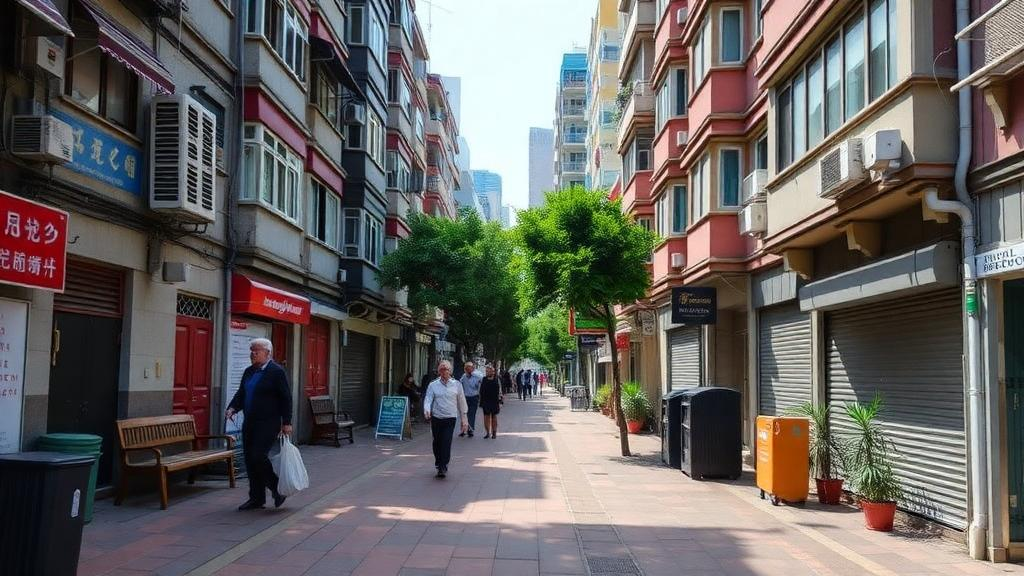
Older adults in Hong Kong move more when they believe their neighbourhoods are pleasant, safe and socially connected, according to a cross-sectional study published in BMC Geriatrics that paired subjective perceptions of the urban environment with week-long accelerometer readings. The research, led by Alison Y. T. Ou of Hong Kong Baptist University with colleagues from Hong Kong Baptist University and The Chinese University of Hong Kong, offers one of the more granular looks to date at how the felt qualities of a dense Asian city shape the actual movement patterns of people aged 60 to 80.
The team recruited 410 community-dwelling older adults across Hong Kong in 2024 using purposive quota sampling, a design intended to capture a spread of residential districts and socioeconomic circumstances rather than a random population sample. Participants had a mean age of 67.5 years, with a standard deviation of 4.9, and 80.2 percent were women. Each person completed a tablet-assisted interview covering sociodemographic characteristics, health status and seven distinct domains of perceived neighbourhood environment, ranging from aesthetics and walking conditions to social cohesion, safety, neighbourhood violence, neighbourly interaction and the availability of healthy foods.
Crucially, the study did not rely on self-reported exercise, which is notoriously prone to overestimation and recall bias. Instead, participants wore ActiGraph GT3X+ accelerometers, research-grade triaxial devices that record raw acceleration at high frequency, for at least 10 hours per day over four consecutive days including one weekend day. The devices distinguish light activity from moderate-to-vigorous physical activity, or MVPA, the intensity band most strongly linked in epidemiological literature to cardiovascular, metabolic and cognitive health benefits in later life.
The accelerometer data revealed a median MVPA of 283.5 minutes per week, with an interquartile range of 225.0 minutes. That figure is notable because it suggests many of these older Hong Kong residents already exceed widely cited activity guidelines, which typically call for 150 to 300 minutes of moderate activity per week. The authors attribute part of this to the structure of daily life in a compact, transit-oriented city where walking is often the default mode of getting to markets, clinics and community centres.
To connect perception to movement, the researchers fitted separate gamma generalised linear models with a log link, one for each environmental domain, adjusting for sociodemographic, residential and health-related factors. Gamma models are well suited to skewed, strictly positive outcomes such as minutes of activity, and the log link means the coefficients can be read as multiplicative effects on MVPA rather than simple additive shifts.
Four perceptual domains emerged as significant. Higher perceived social cohesion carried the largest association, with a beta of 0.40 and a p-value below 0.001, followed by aesthetic quality at 0.32, safety at 0.30 and walking environment quality at 0.24, all similarly significant. In practical terms, an older adult who rates their neighbourhood as trusting, attractive, secure and walkable tends to log meaningfully more moderate-to-vigorous minutes than an otherwise comparable peer who does not, even after accounting for age, sex, finances, housing and self-rated health.
Just as telling were the null results. Perceived availability of healthy foods, perceived neighbourhood violence and the frequency of neighbourly interaction showed no significant association with MVPA once the models were adjusted. The distinction between social cohesion and mere neighbourly interaction is conceptually interesting: it suggests that a general sense of collective trust and shared norms, rather than the simple amount of chatting over the fence, is what travels with higher activity levels.
The covariates told a consistent story of their own. Older age was reliably associated with lower MVPA across models, while male sex, more favourable financial circumstances and better self-rated physical health were generally linked to higher activity. These gradients align with a large international literature and reinforce the point that environmental perceptions operate alongside, not instead of, individual determinants of movement in later life.
For urban planners and public health officials in high-density cities, the findings carry a pointed implication: age-friendly activity strategies should treat the social texture of a neighbourhood as seriously as its pavements and parks. Improving aesthetics, maintaining safe and comfortable walking routes and cultivating cohesion between residents may each contribute to keeping older adults active, whereas interventions focused narrowly on infrastructure or on food access alone might miss part of the effect. The study’s cross-sectional design, however, limits causal inference; it cannot determine whether people who feel good about their neighbourhoods move more, or whether active residents come to view their surroundings more favourably.
The authors are explicit on this point, calling for longitudinal and intervention studies to establish temporality and to test whether deliberate changes in neighbourhood conditions actually raise physical activity. The work received no specific grant from any funding agency, and it was approved by the Research Ethics Committee of Hong Kong Baptist University under approval number SOSC-SPEH-2023-24_112, with written informed consent from all participants. As Hong Kong and other rapidly ageing societies confront rising chronic disease burdens, the message from this dataset is that the neighbourhood itself, as experienced by its older residents, is a measurable and potentially modifiable lever on health behaviour.
Subject of Research: Associations between perceived neighbourhood environment and accelerometer-measured physical activity among older adults in Hong Kong
Article Title: Perceived neighbourhood environment and accelerometer-measured moderate-to-vigorous physical activity among community-dwelling older adults in Hong Kong: a cross-sectional study
Article References: Ou, A. Y. T., Lai, D. W. L., Sun, Y., Gao, Y., Huang, C. Z. D., & Qu, Z. (2026). Perceived neighbourhood environment and accelerometer-measured moderate-to-vigorous physical activity among community-dwelling older adults in Hong Kong: a cross-sectional study. BMC Geriatrics. https://doi.org/10.1186/s12877-026-08517-0
Image Credits: AI Generated
DOI: 10.1186/s12877-026-08517-0
Keywords: older adults, physical activity, MVPA, neighbourhood environment, accelerometer, Hong Kong, social cohesion, walkability, cross-sectional study, urban health, healthy ageing, BMC Geriatrics
Cite Scienmag News
Beatrice Stafford. (October 17, 2026). Neighbourhood Trust and Walkability Drive Real Activity Levels in Hong Kong’s Older Adults. Scienmag. https://scienmag.com/neighbourhood-trust-and-walkability-drive-real-activity-levels-in-hong-kongs-older-adults/
Beatrice Stafford. "Neighbourhood Trust and Walkability Drive Real Activity Levels in Hong Kong’s Older Adults." Scienmag, 17 October 2026, https://scienmag.com/neighbourhood-trust-and-walkability-drive-real-activity-levels-in-hong-kongs-older-adults/. Accessed 17 October 2026.
Beatrice Stafford. "Neighbourhood Trust and Walkability Drive Real Activity Levels in Hong Kong’s Older Adults." Scienmag. October 17, 2026. https://scienmag.com/neighbourhood-trust-and-walkability-drive-real-activity-levels-in-hong-kongs-older-adults/


