


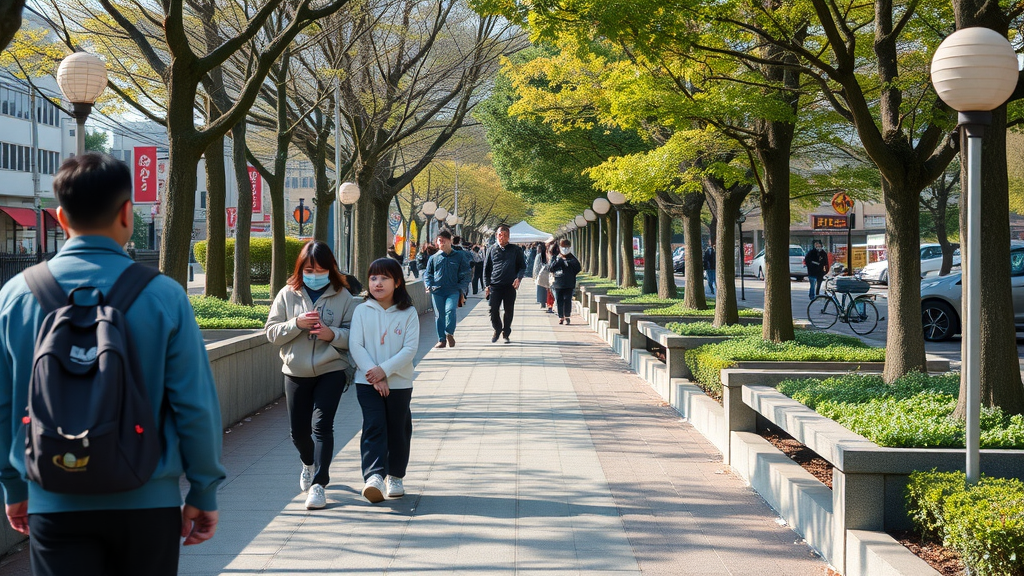
A quiet revolution in urban science is unfolding across the railway stations of metropolitan Tokyo, and it is being measured one pedestrian, one child, and one park at a time. A new study of 693 station catchment areas spanning Tokyo, Kanagawa, Chiba, and Saitama prefectures has found that the presence of a neighborhood park near a railway station is associated with a measurably higher child population and a significant boost in weekday pedestrian flow among workers. At the same time, the research delivers a sobering message for city planners hoping that a single green space can transform a district: parks showed no clear association with retail sales, visitor foot traffic, or most other measures of urban activity. The findings, published in Discover Cities, offer some of the most statistically rigorous evidence yet on what neighborhood parks actually do for the vitality of dense modern cities.
The research team, led by Keito Yamaguchi of Tokyo University of Science together with Xueqing Bo of Kochi University of Technology and colleagues, set out to answer a deceptively simple question that has long eluded empirical scrutiny: does having a neighborhood park nearby actually change how alive a place feels and functions? Urban vibrancy, the researchers emphasize, is not a single number. It is a multidimensional phenomenon reflected in the movement of people, the presence of families, the hum of commerce, and the texture of daily social life. Rather than collapsing all of this into one index, the team measured three distinct dimensions: pedestrian flows derived from anonymized mobile phone location data, annual retail sales as an economic signal, and the population of children aged zero to fourteen as an indicator of family-oriented residential vitality.
What makes the study methodologically distinctive is its effort to overcome a chronic weakness in park research: the fact that parks are not randomly distributed across cities. Areas with parks may differ systematically from areas without them in population density, land use, transit access, and commercial concentration, so a naive comparison of the two would tell us little. To address this, the researchers borrowed tools from causal inference, most notably propensity score matching, a technique introduced by Rosenbaum and Rubin in the 1980s. Each station catchment area, defined as an 800-meter circular buffer around a railway station corresponding roughly to a ten-minute walk, was assigned a propensity score: the estimated probability that an area with its particular urban characteristics would contain at least one neighborhood park. Areas with parks were then matched to statistically comparable areas without them, allowing the researchers to estimate adjusted differences in outcomes while accounting for 64 covariates covering facilities, land use, population, zoning, and transportation.
The balancing diagnostics were encouraging. After matching, 62 of the 64 covariates showed standardized mean differences below the conventional 0.25 threshold, and the propensity score distributions of the treated and control groups overlapped closely across nearly the entire range. In practical terms, this means that station areas with neighborhood parks were compared against station areas that looked remarkably similar in every observed respect except the presence of the park itself. The treatment group comprised 187 station catchment areas containing at least one neighborhood park, while 506 areas served as controls. Because the study rests on observational, cross-sectional data, the authors are careful throughout to describe their results as adjusted associations rather than definitive causal effects, a caution that reflects the possibility that parks were deliberately placed in areas already attractive to families or already bustling with activity.
Within those constraints, the results are striking. Station catchment areas with neighborhood parks contained approximately 116 more children on average than their matched counterparts, a statistically significant difference with a 95 percent confidence interval ranging from about 37 to 195 additional children. This suggests that neighborhood parks are associated with residential environments that draw and retain households with young children, whether by providing spaces for play and parent-child interaction or by signaling a family-friendly neighborhood character. The finding resonates with a long line of research showing that access to quality green space influences where families choose to live and how children use their surroundings, but it is among the first to quantify this relationship at the scale of an entire megaregion while adjusting so extensively for confounding urban conditions.
The second significant result concerned the daily rhythms of commuting. On weekdays, station areas with neighborhood parks recorded roughly 392 more worker pedestrians than comparable areas without parks, a difference that was statistically significant. The researchers interpret this as evidence that neighborhood parks function as what they call micro-rest spaces within workday activity patterns: venues for short walks, lunch breaks, informal rest, and movement between offices and surrounding facilities. In a metropolis where railway stations anchor the daily lives of millions of commuters, even a modest park may meaningfully improve the walking environment during the hours when foot traffic peaks. Notably, the holiday estimate for worker pedestrian flow was positive but not statistically significant, hinting that the park effect on mobility is specific to the structure of the working week.
Just as informative are the results that did not materialize. Annual retail sales showed no significant association with park presence, and neither did pedestrian flows among visitors or residents on either weekdays or holidays. Commercial vitality, the authors argue, is governed by forces far beyond a single green amenity: commercial agglomeration, station size, accessibility, land-use composition, and regional centrality all dwarf the influence of a neighborhood park. This indicator-specific pattern challenges the popular assumption that parks universally energize their surroundings. Instead, the study suggests that neighborhood parks occupy a particular niche in the urban ecosystem, supporting family-oriented residential vitality and weekday worker mobility rather than driving commerce or attracting visitors from afar.
To test whether these findings held beyond the matched sample, the team applied two additional estimators of the average treatment effect across all 693 station areas: inverse probability weighting and a doubly robust learner that combines propensity score modeling with Random Forest regression, a machine-learning method capable of capturing nonlinear relationships among dozens of urban covariates. The two methods broadly agreed on the direction of effects for worker and resident pedestrian flows, both producing positive estimates, with weekday worker flow again showing the clearest signal. But for retail sales and visitor flows, the methods diverged, even producing estimates of opposite signs, a discrepancy the authors attribute to sensitivity in model specification, weighting, and treatment effect heterogeneity. These supplementary results are presented as exploratory evidence, and the diagnostics, including weight distributions and cross-fitted propensity score overlap, support the numerical stability of the estimates without eliminating all uncertainty.
The study is candid about its limitations, and these are worth understanding. The 800-meter circular buffer is an operational simplification that ignores street networks, topography, and physical barriers, and catchment areas of nearby stations may overlap, raising questions of spatial dependence. The datasets are not perfectly aligned in time: park presence and most covariates date from around 2011 to 2014, while the pedestrian flow data come from 2018, drawn from the KDDI Location Analyzer platform based on GPS data from consenting mobile phone subscribers. Carrier choice may introduce sampling bias, and the classification of pedestrians into workers, residents, and visitors relies on inferred home and workplace locations. The treatment variable captures only whether at least one neighborhood park exists, not its size, quality, facilities, or accessibility. And because the analysis excludes stations in wards, towns, and villages, the findings may not generalize to Tokyo’s densest 23 special wards.
Even with these caveats, the implications for urban planning are substantial. As metropolitan areas worldwide grapple with aging populations, declining social interaction, and the uneven distribution of urban functions, the study suggests that neighborhood parks deserve recognition not merely as recreational amenities but as a form of social infrastructure woven into the fabric of daily life. In Japan, where parks double as disaster evacuation hubs and venues for civic activity, their role is arguably even more multifunctional than elsewhere. The research does not claim that planting a park will automatically generate urban vibrancy; rather, its contribution depends on interaction with surrounding land use, pedestrian networks, and residential character. What the evidence does support is a more targeted vision: neighborhood parks as anchors of family-friendly residential environments and as small but meaningful waypoints in the working day of millions of commuters. Future work, the authors suggest, should employ longitudinal designs such as difference-in-differences, network-based catchment definitions, and detailed park-characteristic data to identify precisely which kinds of parks, in which kinds of places, deliver the greatest benefit. For now, the message from Tokyo is clear and refreshingly precise: green spaces close to home matter most for the families who live there and the workers who pass through, and that is a finding worth building on.
Subject of Research: The association between neighborhood park presence and multiple indicators of urban vibrancy in Tokyo metropolitan station catchment areas, analyzed using propensity score matching and machine learning.
Article Title: Effects of neighborhood parks on urban vibrancy in metropolitan Tokyo using propensity score matching and machine learning
Article References: Yamaguchi, K., Bo, X., Terabe, S., Yaginuma, H., Ajito, M., & Inagaki, K. (2026). Effects of neighborhood parks on urban vibrancy in metropolitan Tokyo using propensity score matching and machine learning. Discover Cities, 3(1), Article 181. https://doi.org/10.1007/s44327-026-00346-5
Image Credits: AI Generated
DOI: 10.1007/s44327-026-00346-5
Keywords: urban parks, urban vibrancy, Tokyo, propensity score matching, machine learning, pedestrian flow, station catchment area, child population, retail sales, causal inference, urban planning, mobile phone location data
Cite Scienmag News
Courtney Benton. (September 12, 2026). Neighborhood Parks Tied to More Children and Weekday Foot Traffic in Tokyo. Scienmag. https://scienmag.com/neighborhood-parks-tied-to-more-children-and-weekday-foot-traffic-in-tokyo/
Courtney Benton. "Neighborhood Parks Tied to More Children and Weekday Foot Traffic in Tokyo." Scienmag, 12 September 2026, https://scienmag.com/neighborhood-parks-tied-to-more-children-and-weekday-foot-traffic-in-tokyo/. Accessed 6 October 2026.
Courtney Benton. "Neighborhood Parks Tied to More Children and Weekday Foot Traffic in Tokyo." Scienmag. September 12, 2026. https://scienmag.com/neighborhood-parks-tied-to-more-children-and-weekday-foot-traffic-in-tokyo/


