


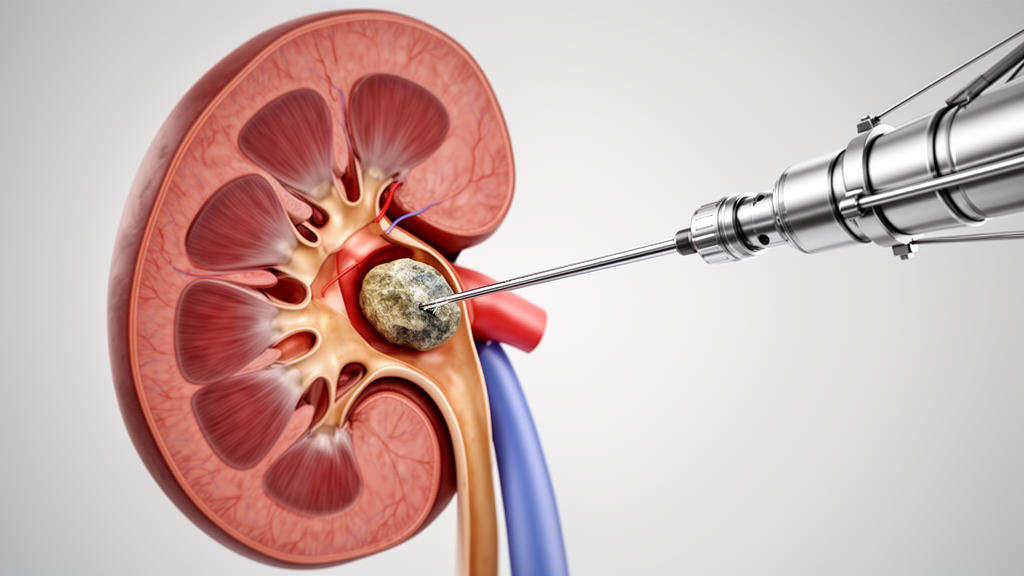
Kidney stones measuring between 2 and 4 centimeters present surgeons with an uncomfortable dilemma. Guidelines recommend percutaneous nephrolithotomy, or PCNL, as the first-line treatment for stones larger than 2 centimeters, a procedure in which surgeons bore a 24-French tract through the flank to reach the kidney and fragment the stone. Yet that relatively wide tract can contribute to bleeding, kidney injury, and infectious complications. A new study from Beijing Tsinghua Changgung Hospital asks whether a needle-thin auxiliary instrument can tip the balance, and the answer, published in Frontiers in Medicine, is a careful maybe.
The device at the center of the study is Needle-perc, a 4.2-French percutaneous nephroscope, roughly the diameter of a heavy pencil lead, designed to reach calyces that the main surgical tract cannot access. The research team compared two ways of using it against Standard PCNL. In needle-perc-assisted PCNL, abbreviated NS, surgeons remove most of the stone through a conventional tract and then use the undilated 4.2-French needle scope, guided by real-time ultrasound, to hunt down residual fragments in awkward calyces. In needle-perc-assisted RIRS, abbreviated NR, one surgeon works a flexible ureteroscope up through the urinary tract while a second simultaneously establishes the tiny percutaneous access, so that stones beyond the ureteroscope’s reach can be pushed or fragmented from the antegrade side.
The retrospective cohort included 365 patients treated between January 2021 and September 2025 for stones with a cumulative diameter of 2 to 4 centimeters diagnosed on non-contrast computed tomography. Because patients were not randomly assigned to a procedure, the team used propensity score matching, a statistical technique that pairs patients across treatment groups based on variables such as age, sex, body mass index, diabetes, stone count, total stone diameter, stone density, the presence of parallel calices, and two established complexity scores. Matching yielded 48 Standard PCNL–NS pairs and 86 Standard PCNL–NR pairs, with all matched covariates well balanced. The primary outcome was the stone-free rate one month after surgery, defined as no residual fragment of 4 millimeters or larger on plain abdominal radiography, with Holm adjustment applied to the two principal comparisons.
The headline numbers looked encouraging. In the Standard PCNL–NS comparison, 85.4 percent of patients were stone-free at one month after Needle-perc-assisted PCNL, compared with 72.9 percent after Standard PCNL, an absolute difference of 12.5 percentage points. In the Standard PCNL–NR comparison, the stone-free rate was 91.9 percent with the combined approach versus 80.2 percent with Standard PCNL, a difference of 11.6 percentage points. But the confidence intervals for both differences included zero, and the exact McNemar P values, 0.210 and 0.052, rose to 0.210 and 0.104 after Holm adjustment. The authors conclude that the estimates numerically favored the Needle-perc approaches but that superiority over Standard PCNL was not established.
The secondary findings, which the researchers label exploratory, painted a more textured picture of trade-offs. Needle-perc-assisted PCNL was associated with markedly less postoperative fever, 8.3 percent versus 35.4 percent after Standard PCNL, and a smaller rise in white blood cell counts, suggesting a blunted inflammatory response. Yet patients in the NS group needed more rescue painkillers, 29.2 percent versus 8.3 percent, and three NS patients received blood transfusions while none of their matched controls did. Needle-perc-assisted RIRS showed the opposite pattern on some measures: less analgesic use, 9.3 percent versus 23.3 percent, and a hospital stay roughly 2.5 days shorter than Standard PCNL, but an operative time about 31 minutes longer, likely reflecting the coordination of two simultaneous surgical pathways.
Because bacteria can lodge inside the matrix of certain stones and persist despite antibiotics, the team also examined whether stone infection status modified the results. Stones containing struvite, carbonate apatite, or ammonium urate were classified as infectious, and such stones are known to carry higher risks of perioperative infection, kidney deterioration, and recurrence. Using a linear probability model with interaction terms, the researchers found no statistically significant treatment-by-infection interaction for either NS or NR, with P values of 0.647 and 0.942. The absolute stone-free rate differences favoring the Needle-perc techniques were broadly similar in both strata, around 9 to 17 percentage points, though the confidence intervals were wide enough that meaningful heterogeneity could not be excluded.
Several features of the study demand caution in interpretation. The design was retrospective and single-center, with no a priori sample-size calculation. Surgeons chose the initial approach through routine clinical judgment rather than a standardized algorithm, and the rationale for each choice could not be reliably reconstructed, leaving open the possibility of selection bias and residual confounding despite matching. The calendar-year distributions differed between groups, with the vast majority of NS procedures performed in 2024 and 2025, so surgeon experience and learning-curve effects were not adjusted. KUB radiography is also less sensitive than CT for detecting residual fragments, which could bias stone-free rates, and Clavien-Dindo complications were reconstructed from records rather than prospectively captured.
The matching procedure itself selected distinctive subsets of the Standard PCNL population. Matched Standard PCNL patients in the NS comparison had larger stones and more parallel calices than their unmatched counterparts, while those in the NR comparison more often had parallel calices but smaller and less dense stones. Parallel calices are chambers that cannot be reached through the primary tract without marked angulation and potential injury to kidney tissue, precisely the situations where a tiny needle scope offers targeted access. This suggests the apparent advantage of Needle-perc assistance may concentrate in anatomically complex cases, though the authors note that comparisons between matched and unmatched patients describe selection into the cohorts rather than prove the mechanism of any benefit.
For patients, the practical message is one of options rather than replacement. Needle-perc-assisted PCNL may supplement a conventional tract when residual stones lie in unreachable calyces, while needle-perc-assisted RIRS offers a tubeless pathway with shorter hospitalization at the cost of longer operating time. Neither approach eliminated the risks of the larger operation, and the transfusion signal in the NS group warrants attention. The findings apply primarily to the successfully matched patients within the study’s common support, not to every patient with a large kidney stone.
The authors call for prospective studies using standardized non-contrast CT assessment of residual fragments and adequate statistical power to confirm or refute the trends observed here. Until such trials are done, Needle-perc-assisted surgery remains a promising but unproven refinement of kidney stone surgery, one whose clearest value so far may be in navigating the anatomical corners where conventional instruments and the kidney’s own plumbing simply do not cooperate.
Subject of Research: Comparative outcomes of needle-perc-assisted PCNL and RIRS versus standard PCNL for 2–4 cm renal calculi
Article Title: Clinical outcomes of needle-perc-assisted endoscopic surgery for 2–4 cm renal calculi: a propensity score-matched comparative study with subgroup analysis by stone infection status
Article References: Wang, Y., Zhang, P., Xu, Z., Luo, D., Tang, Y., & Li, J. (2026). Clinical outcomes of needle-perc-assisted endoscopic surgery for 2–4 cm renal calculi: a propensity score-matched comparative study with subgroup analysis by stone infection status. Frontiers in Medicine, 13, Article 1938484. https://doi.org/10.3389/fmed.2026.1938484
Image Credits: AI Generated
DOI: 10.3389/fmed.2026.1938484
Keywords: kidney stones, PCNL, needle-perc, retrograde intrarenal surgery, urology, propensity score matching, stone-free rate, infectious stones, laser lithotripsy, minimally invasive surgery, Clinical, outcomes
Cite Scienmag News
Ophelia Keating. (October 23, 2026). Needle-Sized Kidney Stone Surgery Shows Promise, But Superiority Not Proven. Scienmag. https://scienmag.com/needle-sized-kidney-stone-surgery-shows-promise-but-superiority-not-proven/
Ophelia Keating. "Needle-Sized Kidney Stone Surgery Shows Promise, But Superiority Not Proven." Scienmag, 23 October 2026, https://scienmag.com/needle-sized-kidney-stone-surgery-shows-promise-but-superiority-not-proven/. Accessed 23 October 2026.
Ophelia Keating. "Needle-Sized Kidney Stone Surgery Shows Promise, But Superiority Not Proven." Scienmag. October 23, 2026. https://scienmag.com/needle-sized-kidney-stone-surgery-shows-promise-but-superiority-not-proven/


