


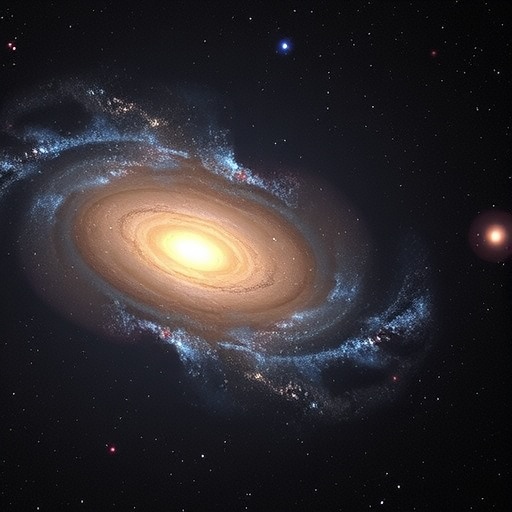
In the vast tapestry of the cosmos, the faintest galaxies orbiting our Milky Way have often been regarded as relics from a bygone era—cosmic fossils preserving the secrets of the Universe’s infancy. Recent groundbreaking research from the Oskar Klein Centre (OKC), in collaboration with the LYRA partnership, has harnessed an unprecedented array of high-resolution simulations to reveal just how profoundly these ultra-faint dwarf galaxies encapsulate the conditions of the early Universe. This novel approach not only sheds light on the enigmatic developmental pathways of small galaxies but also offers an innovative window into why some galaxies flourished while others faded into obscurity.
Azadeh Fattahi, Associate Professor at OKC and leader of the research collective, highlights the sheer scale and ambition of this computational endeavor. She explains that their work has produced the most extensive sample of faint galaxies simulated at resolutions never before achieved. Modeling these ultra-faint systems is exceptionally challenging due to their minuscule mass—often a million times less than that of the Milky Way—and their extreme fragility in the face of cosmic forces. These galaxies form within small dark matter halos, predicted by the prevailing cosmological model, situating them at the frontier where our understanding of galaxy formation meets the mysteries of dark matter.
Dwarf galaxies, often described metaphorically as the small cousins of the Milky Way, serve as critical laboratories for studying the Universe’s past. The ultra-faint category represents the lower bounds of this spectrum, composed of tiny clusters of stars and gas hosted within diminutive dark matter halos. Due to their faint luminosity and sparse populations, they have until now evaded thorough exploration in simulations, limiting insights into their evolution. With this new suite of simulations, scientists can now systematically explore the interplay between these galaxies and their primordial environment, providing an unprecedentedly deep glimpse into cosmic history.
To elucidate the significance of their findings, co-author Shaun Brown draws an evocative parallel: much like how a farmer can infer spring weather conditions by observing summer crop yields, astronomers can deduce the early Universe’s “climate” by analyzing the properties of ultra-faint dwarf galaxies today. This analogy underscores how the state of small galaxies acts as a cosmic recorder, encapsulating episodes that occurred tens of billions of years ago during epochs less accessible through traditional observations.
One of the most compelling aspects of this research lies in its exploration of different hypothetical scenarios regarding the early cosmic radiation environment, specifically within the Universe’s first 500 million years. The team discovered a remarkable sensitivity of the smallest dark matter halos to variations in this early “background radiation,” particularly in the Lyman-Werner band, which can dissociate molecular hydrogen and thus impede star formation. While massive galaxies such as the Milky Way appear largely impervious to these fluctuations, the faintest dwarf galaxies demonstrate a pronounced responsiveness, dramatically altering their star formation trajectories depending on the early radiation milieu.
This sensitivity implies a pivotal role for these minuscule galaxies as probes of early cosmic physics. The simulations reveal that certain dark matter halos either successfully form stars and become visible galaxies or remain barren, starless repositories of dark matter, contingent on the radiation conditions of the infant Universe. This dichotomy offers critical clues about the environmental thresholds required for galaxy formation in the earliest epochs and challenges existing paradigms that have largely focused on larger galactic systems.
The implications of this research are far-reaching, notably with the imminent commissioning of the Vera C. Rubin Observatory. Anticipated to conduct the most comprehensive survey of the Milky Way’s satellite galaxies, the observatory’s data could significantly enhance our census of these elusive ultra-faint dwarfs. According to Fattahi, the new simulations provide a theoretical framework for interpreting future observational catalogs in the context of early Universe conditions, effectively transforming local dwarf galaxies into a cosmic archaeological record that complements direct high-redshift studies.
Moreover, the findings hold particular resonance amid recent surprising discoveries by the James Webb Space Telescope (JWST), which has detected unexpectedly massive and luminous galaxies at very early cosmic times. These revelations suggest the early Universe’s landscape may be more complex and dynamic than previously assumed. Ultra-faint dwarf galaxies, as studied through these new simulations, offer a complementary route to unraveling this complexity by linking local relics to distant phenomena across space-time.
Behind these advancements lies the monumental computational challenge of running such extensive and high-resolution simulations. Fattahi emphasizes that generating this rich data set required over six months of continuous processing on the COSMA 8 supercomputer, a facility specifically geared toward simulation-driven astrophysical research and hosted by Durham University. The sheer volume of generated data, reaching approximately 300 terabytes, necessitated substantial improvements to existing data management and analysis algorithms to ensure efficient and thorough scientific exploration.
Looking forward, the research team intends to leverage this sophisticated simulation suite to dive deeper into unresolved questions in cosmology and galaxy formation. Among their ambitions are pinpointing the locations of the Universe’s first generation of stars and probing how the properties of ultra-faint dwarf galaxies can inform theoretical models of dark matter. The ability to integrate these faint cosmic structures into our broader understanding could catalyze transformative insights into the fundamental building blocks of the Universe.
Ultimately, this work exemplifies the power of combining cutting-edge computational astrophysics with observational prospects to decode the origins and evolution of the cosmos. By treating ultra-faint dwarf galaxies not merely as local curiosities but as sensitive indicators of primordial conditions, this research opens a new frontier for studying how the faintest glimmers in the night sky record the Universe’s formative “weather,” bridging the gap between the past and present in astrophysical inquiry.
News Publication Date: 24-Apr-2026
Web References:
- Article DOI: 10.1093/mnras/stag439
References:
- Azadeh Fattahi et al., Monthly Notices of the Royal Astronomical Society, 2026.
Keywords
Ultra-faint dwarf galaxies, early Universe, galaxy formation, dark matter halos, cosmological simulations, Lyman-Werner background, Vera C. Rubin Observatory, James Webb Space Telescope, cosmic archaeology, dark matter, COSMA 8 supercomputer, cosmic radiation environment
Cite Scienmag News
Grant Pearson. (April 24, 2026). Nearby dwarf galaxies could hold clues to the early Universe, study suggests. Scienmag. https://scienmag.com/nearby-dwarf-galaxies-could-hold-clues-to-the-early-universe-study-suggests/
Grant Pearson. "Nearby dwarf galaxies could hold clues to the early Universe, study suggests." Scienmag, 24 April 2026, https://scienmag.com/nearby-dwarf-galaxies-could-hold-clues-to-the-early-universe-study-suggests/. Accessed 4 September 2026.
Grant Pearson. "Nearby dwarf galaxies could hold clues to the early Universe, study suggests." Scienmag. April 24, 2026. https://scienmag.com/nearby-dwarf-galaxies-could-hold-clues-to-the-early-universe-study-suggests/


