


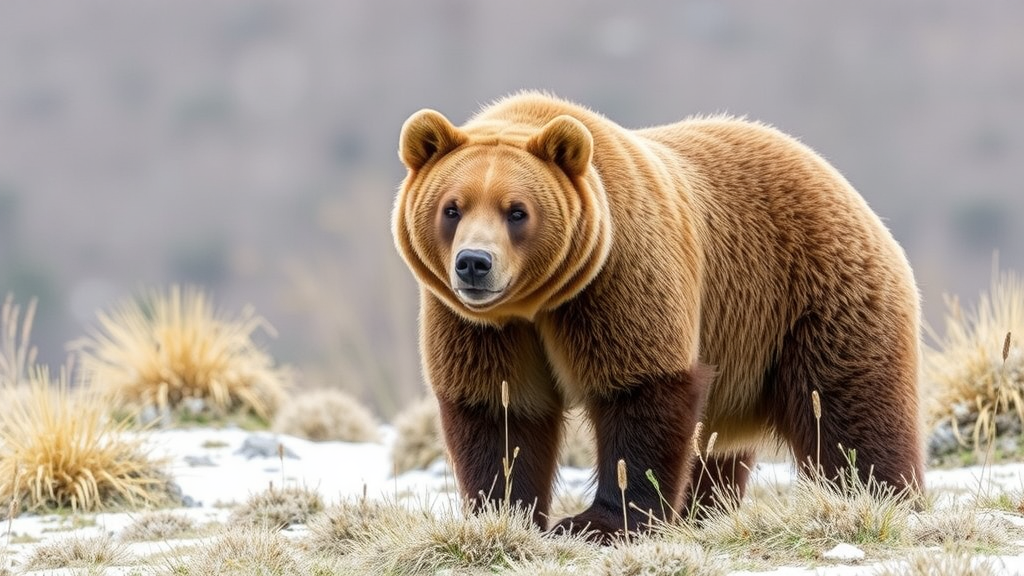
High on the Qinghai-Xizang Plateau, where winter temperatures plunge and food becomes scarce for months at a time, the Tibetan brown bear has quietly mastered one of biology’s most extreme feats: hibernation at altitude. Now, for the first time, scientists have read nearly the entire genome of this elusive apex predator, and what they found is already reshaping how researchers think about bear evolution. A team led by researchers at Qinghai Normal University has assembled a near telomere-to-telomere, chromosome-level genome of a female Tibetan brown bear, an achievement that places Ursus arctos pruinosus among a small handful of mammals whose genetic instruction book has been stitched together from one end of every chromosome almost all the way to the other. The study, published in BMC Genomics, offers both a treasure map of the species’ evolutionary past and a striking clue about how it survives the brutal conditions of the world’s highest plateau.
The technical achievement at the heart of the study is considerable. Building a truly complete genome has long been one of genomics’ most stubborn challenges, because repetitive DNA sequences near the centers and ends of chromosomes resist standard sequencing methods. The research team overcame this by combining PacBio HiFi long-read sequencing, which produces highly accurate reads spanning tens of thousands of DNA letters, with Hi-C technology, which captures the physical contacts between distant stretches of chromosomes and allows the sequences to be anchored into their correct chromosomal positions. The final assembly spans 2.42 gigabases, with a scaffold N50 of 72.35 megabases and a contig N50 of 66.56 megabases, meaning that half of the assembled genome resides in stretches longer than those figures. The guanine-cytosine content of the assembly sits at 42.36 percent. In practical terms, the contiguity of this assembly approaches the ideal of a single gap-free sequence per chromosome, giving researchers an unprecedented view of the bear’s genome architecture.
With that high-resolution reference in hand, the team turned to comparative genomics, aligning the Tibetan brown bear’s chromosomes against those of its closest living relative, the polar bear. The analysis revealed high chromosomal synteny between the two species, meaning that large blocks of genes retain the same order and orientation across both genomes despite millions of years of separate evolution. This structural conservation is scientifically valuable for two reasons. It confirms that the assembly is accurate, since genuine chromosome-scale structure should be preserved between closely related ursids, and it provides a stable framework for pinpointing the regions that have instead diverged, which are precisely the locations where adaptation to very different environments, Arctic sea ice versus high-altitude steppe, is most likely to leave its mark.
The genomic record also preserves a vivid portrait of the species’ demographic turbulence. By reconstructing changes in effective population size through time, the researchers found that the Tibetan brown bear expanded during the early Pleistocene, a period of dynamic climate and habitat change. That expansion, however, was followed by two severe population bottlenecks. The first occurred approximately two million years ago, coinciding with the pre-Poyang Glaciation, and the second struck around one hundred thousand years ago during the Last Glacial Period. Together, these crashes reduced the bear’s cumulative effective population size by nearly eighty percent. For a species that today persists only on the Qinghai-Xizang Plateau, this history of repeated near-collapses carries a sobering message about the genetic fragility that may still lurk beneath its wild, unbroken landscape.
Yet survival through those bottlenecks suggests the species carries more than vulnerability. Enduring glacial cycles on a plateau whose average elevation exceeds 4,000 meters demands a physiology unlike that of lowland relatives, and the most striking discovery of the study concerns exactly that. When the researchers examined candidate hibernation-related pathways, they found that the Tibetan brown bear displays a distinctly carbohydrate-dominated metabolic signature. This stands in sharp contrast to the hibernation strategy documented in North American brown bears, which rely primarily on lipid, or fat-based, metabolism to fuel their long winter dormancy. In other words, two populations of the same widespread species appear to have evolved fundamentally different biochemical approaches to the same survival problem.
The implications of that finding extend well beyond bears. Fat is the standard fuel of hibernation across most studied mammals, because it stores more energy per gram and spares blood sugar during months of fasting. A sugar-first strategy on the Tibetan Plateau hints at selective pressures unique to that environment, where the short growing season, the composition of available foods, and the metabolic demands of life at low oxygen levels may have favored a different balance of carbohydrate and lipid pathways. The authors emphasize that this distinct metabolic adaptation highlights the bear’s unique mechanisms for surviving the extreme plateau environment, and it gives physiologists a natural experiment in alternative hibernation biochemistry encoded within a single species.
For conservation biologists, the new genome arrives at a critical moment. The Tibetan brown bear sits at the top of the plateau’s food web, playing a crucial ecological role, yet high-quality genomic resources for the species have been scarce until now. A chromosome-level reference genome transforms what conservation managers can do: it enables accurate estimates of genetic diversity and inbreeding, allows the tracking of gene flow between populations, and provides the resolution needed to identify locally adapted lineages that deserve special protection. Given the roughly eighty percent historical reduction in effective population size documented in the study, such tools are not a luxury. They are the baseline data upon which any serious plan for the species’ long-term management on the plateau must rest.
The study also strengthens the broader evolutionary picture of the bear family. Ursids have long fascinated evolutionary biologists because the family contains species with radically different ecologies, from the omnivorous brown bear to the hypercarnivorous, ice-bound polar bear. A near telomere-to-telomere assembly for the Tibetan brown bear adds a critical high-quality data point for reconstructing the phylogenomic relationships within Ursus and for dating the divergences that produced today’s brown bear lineages. Because structural variants, gene duplications, and regulatory regions can now be examined in their full chromosomal context rather than through fragmented assemblies, questions about how bears colonized and adapted to some of Earth’s harshest habitats can be addressed with far greater precision than before.
The research was carried out by Muran Zhao, Anmin Wang, Hai Liu, Chenxing Yu, Yanlin Liu, Nan Sun, and Guogang Li of Qinghai Normal University, with fieldwork, sample collection, and laboratory analysis conducted under permits granted by the university. The work was supported by the National Natural Science Foundation of China. The team notes that the new assembly is intended as a resource for the wider community, facilitating future studies of ursid evolutionary history and supporting conservation and management of the plateau’s wildlife. Because the genome is derived from a female bear, it also enables improved analysis of the sex chromosomes, an area where earlier fragmented assemblies often fell short.
What began as a technical sequencing project has ended with a discovery that may echo well beyond the Qinghai-Xizang Plateau. If a close relative of the brown bears studied across North America and Eurasia can hibernate on a carbohydrate-dominated metabolic program, then hibernation is not a single fixed solution that evolution produced once and reused everywhere. It is a flexible toolkit, and different populations have assembled it from different parts. As climate change alters the length and severity of winters across the world’s mountains, understanding that flexibility, and the genes that underpin it, could prove essential not only for protecting the Tibetan brown bear but for predicting which hibernating species can adjust and which cannot. The near-complete genome of this high-altitude survivor is now available as the roadmap for answering those questions.
Subject of Research: Chromosome-level genome assembly and hibernation-related evolution of the Tibetan brown bear (Ursus arctos pruinosus)
Article Title: Near telomere-to-telomere genome reveals the phylogenomics and hibernation-related evolution in Tibetan brown bear (Ursus arctos pruinosus)
Article References: Zhao, M., Wang, A., Liu, H., Yu, C., Liu, Y., Sun, N., & Li, G. (2026). Near telomere-to-telomere genome reveals the phylogenomics and hibernation-related evolution in Tibetan brown bear (Ursus arctos pruinosus). BMC Genomics. https://doi.org/10.1186/s12864-026-13324-3
Image Credits: AI Generated
DOI: 10.1186/s12864-026-13324-3
Keywords: Tibetan brown bear, telomere-to-telomere genome, genomics, hibernation, Qinghai-Xizang Plateau, population bottlenecks, PacBio HiFi, Hi-C sequencing, phylogenomics, conservation genomics, carbohydrate metabolism, Ursidae evolution
Cite Scienmag News
Juliet Wilcox. (September 12, 2026). Near-Complete Genome of Tibetan Brown Bear Reveals a Sugary Secret to Surviving the Roof of the World. Scienmag. https://scienmag.com/near-complete-genome-of-tibetan-brown-bear-reveals-a-sugary-secret-to-surviving-the-roof-of-the-world/
Juliet Wilcox. "Near-Complete Genome of Tibetan Brown Bear Reveals a Sugary Secret to Surviving the Roof of the World." Scienmag, 12 September 2026, https://scienmag.com/near-complete-genome-of-tibetan-brown-bear-reveals-a-sugary-secret-to-surviving-the-roof-of-the-world/. Accessed 5 October 2026.
Juliet Wilcox. "Near-Complete Genome of Tibetan Brown Bear Reveals a Sugary Secret to Surviving the Roof of the World." Scienmag. September 12, 2026. https://scienmag.com/near-complete-genome-of-tibetan-brown-bear-reveals-a-sugary-secret-to-surviving-the-roof-of-the-world/


