


Charles Darwin, the father of the Theory of Evolution, was haunted by a certain quandaryuntil his death: the sudden appearance and rapid diversification of plants that have flowers and fruits, angiosperms, which represent 90% of the plants on the planet. For him it was an “abominable mystery” that numerous subsequent studies have sought to clarify. An international study published in the journal Nature, and in which Manual Estrella, a researcher in the Department of Botany, Ecology and Plant Physiology at the University of Cordoba Manuel de la Estrella, has participated, sheds a little more light on the mystery by generating a large tree of life of angiosperms after analyzing 9,500 species, 200 fossils and 1.8 billion “letters” of genetic code.

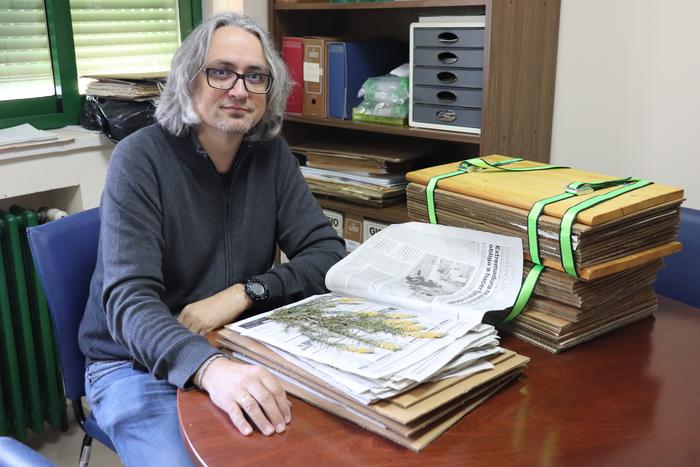
Credit: University of Cordoba
UCO researcher Manuel de la Estrella is part of an international team, led by the Kew Botanical Gardens, which has developed the “tree of life” of flowering plants as a tool with a multitude of uses, from the classification and identification of plants, to conservation in the face of climate change
Charles Darwin, the father of the Theory of Evolution, was haunted by a certain quandaryuntil his death: the sudden appearance and rapid diversification of plants that have flowers and fruits, angiosperms, which represent 90% of the plants on the planet. For him it was an “abominable mystery” that numerous subsequent studies have sought to clarify. An international study published in the journal Nature, and in which Manual Estrella, a researcher in the Department of Botany, Ecology and Plant Physiology at the University of Cordoba Manuel de la Estrella, has participated, sheds a little more light on the mystery by generating a large tree of life of angiosperms after analyzing 9,500 species, 200 fossils and 1.8 billion “letters” of genetic code.
The study, spearheaded by the Kew Botanical Garden an institution that houses one of the largest collections of plants, involved 279 scientists from 139 organizations and 27 countries. This broad participation facilitated access to collections around the world to analyze DNA, compare different sequences and establish relationships between different plant species. Thus, they have worked both with recently collected samples (with well-preserved DNA), and with samples preserved in herbaria, some more than 200 years old, and whose DNA was degraded.
Technological development is what has made it possible to analyze so much information and reconstruct the history of flowering plants’ evolution. Previous studies focused on obtaining genetic information from chloroplasts, a part of plant cells related to photosynthesis and which appear in high quantities in plant cells. The problem is that they offered information on just a few genes. Now, thanks to a molecular analysis tool (Angiosperms353), the team has been able to focus on revealing the information of the nuclear genome, another part of cells that, unlike chloroplasts, is not numerous, but rather unique, offering more information. With this tool they have managed to sequence 353 genes from the DNA of each plant. This information, 15 times greater than that from previous studies, has resulted in the development of the largest tree of life so far for angiosperms.
In addition, they have analyzed data from 200 plant fossils, which served to reconstruct the temporal range of kinship relationships between species and verify that plants underwent very rapid diversification, giving rise to more than 80% of the main lineages that exist today, shortly after their origination.
UCO professor Manuel de la Estrella worked with a Marie Skłodowska-Curie scholarship at the Kew Botanical Garden, studying Detarioideae, abundant plants in the tropical area of Africa and belonging to the Leguminosae (pea or carob) family. He states that the tree “will serve as a foundation for many more subsequent studies, thanks to the large amount of information it offers.” These studies that can range from the classification and identification of plants, to the discovery of new medicinal compounds, bioengineering, genetic improvement, and the conservation of plants in the face of climate change and biodiversity loss.
Reference:
Zuntini, A. R., Carruthers, T. et al, Phylogenomics and the rise of the angiosperms, Nature (2024). www.nature.com/articles/s41586-024-07324-0,
Journal
Nature
Article Title
Phylogenomics and the rise of the angiosperms
Article Publication Date
24-Apr-2024
Cite Scienmag News
Sloane Callahan. (April 30, 2024). Nature publishes the largest “tree of life” of flowering plants to date. Scienmag. https://scienmag.com/nature-publishes-the-largest-tree-of-life-of-flowering-plants-to-date/
Sloane Callahan. "Nature publishes the largest “tree of life” of flowering plants to date." Scienmag, 30 April 2024, https://scienmag.com/nature-publishes-the-largest-tree-of-life-of-flowering-plants-to-date/. Accessed 4 September 2026.
Sloane Callahan. "Nature publishes the largest “tree of life” of flowering plants to date." Scienmag. April 30, 2024. https://scienmag.com/nature-publishes-the-largest-tree-of-life-of-flowering-plants-to-date/

