


Adults recovering in a vocational rehabilitation program in a remote corner of Iceland rated sledging down snowy slopes, kayaking on cold fjord waters, and hiking into the mountains as the most meaningful and psychologically rewarding activities of their rehabilitation, according to a new feasibility study published in the Scandinavian Journal of Occupational Therapy. The research, conducted at a Vocational Rehabilitation Centre in Isafjordur in the Westfjords, offers some of the first evidence that nature-assisted occupations can be successfully woven into vocational rehabilitation in Iceland, and it suggests that the specific design of those activities matters as much as the fact that they take place outdoors.
The study was carried out by Harpa Lind Kristjánsdóttir of the Vocational Rehabilitation Center of the Westfjords, Sigrún Siguröardóttir of the University of Akureyri, and Anna María Pálsdóttir of the Swedish University of Agricultural Sciences in Alnarp. Their goal was practical: to find out which nature-assisted activities participants actually experienced as meaningful and psychologically rewarding, so that the rehabilitation centre could extend and improve the program it offers to clients working toward a return to work or education.
The scientific rationale rests on a substantial body of research showing that nature acts as a salutogenic factor, meaning it actively contributes to health and well-being rather than merely avoiding disease. Both passive exposure to natural environments, such as simply being in a green space, and active engagement, such as gardening or hiking, have been linked to improved mental health. Nature-based interventions have shown particular promise for people with depression, anxiety, and stress-related conditions, and previous Swedish studies have found that longer nature-based rehabilitation may contribute to a faster return to work. Yet, despite this international evidence base, no studies had examined nature-assisted occupations specifically within the Icelandic vocational rehabilitation context, where the landscape, climate, and culture differ markedly from the settings of earlier research.
To fill that gap, the team used a mixed-method convergent longitudinal design over one year. Eleven participants, three men and eight women aged 29 to 53 with an average age of 42, were recruited from the rehabilitation centre and took part in voluntary two-hour nature sessions each week as an add-on to their ongoing rehabilitation. Participation periods ranged from four to eleven months, averaging seven months. The activities fell into five categories: outdoor play, foraging in nature, adventure activities, outdoor gardening, and indoor gardening. Crucially, the sessions were deliberately unstructured. No goals were set for completing work, participants were free to quit mid-task, and they were even encouraged to stop without finishing projects they had started, a design choice intended to relieve the performance pressure that many people with stress-related difficulties find debilitating.
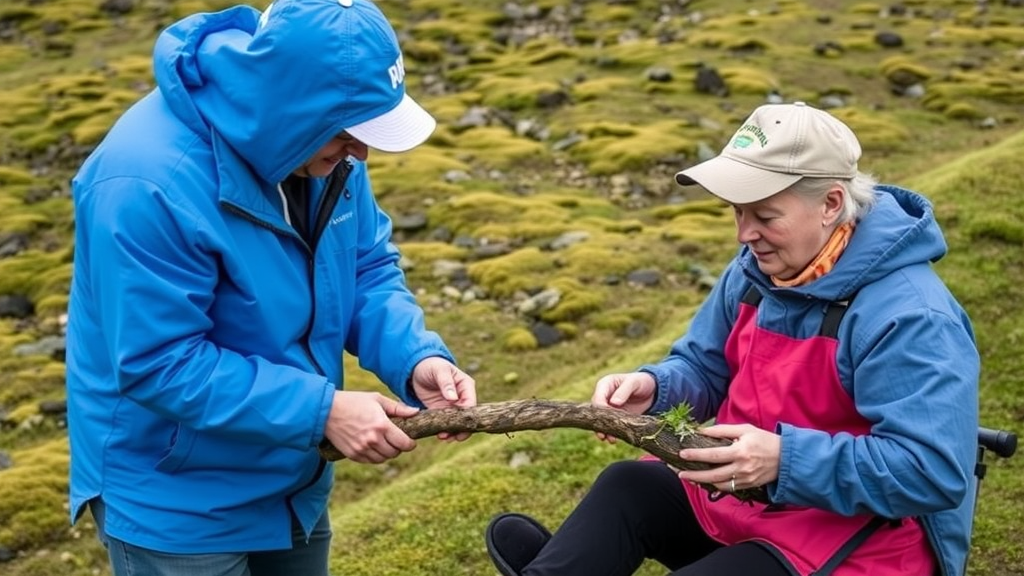
The activity calendar tracked the rhythms of the Icelandic year. In winter, participants built snow sculptures and snowmen, made snow angels, and sledged down mountainsides, carrying their sledges back up repeatedly despite fatigue. In late June they picked herbs that were dried and brewed into tea; in August they gathered bilberries eaten with cream; in October they harvested Icelandic moss, later boiled in milk as a nourishing drink; and in November, timed carefully around low tide, they collected dulse seaweed that was rinsed, baked, and eaten as a snack. Cones, birch branches, heather, and moss gathered in early November became Christmas decorations in December. Spring brought a guided kayak trip from the local sailing club, and autumn a mountain hike along a gentle marked path to a viewpoint. Outdoor gardening ran from May to September in a 300-square-metre garden beside the centre, while indoor gardening, including sowing, repotting, and propagating plants under vegetation lights, continued year-round.
Quantitatively, the researchers used the Meaningful and Psychologically Rewarding Occupation Rating Scale, a validated instrument in which participants rate how well descriptors such as fun, boring, physically stimulating, mentally stimulating, connecting, and isolating apply to each activity on a scale from one to seven. A calculation method converts these ratings into scores for meaningfulness and psychological reward, each ranging from six to 42, with higher numbers indicating greater meaning or reward. The results were striking: every activity category scored above 30, and the two factors showed a strong positive correlation of 0.92, meaning that activities participants found meaningful were almost invariably the ones they found psychologically rewarding. Adventure activities, outdoor gardening, and outdoor play ranked highest, while foraging and indoor gardening, though still rated positively, came in lower.
The qualitative half of the study, based on a focus group interview with six of the eleven participants supported by photographs, videos, and field notes, explained why. Participants described outdoor play as something they had never considered or dared to do alone, with one remarking that it had not occurred to them to go sledging since childhood. The laughter and joy kept people going despite exhaustion, and for some the physical challenge stirred both sadness over their limitations and a sincere desire to improve. Others initially dismissed play as purposeless, only to conclude that perhaps doing something purely fun was exactly what they needed. Foraging, by contrast, produced a state of absorption and mindfulness, as participants learned to see what had been invisible to them, suddenly noticing cones or moss everywhere once they knew where to look.
The adventure activities generated the most dramatic emotional accounts. None of the participants had ever kayaked before, and one capsized after only fifteen to twenty minutes at sea, later describing the experience as passing through all the emotional realms: the excitement of trying the kayak, an indescribable feeling of freedom alone on the still sea, fear at falling into the water, relief at being rescued by the guide, and pleasure at having achieved it all. On the hike, one participant said he had overcome an invisible hurdle and now knew he could hike in the mountains again by himself. Outdoor gardening gave participants the satisfaction of real tasks that mattered and visible results, while indoor gardening offered the best opportunities for social connection and, for several, sparked a lasting interest in growing plants at home, with one participant reporting that she grew basil on her kitchen windowsill the following summer.
The authors interpret the findings through the lens of occupational science and the theory of occupational values, which distinguishes concrete value tied to results, symbolic value tied to personal and cultural meaning, and self-rewarding value found in the pleasure of performing an activity itself. The three highest-rated categories all took place entirely outdoors in natural settings, which the researchers believe acted as a supportive factor throughout the rehabilitation process, consistent with earlier findings that natural environments support clients across all phases of recovery. Equally important was the absence of performance pressure: participants could stop when they had had enough, and the outdoors even allowed them to step back from the group and work independently. The lower ratings for foraging and indoor gardening may reflect their result-oriented structure, since foraging sessions typically ended with a harvest or product, and indoor activities required cleanup and lacked fresh air, daylight, and the sense of freedom outside walls.
The study’s conclusion is that engagement in enjoyable, flexible, nature-based outdoor occupations supports psychological recovery and well-being in vocational rehabilitation settings, and that personally meaningful, low-pressure nature-assisted occupations deserve a permanent place in such programs. The findings also point to long-term effects: many participants continued nature-based activities on their own after the program ended, echoing earlier research showing that people find ways to incorporate nature into their lives and keep doing so after rehabilitation concludes. The authors caution that this was a feasibility study with a small sample, no specific target group, and a possible selection bias toward people already interested in nature, so the results reflect participants’ experiences of the activities rather than measured health outcomes. Even so, the work provides a concrete foundation for building nature-assisted rehabilitation programs in Iceland and for future studies targeting the needs of different user groups in vocational rehabilitation, suggesting that sometimes the most therapeutic prescription is permission to play, explore, and grow in the open air.
Subject of Research: Participants' experiences of meaningful and psychologically rewarding nature-assisted occupations within vocational rehabilitation in Iceland
Article Title: Meaningful and psychologically rewarding nature-assisted occupations – A feasibility study for improving alternatives in vocational rehabilitation in Iceland
Article References: Kristjánsdóttir, H. L., Siguröardóttir, S., & Pálsdóttir, A. M. (2025). Meaningful and psychologically rewarding nature-assisted occupations – A feasibility study for improving alternatives in vocational rehabilitation in Iceland. Scandinavian Journal of Occupational Therapy, 32(1), 1-14. https://doi.org/10.1080/11038128.2026.2633053
Image Credits: AI Generated
DOI: 10.1080/11038128.2026.2633053
Keywords: nature-assisted activities, vocational rehabilitation, occupational therapy, nature-based interventions, mental health, well-being, Iceland, adventure activities, gardening, stress recovery, meaningful occupation, feasibility study
Cite Scienmag News
Ophelia Keating. (September 12, 2026). Nature-Based Activities Prove Meaningful and Rewarding in Icelandic Vocational Rehabilitation. Scienmag. https://scienmag.com/nature-based-activities-prove-meaningful-and-rewarding-in-icelandic-vocational-rehabilitation/
Ophelia Keating. "Nature-Based Activities Prove Meaningful and Rewarding in Icelandic Vocational Rehabilitation." Scienmag, 12 September 2026, https://scienmag.com/nature-based-activities-prove-meaningful-and-rewarding-in-icelandic-vocational-rehabilitation/. Accessed 5 October 2026.
Ophelia Keating. "Nature-Based Activities Prove Meaningful and Rewarding in Icelandic Vocational Rehabilitation." Scienmag. September 12, 2026. https://scienmag.com/nature-based-activities-prove-meaningful-and-rewarding-in-icelandic-vocational-rehabilitation/


