
Sunday, March 1, 2026
Science
No Result
View All Result
  • Login
  • HOME
  • SCIENCE NEWS
  • CONTACT US
  • HOME
  • SCIENCE NEWS
  • CONTACT US
No Result
View All Result
Scienmag
No Result
View All Result
Home Science News Archaeology

Natural born consumers

August 1, 2024
in Archaeology
Reading Time: 3 mins read
0
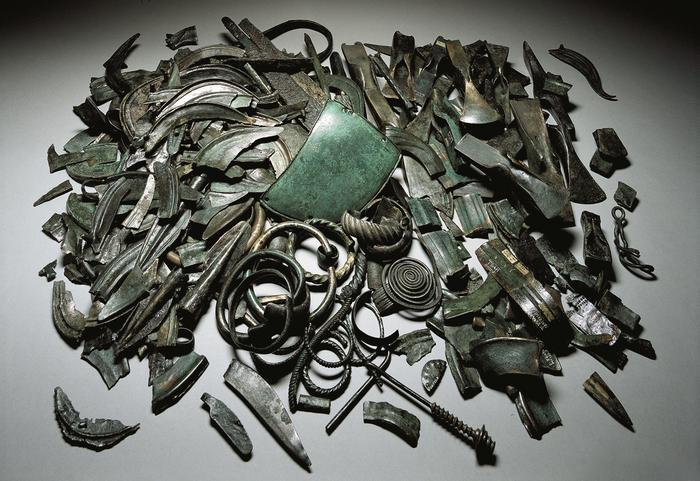
One of the largest hoards of the Late Bronze Age: this scrap hoard discovered in Weißig near Dresden weighs around 20 kilogram and is made up of 63 complete objects and 328 fragments.
67
SHARES
605
VIEWS
Share on FacebookShare on Twitter
ADVERTISEMENT

What if the ‘Market Economy’ always existed? Archaeologists from the Universities of Göttingen in Germany and Salento in Italy tried to answer this question by researching how much Bronze Age people used to spend to sustain their daily lives. Their results show that, starting at least 3,500 years ago, the spending habits of prehistoric Europeans were not substantially different from what they are today. The study was published in Nature Human Behaviour.

One of the largest hoards of the Late Bronze Age: this scrap hoard discovered in Weißig near Dresden weighs around 20 kilogram and is made up of 63 complete objects and 328 fragments.

Credit: Landesamt für Archäologie Sachsen / J. Lipták

What if the ‘Market Economy’ always existed? Archaeologists from the Universities of Göttingen in Germany and Salento in Italy tried to answer this question by researching how much Bronze Age people used to spend to sustain their daily lives. Their results show that, starting at least 3,500 years ago, the spending habits of prehistoric Europeans were not substantially different from what they are today. The study was published in Nature Human Behaviour.


The study analysed more than 20,000 metal objects from more than 1,000 hoards that were buried in Italy, Switzerland, Austria, Slovenia and Germany between around 2,300 BC and 800 BC. The researchers used a statistical technique to determine if the analysed objects are multiples of a unit of weight. They found that starting around 1,500 BC, metal objects were intentionally fragmented in order to obtain multiples of the weight unit of roughly 10 g – a unit which was used everywhere across Europe. This indicates that metal fragments circulated as money. Then they analysed the statistical distribution of the daily expenses of prehistoric households in prehistoric Europe – meaning they observed how much was spent in various amounts – and compared it with modern Western economies.


The researchers found that the weight values of metallic money in prehistory had the same statistical distribution of the daily expenses as a modern Western household: small everyday expenses made up the vast majority of expenses, while larger expenses were comparatively rare. Using simulations, they demonstrated that the most likely scenario to explain the prehistoric data is to imagine an economic system regulated by supply and demand, in which everyone participates proportionally to how much they earn. That is, a market economy.


The prehistoric economy is commonly imagined as a primitive system based on barter and on the exchange of gifts, with the market system appearing as some kind of evolutionary milestone at some point during the making of ‘advanced’ Western societies. The study challenges this notion by showing that not only did the market exist before formal coinage was invented, but even long before any form of state actually appeared in Europe. “We are used to thinking of the market economy as a product of modernity, an innovation that deeply changed people’s lives and minds as soon as it appeared,” explains Dr Nicola Ialongo, University of Göttingen’s Institute for Prehistory and Early History. “Our results suggest that it may have always existed. In a way, one could even think of it as one of the many behavioural traits that define us as humans: like warfare and marriage.”


“To be honest, we were quite surprised by our results,” adds Giancarlo Lago, who carried out the research while at the University of Salento, Department of Cultural Heritage. “Our findings defy some long-established beliefs among archaeologists, economists and anthropologists. They also suggest that many of the differences that we see between ‘Western’ and supposedly ‘primitive’ cultures are not as substantial as we might think.”


Original publication: Ialongo, N., Lago, G. 2024. Consumption patterns in prehistoric Europe are consistent with modern behaviour. Nature Human Behaviour 2024. www.nature.com/articles/s41562-024-01926-4.


Contact:

Dr Nicola Ialongo

University of Göttingen

Faculty of Humanities

Institute for Prehistory and Early History

Nikolausberger Weg 15, 37073 Göttingen

Tel: +49 (0)551 25078

Email: nicola.ialongo@uni-goettingen.de

www.uni-goettingen.de/de/569681.html


Journal

Nature Human Behaviour

DOI

10.1038/s41562-024-01926-4

Method of Research

Data/statistical analysis

Subject of Research

People

Article Title

Consumption patterns in prehistoric Europe are consistent with modern economic behaviour

Article Publication Date

29-Jul-2024

Share27Tweet17
Previous Post

Warming stops tiny organisms working together

Next Post

The Open Encyclopedia of Cognitive Science, a paradigm-shifting open access reference work, officially launches with first articles

Related Posts

Image 1
Archaeology

From the Late Bronze Age to the Present: The Old Irish Goat Embodies 3,000 Years of Irish Heritage

February 26, 2026
Large mining complex (approx. 200 x 50 m)
Archaeology

Newly Discovered Bronze Age Mines in Spain Could Unlock the Origins of Scandinavian Bronze

February 24, 2026
Artist’s impression of the Skateholm burial island
Archaeology

Ancient Stone Age Individual Adorned with Elaborate Feather and Fur Headdress Discovered

February 24, 2026
Signs on Stone Age objects: Precursor to written language dates back 40,000 years
Archaeology

Ancient Stone Age Symbols: Origins of Written Language Traced Back 40,000 Years

February 23, 2026
Fossil Shell Used in Dating Analysis
Archaeology

1.9 Million-Year-Old Out-of-Africa Migration Leaves Lasting Traces in the Jordan Valley, Study Reveals

February 19, 2026
UC Merced student presenting isotope study of Chincha culture
Archaeology

Ancient Peruvian Kingdom Thrived Thanks to Bird Guano, New Analysis Reveals

February 19, 2026
Next Post
The Open Encyclopedia of Cognitive Science, a paradigm-shifting open access reference work, officially launches with first articles

The Open Encyclopedia of Cognitive Science, a paradigm-shifting open access reference work, officially launches with first articles

  • Mothers who receive childcare support from maternal grandparents show more parental warmth, finds NTU Singapore study

    Mothers who receive childcare support from maternal grandparents show more parental warmth, finds NTU Singapore study

    27618 shares
    Share 11044 Tweet 6902
  • University of Seville Breaks 120-Year-Old Mystery, Revises a Key Einstein Concept

    1022 shares
    Share 409 Tweet 256
  • Bee body mass, pathogens and local climate influence heat tolerance

    665 shares
    Share 266 Tweet 166
  • Researchers record first-ever images and data of a shark experiencing a boat strike

    532 shares
    Share 213 Tweet 133
  • Groundbreaking Clinical Trial Reveals Lubiprostone Enhances Kidney Function

    518 shares
    Share 207 Tweet 130
Science

Embark on a thrilling journey of discovery with Scienmag.com—your ultimate source for cutting-edge breakthroughs. Immerse yourself in a world where curiosity knows no limits and tomorrow’s possibilities become today’s reality!

RECENT NEWS

  • Electronic Frailty Index: Valid Tool for Primary Care
  • Geriatric Surgery Outcomes: Mortality and Hospital Stay Factors
  • Risk Factors for Elderly Bacteraemia Deaths Revealed
  • Sub-1V Reconfigurable Gires-Tournois Resonators Enable Full-Color Monopixels

Categories

  • Agriculture
  • Anthropology
  • Archaeology
  • Athmospheric
  • Biology
  • Biotechnology
  • Blog
  • Bussines
  • Cancer
  • Chemistry
  • Climate
  • Earth Science
  • Editorial Policy
  • Marine
  • Mathematics
  • Medicine
  • Pediatry
  • Policy
  • Psychology & Psychiatry
  • Science Education
  • Social Science
  • Space
  • Technology and Engineering

Subscribe to Blog via Email

Enter your email address to subscribe to this blog and receive notifications of new posts by email.

Join 5,190 other subscribers

© 2025 Scienmag - Science Magazine

Welcome Back!

Login to your account below

Forgotten Password?

Retrieve your password

Please enter your username or email address to reset your password.

Log In
No Result
View All Result
  • HOME
  • SCIENCE NEWS
  • CONTACT US

© 2025 Scienmag - Science Magazine

Discover more from Science

Subscribe now to keep reading and get access to the full archive.

Continue reading