


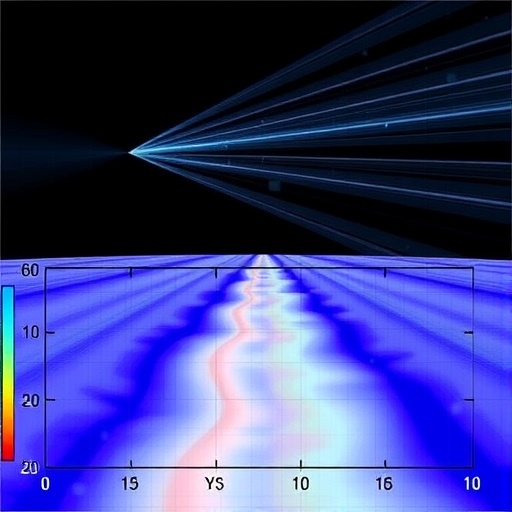
In a breakthrough that promises to revolutionize high-precision frequency measurements, researchers Zhang, Ba, Yang, and colleagues have unveiled a novel interpretation of the Doppler effect, termed the “Generalized Doppler Effect.” Published in Light: Science & Applications, this pioneering work offers a transformative lens through which subtle frequency shifts can be detected with unprecedented accuracy, opening new frontiers in optical metrology, communication technologies, and fundamental physics experiments.
The classical Doppler effect, familiar since the 19th century, describes the change in frequency of waves — such as sound or electromagnetic radiation — as the source and observer move relative to each other. Traditionally employed in radar speed detection, medical imaging, and astronomy, the accuracy of such measurements has been bounded by constraints of conventional theory and instrumental limitations. The new generalized framework proposed by Zhang and colleagues not only extends the Doppler paradigm but also fundamentally recalibrates the relationship between frequency shifts and their causative dynamics.
At the heart of this advancement lies an innovative mathematical formalism that encompasses broader motion and wave interaction scenarios beyond uniform linear velocity. The study meticulously redefines the parameters affecting frequency variations, including acceleration, angular momentum of light, and complex media interactions, thus enabling a more comprehensive frequency shift analysis capable of detecting changes that previous methodologies would have deemed indistinguishable from noise.
This refined description hinges on an enhanced treatment of wave-particle duality and relativistic effects, introducing novel operators into the Doppler shift equations. The team successfully integrates these conceptual tools with cutting-edge frequency-comb technology, allowing experimental validation that demonstrates frequency resolution improvements by orders of magnitude compared to traditional approaches.
Importantly, the implications of such precise frequency determination extend far beyond laboratory benchwork. For instance, this advance could enable ultra-sensitive detection of gravitational waves through laser interferometers, where minute frequency shifts encode critical information about cosmic events. Similarly, in telecommunications, the ability to discern minuscule frequency deviations could dramatically enhance data integrity and channel capacity in fiber-optic networks, supporting the ever-growing demand for faster and more reliable internet connections.
The research also addresses a longstanding challenge in Doppler-based velocity measurements. Conventional interpretations often struggle with complex motion paths or multi-directional velocities, which introduce ambiguity and degrade measurement fidelity. By generalizing the Doppler effect, Zhang et al. formulate a framework that inherently accounts for these intricate motion patterns, thus providing unambiguous and high-accuracy velocity and frequency shift readings in real-world, multidimensional scenarios.
One of the most striking aspects of this study is how it leverages advancements in quantum optics and laser physics. The team employs a sophisticated combination of coherent light sources, precision modulators, and ultra-stable cavities to generate and monitor frequency shifts under controlled experimental conditions. Such orchestration allows for meticulous scrutiny of the generalized Doppler effect’s predictions, affirming its practical viability and setting the stage for immediate technological adoption.
Beyond pure physics and engineering, this breakthrough may catalyze a new wave of innovation in sensing technologies. Applications in environmental monitoring, geological surveying, and even biomedical diagnostics stand to benefit from tools capable of detecting highly subtle changes in frequency caused by physical or chemical alterations in a sample’s environment, potentially enabling real-time, non-invasive analysis with superior accuracy.
Moreover, the study’s rigorous theoretical backbone has unearthed fresh insights into the interplay between electromagnetic waves and moving media, which could inspire novel metamaterials and photonic devices tailored to manipulate frequency shifts intentionally. Such materials might pave the way for dynamic light control systems with applications ranging from adaptive camouflage to quantum information processing.
The generalized Doppler effect framework also rewrites the classical understanding of frequency shift asymmetries, revealing conditions under which counterintuitive frequency behaviors arise, such as frequency shifts invariant under specific acceleration profiles or angular momentum states of the probing beam. These findings challenge long-held assumptions and promise to invigorate research into wave dynamics and relativistic phenomena.
In summary, the work by Zhang, Ba, Yang, and their team sets a new standard for frequency shift measurement science. By transcending the limitations of classical Doppler theory, it not only refines the fundamental physics of wave propagation but also unlocks tangible benefits for a wide array of high-tech domains. As industries facing stringent precision demands seek ever finer measurement tools, the generalized Doppler effect stands poised to become a foundational principle underpinning next-generation instruments and methodologies.
Looking forward, ongoing research will likely explore integrating this generalized framework with emerging quantum sensors and nanoscale photonic platforms. Such convergence could amplify sensitivity even further, potentially enabling detection of phenomena currently beyond observational reach—like dark matter interactions or minute spacetime distortions—thereby deepening humanity’s understanding of the universe.
This research underscores the enduring vitality of classical physics concepts, demonstrating how innovative reinterpretation coupled with modern technology can yield breakthroughs that ripple across both theoretical and applied sciences. As adoption spreads through academic and industrial laboratories worldwide, the generalized Doppler effect will undoubtedly fuel a cascade of novel discoveries and technological leaps in the coming years.
Cite Scienmag News
Denise Maddox. (April 13, 2026). Generalized Doppler Effect Enhances Frequency Shift Accuracy. Scienmag. https://scienmag.com/generalized-doppler-effect-enhances-frequency-shift-accuracy/
Denise Maddox. "Generalized Doppler Effect Enhances Frequency Shift Accuracy." Scienmag, 13 April 2026, https://scienmag.com/generalized-doppler-effect-enhances-frequency-shift-accuracy/. Accessed 4 September 2026.
Denise Maddox. "Generalized Doppler Effect Enhances Frequency Shift Accuracy." Scienmag. April 13, 2026. https://scienmag.com/generalized-doppler-effect-enhances-frequency-shift-accuracy/


