


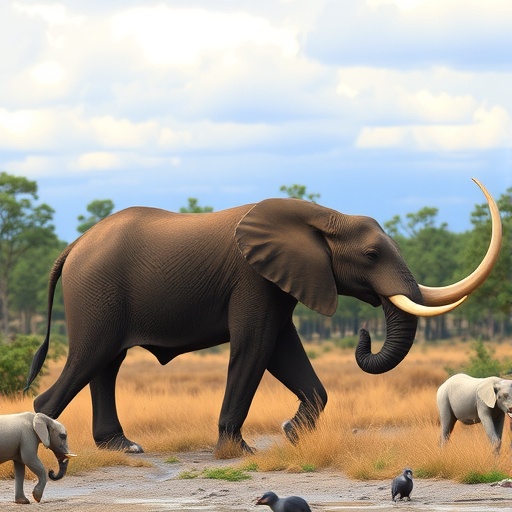
A new meta-analysis is challenging one of ecology’s most familiar assumptions: that the effects of large animals depend primarily on whether they are native to an ecosystem. The study, led by E.J. Lundgren, S. Nakagawa and J. Trepel, concludes that native and introduced megafauna can produce remarkably similar changes in animal communities and ecosystem processes. Published in Nature Communications, the research brings together evidence from studies of some of the planet’s largest land animals and suggests that body size, feeding strategy and behavior may often matter more than geographic origin when predicting ecological consequences.
Megafauna are generally defined as very large-bodied animals, although ecologists use different size thresholds depending on the research question. Elephants, rhinoceroses, hippopotamuses, giraffes, bison and large deer are classic examples, but the category can also include giant tortoises, camels, wild cattle and other oversized herbivores. Their ecological influence extends far beyond the plants they consume. By browsing trees, trampling vegetation, digging soil, dispersing seeds, creating wallows and opening paths through dense habitats, large animals physically reshape landscapes. Predators and scavengers respond to their presence, while smaller animals may gain or lose food, shelter and breeding sites as a result.
The central finding of the study concerns convergence: animals with different evolutionary histories can nevertheless generate comparable ecological effects when they occupy similar functional roles. A large herbivore introduced to a new region may browse vegetation, transport seeds and disturb soil in ways that resemble the activities of a native herbivore that disappeared centuries ago. Conversely, a native species can exert strong and disruptive pressure when its population expands or when human activity changes the ecological conditions around it. In this framework, “native” and “introduced” describe biogeographic history, but they do not by themselves explain how an animal functions within an ecosystem.
The researchers used a meta-analysis, a statistical approach that combines results from multiple independent studies to identify broader patterns. Individual ecological experiments often differ in habitat, climate, species, measurement methods and study duration. One investigation may measure plant biomass, another seed dispersal, another bird abundance or soil nutrient cycling. Meta-analysis allows those diverse findings to be translated into comparable effect sizes, estimates of how strongly an ecological variable changes in the presence, absence or altered abundance of a particular animal. By examining the direction and magnitude of effects across studies, scientists can test whether apparently different animals repeatedly influence ecosystems in similar ways.
The technical importance of this approach lies in its focus on ecological function rather than identity alone. A species’ effect can be mediated through several pathways at once. Herbivory removes leaves and can alter competition among plants. Trampling compresses soil in some locations but creates bare ground and germination sites in others. Digging may expose minerals, mix organic matter and increase water infiltration. Seed movement can connect plant populations across fragmented landscapes, while dung supports insects and returns nutrients to the soil. These mechanisms can trigger cascading responses through food webs, meaning that changes initiated by a large animal may eventually affect organisms that never directly interact with it.
Such effects are not automatically beneficial or harmful. The same behavior can produce contrasting outcomes depending on context. Browsing may suppress invasive vegetation, maintain open grassland and increase habitat diversity, yet excessive browsing can prevent forest regeneration. Wallows created by large mammals may become breeding sites for amphibians and invertebrates, but they can also spread parasites or damage sensitive wetlands. Seed dispersal may help native plants recolonize degraded land, while transported seeds may include invasive species. The meta-analysis therefore speaks less to a simple verdict about megafauna and more to the need to understand the mechanisms and conditions through which their influence is expressed.
The findings carry particular weight in a world where humans have removed, relocated and reintroduced large animals on an unprecedented scale. Many ecosystems have lost their original megafauna through hunting, habitat conversion and climate change. In other regions, animals have been transported beyond their historical ranges, either deliberately for conservation, agriculture and hunting or accidentally through trade and human movement. Conservation programs increasingly consider rewilding, the restoration of ecological processes associated with missing species, while managers also confront introduced large mammals that alter vegetation, soils and water systems. The study’s conclusion suggests that both situations should be evaluated using the same ecological questions: What does the animal eat? How does it move? What does it disturb, transport or create? Which species respond?
This perspective could complicate conservation policy, which often treats native species as inherently desirable and introduced species as inherently damaging. Geographic origin remains critically important because introduced animals can carry pathogens, compete with endemic species or lack natural predators. Native species can also be threatened, culturally significant or essential to long-established food webs. Yet the research indicates that origin alone may be a poor shortcut for forecasting ecological impact. A large introduced grazer might restore a missing disturbance regime in one landscape, while a native grazer at unnaturally high density might degrade the same type of habitat elsewhere. Effective management may therefore require measurements of population density, seasonal behavior, resource use and interactions with other species rather than labels alone.
The study also highlights why large animals are disproportionately important in ecosystem science. Their bodies require substantial energy, their movements cover broad areas and their physical interactions with landscapes are difficult for smaller organisms to replicate. A single elephant can break branches, excavate water, disperse seeds over long distances and create habitat used by numerous species. A herd can transform vegetation structure across hundreds of hectares. At the same time, megafauna populations are often highly sensitive to human pressures because they reproduce slowly and require extensive ranges. Their ecological influence and their vulnerability are therefore linked: the disappearance of a large animal can remove an entire suite of processes, while its rapid population increase can amplify those same processes beyond historical levels.
The broader message from Lundgren, Nakagawa, Trepel and their colleagues is that ecosystems respond to what animals do, not simply to where those animals originated. By revealing convergent effects among native and introduced megafauna, the meta-analysis offers a more functional way to interpret ecological change. It does not erase the distinction between conservation and biological invasion, nor does it imply that all large animals are interchangeable. Instead, it encourages scientists and land managers to examine traits, interactions and measurable ecosystem outcomes together. As rewilding projects expand and landscapes continue to lose or gain large animals, that evidence-based approach may become essential for deciding which species belong where, at what densities and with what consequences.
Cite Scienmag News
Gavin Prescott. (August 21, 2026). Native and introduced megafauna similarly reshape animals and ecosystems, meta-analysis finds. Scienmag. https://scienmag.com/native-and-introduced-megafauna-similarly-reshape-animals-and-ecosystems-meta-analysis-finds/
Gavin Prescott. "Native and introduced megafauna similarly reshape animals and ecosystems, meta-analysis finds." Scienmag, 21 August 2026, https://scienmag.com/native-and-introduced-megafauna-similarly-reshape-animals-and-ecosystems-meta-analysis-finds/. Accessed 3 September 2026.
Gavin Prescott. "Native and introduced megafauna similarly reshape animals and ecosystems, meta-analysis finds." Scienmag. August 21, 2026. https://scienmag.com/native-and-introduced-megafauna-similarly-reshape-animals-and-ecosystems-meta-analysis-finds/


