


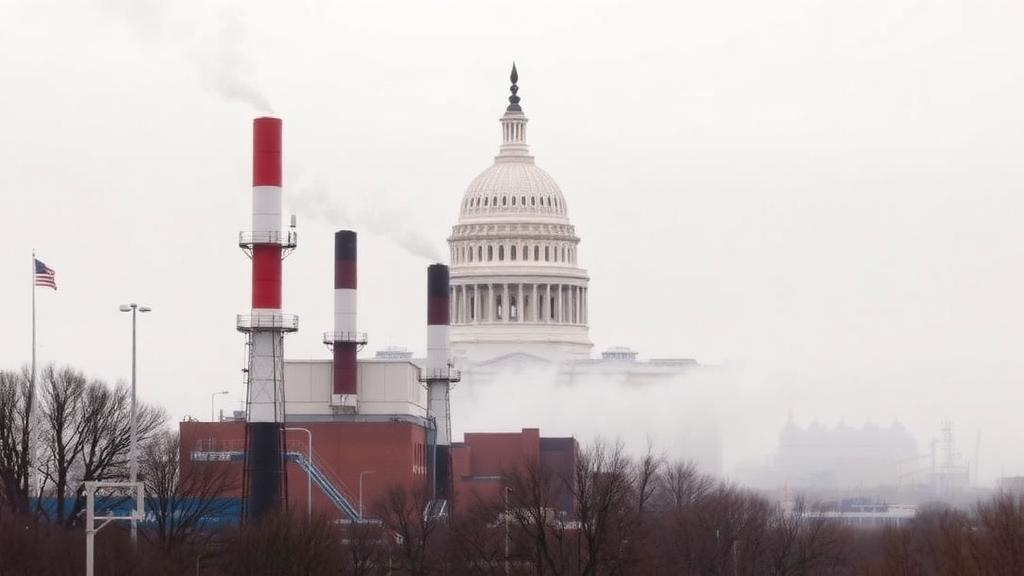
A close congressional election can decide far more than who holds a seat in Washington. According to a new study published in the September print edition of The Review of Financial Studies, the party affiliation of a narrowly elected U.S. House representative is strongly associated with the amount of pollution that industrial plants emit within that representative’s district. The analysis, conducted by a multi-institutional team including researchers at Penn State, examined nearly 40,000 industrial facilities and more than 5,000 House elections over a quarter century, and it found that plants located in districts carried by a Democrat by a slim margin emitted roughly 30 percent less on average than comparable plants in districts narrowly won by a Republican.
The research team, which included Stefan Lewellen, assistant professor of finance at Penn State’s Smeal College of Business, built its dataset from 37,368 industrial plants and 5,304 U.S. House elections held between 1991 and 2016. Rather than analyzing all races equally, the core of the study focused on a smaller subset of close elections. This design choice is central to the paper’s credibility. When a race is decided by a razor-thin margin, the overall environmental preferences of voters in the district should be largely similar regardless of which candidate ultimately prevails. That similarity allows the researchers to isolate the effect of the winning representative’s own preferences from the underlying attitudes of the electorate, a persistent challenge in research that links political outcomes to economic or environmental results.
The mechanism the authors propose is not formal legislation. Congressional representatives typically wield little direct legislative control over their own districts, and most enforcement of Environmental Protection Agency regulations happens at the state and local level. Instead, the study points to what the researchers describe as political soft power. Representatives can lean on firms indirectly, for example by pressing state regulators to conduct more inspections, pursue tighter enforcement, or, conversely, to ease off. As Lewellen noted, there is never going to be a smoking gun in this kind of research, because the phone call or the coffee meeting between a politician and a regulator or firm executive is never observed. The evidence has to be assembled by looking around the edges of the system.
One of those edges is the inspection record. The team’s analysis found that close Democratic wins were associated with approximately 34 percent higher inspection rates and roughly 30 percent more enforcement actions in the affected districts. Notably, most of these enforcement actions were informal measures such as cease-and-desist letters rather than severe formal penalties like fines or formal investigations. This pattern fits the economics of compliance. Companies strongly dislike formal enforcement fines because they generate public and negative publicity, so firms often respond to informal pressure by reducing emissions, but typically only enough to avoid triggering harsher penalties. The regulatory structure itself creates room for this dynamic, since pollution permits are rarely simple annual caps. Limits can be set by the day, the hour, or even the minute, and they can vary with factors such as temperature, which makes inspections a key tool for catching irregularities in a system that otherwise offers firms considerable gray area.
Firms, it turns out, have multiple technical levers they can pull to change their emissions profile. The researchers documented a 47 percent higher investment in abatement technologies in Democratic districts. These technologies include wet scrubbers, which remove pollutants directly from contaminated gas streams before they are released into the atmosphere. Plants in Democratic districts also showed higher rates of postproduction treatment and recycling. Crucially, the study found no major differences in plant productivity between the two groups, which suggests that the emissions gap reflects deliberate choices about pollution control rather than differences in how hard the plants were running or how efficiently they operated.
Perhaps the most striking finding concerns multi-district firms. The researchers discovered that emissions were higher at a given plant when its parent company’s other facilities were located in districts with Democratic representation. In other words, firms with a national footprint appear to reallocate pollution away from Democratic areas, shifting the burden toward districts where political pressure to clean up is weaker. The interpretation offered by the team is that firms attempt to recoup the higher investment costs they incur in Democratic districts by allowing their plants elsewhere to pollute more. This reallocation, however, was often imperfect, and it carried measurable financial consequences for the companies themselves.
Those financial consequences were quantified directly. Raising a firm’s share of Democratic representatives from zero to one increased its cost of goods sold by about 4 percent and lowered its market-to-book ratio, a stock valuation metric that serves as a proxy for firm value, by a similar degree. These figures indicate that the compliance costs induced by politically influenced enforcement are material at the level of the whole enterprise, large enough to show up in accounting statements and in how investors value the company. The findings therefore connect electoral outcomes not only to local air quality but to corporate balance sheets, adding a financial dimension to the well-documented relationship between politics and environmental policy.
The public health implications are equally concrete. Drawing on data from the Center for Medicare and Medicaid Services, the researchers explored how differing pollution rates affected health outcomes within these districts. They broke districts down into smaller areas based on three-digit ZIP codes, which correspond to metropolitan areas or regions within states and also act as typical service areas for hospitals. Within those areas, they compared respiratory illness rates and associated healthcare costs between places with a high number of industrial plants and places with a low number. Because respiratory illnesses are always higher in areas with many plants, the key test was whether that gap changed after a Democrat was elected, a comparison that isolates the effect of pollution changes from the other differences between plant-dense and plant-sparse areas.
The results were sobering. In areas with high numbers of plants, districts represented by a Republican showed a 7 to 8 percent higher incidence of respiratory illnesses and 7 to 13 percent higher healthcare costs for respiratory-related hospital visits compared with districts represented by a Democrat. The researchers estimated that each Democrat-to-Republican House seat transition is associated with 67 additional hospital visits, costing around 628,000 dollars per year. Because firms reallocate emissions across districts, the health burden does not simply disappear when one area cleans up; it can migrate to communities whose voters had no direct say in the matter, raising questions about the geographic equity of environmental enforcement in a system where local political pressure determines how strictly the rules are applied.
Beyond the specific numbers, the study speaks to a larger point about the American democratic system. The Clean Air Act of 1970 standardized pollution limits at the national level, yet individual politicians still exert significant influence over how those limits are experienced on the ground. As Lewellen observed, politicians’ preferences are just as important as the laws that are passed in deciding what happens in their districts. For voters, the research suggests that a single House race can shape the air their communities breathe, the health costs they bear, and the investment decisions of the firms operating in their backyards. For firms and regulators alike, the findings reveal a pollution dial that is far more responsive to local political pressure than the letter of federal law alone would imply, with consequences that ripple across district lines and into the national economy.
Subject of Research: The influence of congressional election outcomes on local industrial emissions, regulatory enforcement, and public health in the United States
Article Title: Local industrial emissions linked to congressional election outcomes
Article References: Local industrial emissions linked to congressional election outcomes. (n.d.). Original publication
Image Credits: AI Generated
DOI: Not provided
Keywords: industrial emissions, Clean Air Act, U.S. House elections, political soft power, regulatory enforcement, abatement technology, public health, respiratory illness, corporate finance, environmental regulation, Penn State, Review of Financial Studies
Cite Scienmag News
Courtney Benton. (October 5, 2026). Narrow Election Wins Shape Industrial Pollution in US House Districts. Scienmag. https://scienmag.com/narrow-election-wins-shape-industrial-pollution-in-us-house-districts/
Courtney Benton. "Narrow Election Wins Shape Industrial Pollution in US House Districts." Scienmag, 5 October 2026, https://scienmag.com/narrow-election-wins-shape-industrial-pollution-in-us-house-districts/. Accessed 5 October 2026.
Courtney Benton. "Narrow Election Wins Shape Industrial Pollution in US House Districts." Scienmag. October 5, 2026. https://scienmag.com/narrow-election-wins-shape-industrial-pollution-in-us-house-districts/


