


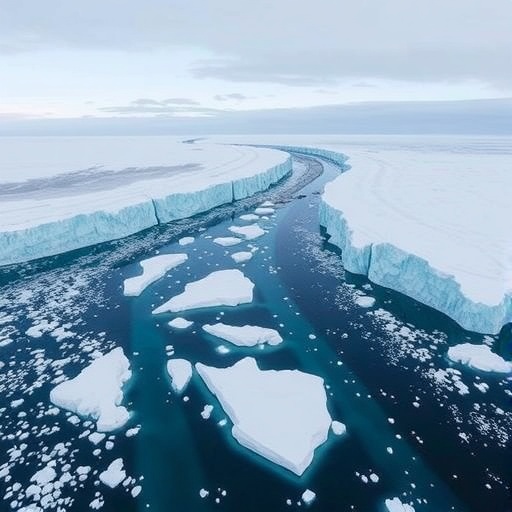
A vast opening in the Arctic sea ice has long been treated as one of nature’s great contradictions: a region surrounded by frozen ocean that remains seasonally open, productive and biologically alive. Now, a new study presents the North Water Polynya as both remarkably persistent and more dynamic than its stable reputation suggests. The research, led by F. Tachon, K. Nieto and P. Massicotte, shows how the interaction between sea-ice arches in Nares Strait and oceanic circulation can maintain the polynya over long periods while also creating new, highly productive hotspots along its margins. The findings offer a more detailed view of how Arctic ecosystems function in a warming world—and why changes in seemingly small ice structures can have consequences across the food web.
The North Water Polynya, also known by its Inuktitut name Pikialasorsuaq, lies between northern Greenland and Ellesmere Island in the Canadian Arctic. A polynya is an area of open water or thin ice within a region that is otherwise frozen. These openings can form when winds push ice away from a coastline, when warm water rises from below, or when currents and tides prevent new ice from remaining in place. The North Water is unusual because it is not simply a temporary break in the ice. It repeatedly opens in the same broad region, generating sunlight, access to the atmosphere and space for marine life during a season when much of the Arctic Ocean is locked under ice.
Its ecological importance begins with physics. When sunlight returns after the polar night, the open surface of a polynya allows light to penetrate the upper ocean. That energy stimulates microscopic algae known as phytoplankton, which convert sunlight and carbon dioxide into organic matter through photosynthesis. Phytoplankton feed zooplankton, which support fish, seabirds and marine mammals. In the North Water, this chain helps sustain organisms ranging from tiny copepods to narwhals, seals and polar bears. The region is also culturally significant for Inuit communities, whose travel, hunting and ecological knowledge are closely connected to sea-ice conditions.
The new research focuses on Nares Strait, a narrow marine passage separating Greenland from Ellesmere Island. Nares Strait acts as a gateway through which sea ice can move between the Arctic Ocean and Baffin Bay. During winter, thick accumulations of ice can form arches across constricted sections of the strait. These structures are sometimes called ice bridges or ice arches because they span the channel and partially lock the surrounding pack ice in place. They are not permanent features: they can form, weaken, fracture and collapse as winds, tides, ocean currents and air temperatures shift. Yet while they stand, they can dramatically reorganize the movement of ice and water.
An ice arch functions less like a solid wall than a temporary mechanical gate. The arch can halt or slow the downstream drift of large ice floes, while winds continue to move thinner ice and broken fragments around its edges. This difference in mobility creates zones where ice is compressed, diverted or repeatedly cleared. The result is a complex mosaic: dense pack ice in one location, open water in another and thin, newly formed ice elsewhere. According to the study, these arch-driven patterns help explain why the North Water can remain stable as a regional phenomenon while its most biologically active locations shift over time.
That distinction is crucial. “Stable” does not mean motionless. A polynya may persist in roughly the same geographic area for decades while the exact position of its open-water zones, ice-edge boundaries and biological hotspots changes from season to season. The researchers’ focus on long-term stability alongside emerging productivity hotspots highlights this layered behavior. Large-scale geography can remain recognizable even as local conditions are constantly rearranged by the timing of arch formation, the direction of ice transport and the exchange of water through Nares Strait.
The biological consequences of this ice architecture can be substantial. Sea-ice edges concentrate nutrients, light and organisms, creating what oceanographers call ecological interfaces. As ice moves, melts or fractures, it can release algae that grow on its underside and transport nutrients between different parts of the marine system. Open-water areas expose the surface to sunlight, while nearby ice provides habitat for organisms adapted to the frozen ocean. Where these conditions overlap, phytoplankton growth can intensify, drawing zooplankton and larger predators toward newly favorable feeding grounds. The study identifies such emerging productivity hotspots as a key feature of the region’s changing ecology.
Productivity in this context refers to the rate at which marine organisms—especially phytoplankton—produce new organic matter. It is often estimated using measurements such as chlorophyll concentration, ocean color, light availability and physical indicators of mixing. High productivity does not automatically mean a healthy ecosystem, but it does indicate that more energy is entering the food web. In the Arctic, that energy can be especially valuable because the productive season is short. A shift of only a few weeks in ice retreat, sunlight exposure or nutrient delivery can alter when and where feeding opportunities appear for animals that time their movements around seasonal pulses.
The study’s implications extend beyond the North Water. Arctic sea ice is declining in extent, becoming younger and generally thinner, while the mechanical behavior of the remaining ice is also changing. These trends could affect how often ice arches form, how long they persist and how effectively they regulate transport through Nares Strait. A weaker or less predictable arch may allow more ice to escape, potentially altering the timing of open-water formation and the delivery of freshwater, nutrients and biological material. At the same time, increased openings could create new areas of production. Whether those changes ultimately benefit or disrupt the ecosystem will depend on their timing, intensity and interaction with ocean circulation.
The findings also challenge the idea that Arctic change can be understood simply by tracking the total area covered by sea ice. Two regions with similar ice concentration can function very differently if one contains a stable arch, a mobile ice edge or a recently fractured floe field. For communities and wildlife that depend on predictable ice conditions, the structure and motion of the ice may matter as much as its presence. By linking the long-term persistence of the North Water Polynya to the short-term behavior of sea-ice arches, the research reveals an Arctic system that is neither frozen in place nor collapsing uniformly. It is a living, shifting machine—one in which a temporary bridge of ice can help control the productivity of an entire marine landscape.
Cite Scienmag News
Violet Maxwell. (August 24, 2026). Nares Strait Ice Arches Sustain North Water Polynya, Creating Emerging Productivity Hotspots. Scienmag. https://scienmag.com/nares-strait-ice-arches-sustain-north-water-polynya-creating-emerging-productivity-hotspots/
Violet Maxwell. "Nares Strait Ice Arches Sustain North Water Polynya, Creating Emerging Productivity Hotspots." Scienmag, 24 August 2026, https://scienmag.com/nares-strait-ice-arches-sustain-north-water-polynya-creating-emerging-productivity-hotspots/. Accessed 3 September 2026.
Violet Maxwell. "Nares Strait Ice Arches Sustain North Water Polynya, Creating Emerging Productivity Hotspots." Scienmag. August 24, 2026. https://scienmag.com/nares-strait-ice-arches-sustain-north-water-polynya-creating-emerging-productivity-hotspots/


