


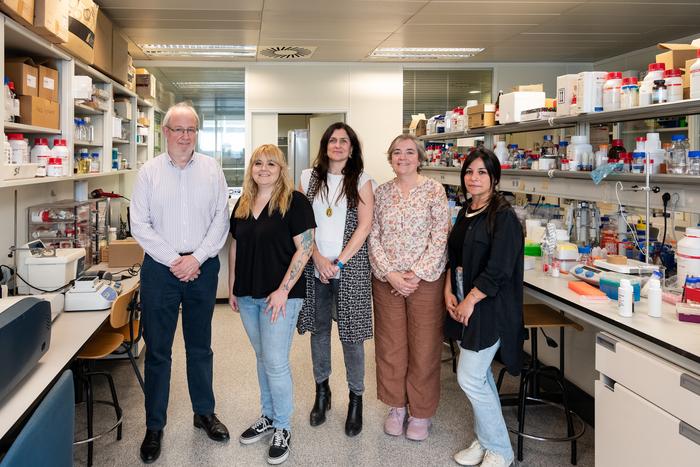
A team of researchers from the Universitat Politècnica de València (UPV) and the CIBER de Bioingeniería, Biomaterials y Nanomedicine (CIBER-BBN) has developed an intelligent nano killer based on a component of cinnamon essential oil (cinnamaldehyde) for use as an antimicrobial agent.

Credit: UPV
A team of researchers from the Universitat Politècnica de València (UPV) and the CIBER de Bioingeniería, Biomaterials y Nanomedicine (CIBER-BBN) has developed an intelligent nano killer based on a component of cinnamon essential oil (cinnamaldehyde) for use as an antimicrobial agent.
So far, the new nanodevice has shown significant efficacy against pathogenic microorganisms such as Escherichia coli, Staphylococcus aureus, and Candida albicans. It could be applied for the elimination of pathogens that may be present in food, wastewater and in the treatment of nosocomial infections, which are those acquired during hospital stays.
In the case of Escherichia coli, most strains are harmless, although some can cause severe abdominal cramping or acute diarrhea and vomiting. In the case of Staphylococcus aureus bacteria, its effects can be skin infections, bloodstream infections, osteomyelitis, or pneumonia. Meanwhile, Candida albicans is a fungus found in different biological fluids, causing diseases such as candidemia or invasive candidiasis.
Easy application
According to the team of the IDM-CIBER NanoSens group, applying this ” nanokiller ” would be very simple. “For example, we could create a spray, make a formulation based on water and other compounds, and apply it directly. We could make a water-based formulation in the field and spray it directly, like any pesticide today. And in hospitals, it could be applied on bandages, and we could even try to make a capsule that could be taken orally,” explains Andrea Bernardos, a researcher in the NanoSens group at the Inter-University Institute for Molecular Recognition Research and Technological Development (IDM).
High efficacy
The new nanodevice improves the efficacy of encapsulated cinnamaldehyde compared to the free compound: about 52-fold for Escherichia coli, about 60-fold for Staphylococcus aureus, and about 7-fold for Candida albicans.
“The increase in the antimicrobial activity of the essential oil component is possible thanks to the decrease in its volatility due to its encapsulation in a porous silica matrix and the increase in its local concentration when released due to the presence of the microorganisms,” highlights Andrea Bernardos, a researcher at the Inter-University Research Institute for Molecular Recognition and Technological Development (IDM).
It stands out for its high antimicrobial activity at very low doses, among its advantages. In addition, it enhances the antimicrobial properties of free cinnamaldehyde with a reduction of the biocidal dose of around 98% for bacterial strains (Escherichia coli and Staphylococcus aureus) and 72% for the yeast strain (Candida albicans) when the nanodevice is applied.
“Moreover, this type of device containing natural biocides (such as essential oil components) whose release is controlled by the presence of pathogens could also be applied in fields such as biomedicine, food technology, agriculture, and many others,” concludes Ángela Morellá-Aucejo, also an IDM researcher at the Universitat Politècnica de València.
The results of this study have been published in the journal Biomaterials Advances.
Journal
Biomaterials Advances
Method of Research
Experimental study
Subject of Research
Not applicable
Article Title
Remarkable enhancement of cinnamaldehyde antimicrobial activity encapsulated in capped mesoporous nanoparticles: A new “nanokiller” approach in the era of antimicrobial resistance
Article Publication Date
26-Mar-2024
Cite Scienmag News
Bethany Barker. (May 23, 2024). Nanokillers” against bacteria and other pathogens. Scienmag. https://scienmag.com/nanokillers-against-bacteria-and-other-pathogens/
Bethany Barker. "Nanokillers” against bacteria and other pathogens." Scienmag, 23 May 2024, https://scienmag.com/nanokillers-against-bacteria-and-other-pathogens/. Accessed 7 September 2026.
Bethany Barker. "Nanokillers” against bacteria and other pathogens." Scienmag. May 23, 2024. https://scienmag.com/nanokillers-against-bacteria-and-other-pathogens/

