


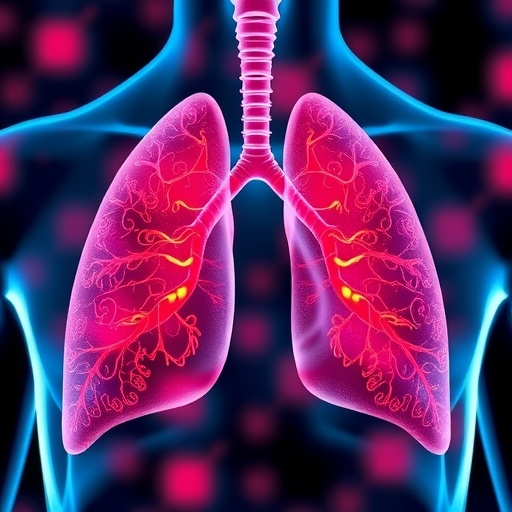
In the relentless pursuit of more effective and safer cancer therapies, nanotechnology continues to revolutionize the landscape of targeted drug delivery. A newly published study, spearheaded by Elmetwalli et al., has introduced an innovative and multifaceted nanoformulation designed specifically for lung cancer treatment. This cutting-edge development harnesses the natural bioactivity of Glycyrrhiza glabra, commonly known as licorice root, integrated within a chitosan–curcumin MgO/Fe₂O₃ nanocomposite. This ground-breaking formulation promises not only targeted anticancer efficacy but also exhibits potent dual antioxidant properties, positioning it as a formidable contender in the fight against lung malignancies.
Lung cancer remains one of the leading causes of cancer-related deaths worldwide, characterized by its aggressive progression and often late diagnosis. Traditional chemotherapy methods, while somewhat effective, are plagued by systemic toxicity and the frequent development of drug resistance, severely compromising patient quality of life and survival rates. Against this backdrop, the engineered nanocomposite reported in this study stands out by addressing these challenges through its unique design—a synthesis of natural compounds and nanomaterials aimed at maximizing therapeutic impact while minimizing adverse effects.
Central to this novel nanoformulation is Glycyrrhiza glabra, a plant known for its extensive pharmacological benefits, including anti-inflammatory, antiviral, and anticancer effects. By integrating this natural extract into the nanocomposite matrix, the researchers leveraged its bioactive components to enhance therapeutic effectiveness. The team utilized chitosan—a biodegradable, biocompatible polysaccharide derived from chitin—as the primary carrier due to its proven ability to facilitate controlled drug release and improve cellular uptake. This chitosan matrix was enriched with curcumin, a well-documented polyphenolic compound with established anticancer properties but limited bioavailability in its native form.
The innovation lies in the incorporation of MgO and Fe₂O₃ nanoparticles within this chitosan–curcumin framework, yielding a multifunctional nanocomposite. Magnesium oxide (MgO) nanoparticles are renowned for their stability, biocompatibility, and intrinsic cytotoxic effects on cancer cells. Meanwhile, iron oxide (Fe₂O₃) nanoparticles contribute magnetic properties that can be exploited for targeted delivery, allowing for external magnetic field guidance to lung tumor sites, thereby enhancing accumulation and reducing systemic dispersion. This synergy of components was meticulously engineered, resulting in a nanoformulation that exhibits improved targeting precision and enhanced therapeutic potency.
Methodologically, the researchers employed advanced synthesis techniques to ensure the homogenous incorporation of Glycyrrhiza glabra extract, curcumin, and metal oxides into the chitosan matrix. Characterization studies, including transmission electron microscopy (TEM), X-ray diffraction (XRD), and Fourier-transform infrared spectroscopy (FTIR), confirmed the successful fabrication of uniform nanoparticles with optimal size distribution and functional group integration. These structural attributes are critical for facilitating cellular internalization and ensuring robust interaction with tumor microenvironments.
From a pharmacological perspective, in vitro cytotoxicity assays demonstrated a marked increase in antiproliferative effects against aggressive lung cancer cell lines treated with the nanocomposite, compared to controls treated with free curcumin or chitosan alone. The dual antioxidant mechanism is particularly noteworthy; curcumin and Glycyrrhiza glabra collectively mitigate oxidative stress induced by the tumor microenvironment, thereby protecting healthy pulmonary cells and reducing inflammatory responses associated with tumor progression. Concurrently, the metallic nanoparticle constituents facilitate reactive oxygen species (ROS) generation within cancer cells, promoting apoptosis selectively.
In vivo experiments substantiated these findings, revealing significant tumor volume reduction in murine lung cancer models upon systemic administration of the nanocomposite. Importantly, the formulation exhibited minimal off-target toxicity as evidenced by histopathological analysis of major organs, a substantial improvement over conventional chemotherapeutic agents known for their systemic side effects. The magnetic properties of Fe₂O₃ enabled the application of external magnetic fields to concentrate nanoparticles at tumor sites, further augmenting therapeutic index.
This research underscores the remarkable potential of integrating phytochemicals with nanomaterials to overcome longstanding limitations in cancer therapy. By achieving a harmonious balance between biocompatibility, targeting accuracy, and therapeutic efficacy, the Glycyrrhiza glabra-based chitosan–curcumin MgO/Fe₂O₃ nanocomposite embodies the next frontier of personalized oncological medicine. Additionally, the dual antioxidant action offers a novel therapeutic angle by modulating redox states within the tumor milieu, a strategy that could mitigate drug resistance and improve long-term outcomes.
Moreover, the design principles articulated by Elmetwalli and colleagues pave the way for the inclusion of other plant-derived bioactives and metal oxides to tailor nanomedicines for various cancer types or even other diseases characterized by oxidative stress and inflammation. The modularity of this approach facilitates customization and scalability, crucial for translating nanotechnological advances from the laboratory to clinical practice.
Future research directions emphasize the need for detailed pharmacokinetic and biodistribution studies to optimize dosing regimens, as well as clinical trials to evaluate safety and efficacy in human subjects. The interplay of nanocomposite components with the immune system also warrants investigation to harness potential immunomodulatory effects. Additionally, exploring the stimuli-responsive behavior of the nanocomposite—such as pH or temperature-triggered drug release—could further refine targeting capabilities.
In conclusion, this groundbreaking nanoformulation represents a significant stride forward in nanomedicine and oncology. The strategic use of Glycyrrhiza glabra-derived compounds within a precisely engineered chitosan–curcumin MgO/Fe₂O₃ matrix not only potentiates direct antitumor activities but also promotes a protective antioxidant environment, thereby offering a two-pronged attack against lung cancer. As the global burden of this devastating disease continues to rise, innovations like this herald a new era of treatment modalities that prioritize efficacy and patient safety through intelligent design and natural synergy.
Cite Scienmag News
Nathaniel Bowman. (August 7, 2025). Nanoformulation Targets Lung Cancer with Dual Antioxidants. Scienmag. https://scienmag.com/nanoformulation-targets-lung-cancer-with-dual-antioxidants/
Nathaniel Bowman. "Nanoformulation Targets Lung Cancer with Dual Antioxidants." Scienmag, 7 August 2025, https://scienmag.com/nanoformulation-targets-lung-cancer-with-dual-antioxidants/. Accessed 4 September 2026.
Nathaniel Bowman. "Nanoformulation Targets Lung Cancer with Dual Antioxidants." Scienmag. August 7, 2025. https://scienmag.com/nanoformulation-targets-lung-cancer-with-dual-antioxidants/


