


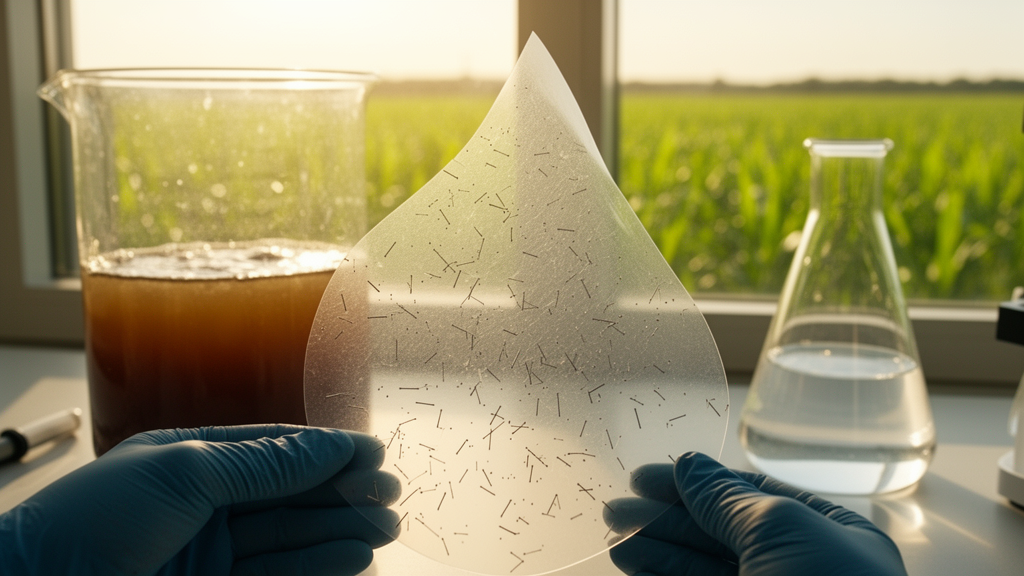
Agriculture drinks the world dry. Farming accounts for roughly 70 to 72 percent of all freshwater withdrawals on the planet, dwarfing municipal and industrial use combined, and the pressure is only intensifying. According to the FAO’s most recent AQUASTAT assessment, renewable water availability per person fell by about seven percent in the last decade alone, with the sharpest declines concentrated in Northern Africa, Southern Asia, and Western Asia. UN-Water estimates that more than three billion people already live in agricultural regions facing high to very high water shortages, and nearly four billion people experience severe water scarcity for at least part of the year. A comprehensive new review published in Frontiers in Membrane Science and Technology by Masoud Rahbari-Sisakht, Ahmad Fauzi Ismail, and Pei Sean Goh of Universiti Teknologi Malaysia argues that a class of engineered materials called nanocomposite membranes could be the key to unlocking the vast, underused reservoir of wastewater that agriculture desperately needs.
The logic behind water reuse is compelling. Municipal sewage, industrial effluents, and agricultural drainage are typically treated once and discharged, even though they frequently contain recoverable nitrogen, phosphorus, and potassium that could reduce a farm’s dependence on synthetic fertilizer. Reclaimed wastewater is, in effect, a resource stream disguised as a waste stream, and the concept aligns squarely with circular economy principles. But the chemistry is unforgiving. Untreated wastewater can carry pathogens, antibiotic-resistant bacteria and resistance genes, heavy metals, pharmaceutical residues, and salts that damage both crops and soil. The engineering challenge is therefore not simply reclaiming water in bulk, but reclaiming it to a quality that is agronomically appropriate, publicly acceptable, and affordable enough for a sector that operates on razor-thin margins.
Membrane technologies have become the workhorse of this tertiary treatment. Microfiltration and ultrafiltration use low pressure and relatively large pores to strip out suspended solids and larger microbes, making them cost-effective pretreatments. Nanofiltration occupies the selectivity sweet spot between ultrafiltration and reverse osmosis, rejecting multivalent ions, organic molecules, and many pathogens while letting a useful fraction of monovalent nutrient ions pass through, which is precisely what irrigation demands. Reverse osmosis delivers near-complete salt and contaminant rejection but at a punishing energy cost, and its mineral-free permeate usually must be blended with other water before crops can tolerate it. Forward osmosis, membrane bioreactors, and membrane distillation round out the toolkit, each with distinct trade-offs in energy, fouling, and selectivity. Yet every one of these processes is hobbled by the same trio of problems: fouling, energy demand, and an awkward tension between removing contaminants and retaining nutrients.
Fouling deserves special emphasis because it is the single most persistent operational cost in membrane-based reuse. Organic matter, colloids, scaling minerals, and microorganisms accumulate on or within the membrane, driving down permeate flux, forcing up trans-membrane pressure, and, in the case of biofouling, forming stubborn biofilms that resist conventional chemical cleaning. Agricultural wastewater, rich in natural organic matter and microbial loads, is particularly aggressive in this regard. In one long-term demonstration of a hybrid forward osmosis-nanofiltration system operated continuously for 480 days on real wastewater, magnesium sulfate draw solution caused severe irreversible fouling and had to be abandoned, while magnesium chloride maintained stable permeability and produced irrigation-quality water. Conventional membranes, in short, are being asked to do a job their base polymers were never designed for.
This is where nanocomposite membranes enter the picture. The concept is elegantly simple: embed, coat, or grow nanoscale materials, typically between 1 and 100 nanometers, into or onto a polymeric or ceramic membrane matrix. Nanoscale fillers offer enormous surface-area-to-volume ratios and tunable surface chemistry, and many carry intrinsic catalytic, antimicrobial, or hydrophilic functionality that transfers to the surrounding polymer at very low loading fractions. The review classifies these fillers by dimensionality. Zero-dimensional metal and metal oxide nanoparticles, such as titanium dioxide, silver, and zinc oxide, bring photocatalytic and biocidal power. One-dimensional carbon nanotubes combine exceptional mechanical strength with favorable water transport channels. Two-dimensional graphene oxide sheets create sub-nanometer interlayer channels for high-flux, size-sieving separation. Three-dimensional frameworks, including zeolites and metal-organic frameworks, contribute ordered, tunable porosity for molecular sieving and catalysis. More recently, bio-based alternatives like cellulose nanocrystals and chitosan have attracted attention as greener options.
The performance gains documented in the literature are striking and mechanism-specific. Photocatalytic titanium dioxide enables self-cleaning membranes in which adsorbed organic foulants are degraded in place under light exposure rather than accumulating; a hydrogenated TiO2 ceramic ultrafiltration membrane showed markedly improved humic acid removal and fouling resistance after ultraviolet pretreatment, and visible-light-responsive composites extend this to natural sunlight, a natural fit for outdoor farm installations. Silver nanoparticles attack biofouling from a different angle, suppressing bacterial attachment and biofilm formation at the surface, and green-synthesized silver-enhanced nanofiltration membranes have shown the lowest irreversible fouling and highest flux recovery at optimized loading. In membrane bioreactors, alumina nanoparticle incorporation reduced fouling by roughly 83 percent. On the selectivity front, a metal-organic framework combined with graphene oxide rejected more than 98 percent of Congo red dye, while MOF-filled thin-film nanocomposite reverse osmosis membranes have more than doubled water permeance relative to conventional thin-film composites while sustaining salt rejection. A thin-film nanocomposite membrane embedded with covalent organic framework nanoparticles achieved over 99 percent rejection of copper and manganese ions with superior antifouling behavior.
Fabrication strategy matters as much as material choice. Dope blending during conventional phase inversion is the most scalable route and slots into existing production lines, though achieving uniform dispersion without nanoparticle agglomeration remains a persistent challenge. Interfacial polymerization can tuck nanofillers directly into the thin polyamide selective layer of nanofiltration and reverse osmosis membranes. Surface coating delivers high functional concentrations but risks detachment and leaching, while electrospinning builds nanomaterials directly into high-porosity nanofibrous structures, and in situ hydrothermal growth achieves strong interfacial bonding for long-term stability. Design also demands balance: performance improves with loading only up to an optimum, beyond which particles clump, block pores, or weaken the membrane, and where a nanoparticle sits within the membrane matrix, support layer, selective layer, or surface, strongly governs whether it actually works.
But the review is refreshingly candid about the dark side of nanoscale engineering: nanoparticles can leach. In one study of CuO-modified polyethersulfone ultrafiltration membranes, ICP-MS analysis after 840 hours of exposure detected copper concentrations ranging from about 65 micrograms per liter in water to 589 micrograms per liter in acidic cleaning solution, with some values exceeding the FAO’s 0.2 milligrams per liter guideline for copper in irrigation water, though the authors caution that aggressive cleaning conditions differ from normal operation. Silver-release studies tell a similar story of architecture-dependent behavior: cumulative silver release of roughly 4 to 5 micrograms per liter over 14 days in one membrane design, around 20 micrograms per liter after ten months in another, and casein-coated silver membranes that retained 97 to 98 percent of their silver over a week of cross-flow operation. The ecological stakes are real, since the Canadian long-term guideline for protecting freshwater organisms sits at just 0.25 micrograms of silver per liter, and chronic toxicity in microalgae has been reported at low microgram levels. Irrigation compounds the concern, because repeated applications can let nanoparticles accumulate in soil, interact with microbes, and reach plant roots.
The path forward, the researchers conclude, lies less in chasing further incremental laboratory gains and more in resolving safety, scalability, and cost in parallel. Regulatory frameworks, from the EU’s Regulation 2020/741 with its Class A limit of E. coli at or below 10 CFU per 100 milliliters, to California’s Title 22 coliform and turbidity requirements, currently govern reclaimed water quality but say nothing about nanoparticles released from the membranes themselves, a gap the review flags explicitly. Machine-learning-guided membrane design is already accelerating the screening of nanomaterial-polymer combinations for fertilizer-drawn forward osmosis, and hybrid configurations such as forward osmosis paired with electrodialysis, which has achieved specific energy consumption as low as 0.35 kilowatt-hours per cubic meter, let each material’s strengths be deployed where they matter most. Solar-powered membrane distillation boosted with waste heat has pushed distillate flux up 88 percent while cutting specific energy by 62 percent. If the field can couple those engineering advances with rigorous leaching measurements, crop-uptake studies, and scalable manufacturing, nanocomposite membranes may graduate from laboratory promise to the field-proven infrastructure that four billion water-stressed people are waiting for.
Subject of Research: Nanocomposite membranes for sustainable agricultural water reuse
Article Title: Advanced nanocomposite membranes for sustainable water reuse in agriculture
Article References: Rahbari-Sisakht, M., Ismail, A. F., & Goh, P. S. (2026). Advanced nanocomposite membranes for sustainable water reuse in agriculture. Frontiers in Membrane Science and Technology, 5, Article 1954364. https://doi.org/10.3389/frmst.2026.1954364
Image Credits: AI Generated
DOI: 10.3389/frmst.2026.1954364
Keywords: nanocomposite membranes, water reuse, agricultural irrigation, membrane fouling, graphene oxide, silver nanoparticles, titanium dioxide, forward osmosis, reverse osmosis, nanoparticle leaching, metal-organic frameworks, water scarcity
Cite Scienmag News
Denise Maddox. (October 15, 2026). Nanocomposite Membranes Could Turn Wastewater Into Irrigation Gold for Farming. Scienmag. https://scienmag.com/nanocomposite-membranes-could-turn-wastewater-into-irrigation-gold-for-farming/
Denise Maddox. "Nanocomposite Membranes Could Turn Wastewater Into Irrigation Gold for Farming." Scienmag, 15 October 2026, https://scienmag.com/nanocomposite-membranes-could-turn-wastewater-into-irrigation-gold-for-farming/. Accessed 15 October 2026.
Denise Maddox. "Nanocomposite Membranes Could Turn Wastewater Into Irrigation Gold for Farming." Scienmag. October 15, 2026. https://scienmag.com/nanocomposite-membranes-could-turn-wastewater-into-irrigation-gold-for-farming/


