


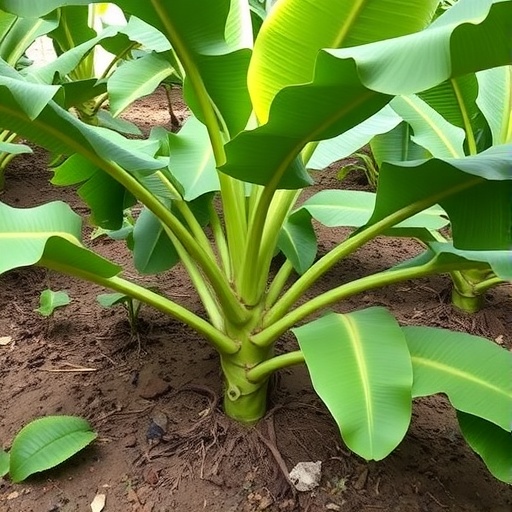
In a groundbreaking study, researchers have revealed the profound impact of arbuscular mycorrhizal fungi inoculation on the growth and yield of banana plants in Central-northern Tanzania. This research, conducted by a team of scientists led by H.B. Mapunda and involving experts such as S. Declerck and K.M. Mtei, explores a sustainable agricultural practice that not only enhances plant development but also holds significant promise for improving food security in the region.
The study demonstrates that by inoculating banana plants with arbuscular mycorrhizal fungi, crops exhibit robust growth characteristics. These beneficial fungi form symbiotic relationships with the roots of the banana plants, vastly increasing nutrient uptake and translating this into enhanced biomass. The results indicate that fungi aid in the absorption of essential minerals, particularly phosphorus, which is often in short supply in Tanzanian soils. By addressing these nutrient deficiencies, farmers can witness a remarkable transformation in their crops, laying the groundwork for sustainable agricultural practices.
Banana plants are a staple food source in many tropical and subtropical regions, particularly in Africa. In Tanzania, bananas are not just a dietary staple; they are integral to the livelihoods of millions of smallholder farmers. With the increasing pressures of climate change and soil depletion, improving banana plant growth and fruit yield is crucial for sustaining local economies and food supplies. The introduction of arbuscular mycorrhizal fungi could serve as a game-changer in this regard, providing a dual benefit of enhanced agricultural productivity while fostering environmental resilience.
The research findings highlight a range of growth metrics that experienced significant improvement post-fungi inoculation. Height, leaf area, and root biomass of the treated banana plants exceeded those of the control group, drawing attention to the tangible benefits that such biological amendments can provide. This amplification of growth suggests that implementing fungi inoculation could be a strategic approach for farmers seeking to boost their harvests without relying on chemical fertilizers that can degrade soil health over time.
Moreover, the fruit yield recorded in the inoculated banana plants was astounding, with yields surpassing initial estimates and exhibiting earlier maturation times than those without the amendment. This accelerated growth cycle not only benefits farmers through increased productivity but also aligns with the urgent need to optimize food production amidst growing global populations. With premature fruiting, farmers can reap rewards sooner, improving their economic conditions and household food security.
In addition to the immediate benefits of increased growth and yield, the ecological implications of utilizing arbuscular mycorrhizal fungi in agriculture are profound. By enhancing soil health, these fungi play a crucial role in fostering biodiversity and supporting various soil organisms. Their presence can lead to more resilient ecosystems, which are essential for sustainable agriculture amid environmental changes. Healthier soil translates to better water retention and reduced erosion, contributing to long-term agricultural sustainability.
The research outlines the need for further investigations into the optimal inoculation techniques and the specific fungal strains most effective for banana cultivation. Each fungal species may interact differently with varying soil types and climatic conditions. Understanding these nuances can inform best practices for farmers, maximizing the benefits of mycorrhizal associations for diverse agricultural landscapes across Tanzania and beyond.
As the discussion around sustainable agricultural practices gains momentum globally, this study by Mapunda et al. strengthens the argument for integrating biological solutions into traditional farming methodologies. The endorsement of arbuscular mycorrhizal fungi not only embodies a shift towards environmentally friendly practices but also ensures economic viability for farming communities. It highlights an innovative pathway to address the pressing challenges posed by modern agriculture, including soil degradation and dependency on chemical fertilizers.
In conclusion, the findings of this research underscore the tremendous potential of adopting arbuscular mycorrhizal fungi inoculation to catalyze change in banana production systems. This biological method offers a promising avenue for boosting crop performance while promoting ecological integrity. As the agricultural sector evolves, embracing such symbiotic relationships between plants and fungi could forge a new frontier in sustainable practices, aiding in the quest for food security and environmental stewardship.
The journey to implementing these findings on a wider scale involves collaboration among agricultural scientists, policymakers, and farmers. Educational programs and workshops are essential in disseminating knowledge about the benefits of mycorrhizal fungi and practical inoculation techniques. By advocating for this innovation, stakeholders can help transform traditional farming practices, collectively working towards a sustainable future for agriculture in Tanzania.
The transformative potential of mycorrhizal fungi extends far beyond banana cultivation. As researchers explore their applications in diverse crops, the implications for global agriculture become increasingly significant. This study lays the foundation for expanding research into various plant-fungal interactions, ultimately contributing to a more profound understanding of ecological agriculture.
Through continued support and investment in biological farming practices, we can enhance food security, protect soil health, and promote sustainable agriculture. The work of Mapunda and colleagues is a compelling call to embrace the power of nature to nourish our crops and sustain our communities, guiding the way towards a resilient agricultural future.
Mapunda, H.B., Declerck, S., Mtei, K.M. et al. Arbuscular mycorrhizal fungi inoculation enhanced banana plant growth and fruit yield in Central-northern Tanzania.
Discov Sustain 6, 869 (2025). https://doi.org/10.1007/s43621-025-01183-z
Cite Scienmag News
Roger Howard. (August 27, 2025). Mycorrhizal Fungi Boost Banana Growth in Tanzania. Scienmag. https://scienmag.com/mycorrhizal-fungi-boost-banana-growth-in-tanzania/
Roger Howard. "Mycorrhizal Fungi Boost Banana Growth in Tanzania." Scienmag, 27 August 2025, https://scienmag.com/mycorrhizal-fungi-boost-banana-growth-in-tanzania/. Accessed 5 September 2026.
Roger Howard. "Mycorrhizal Fungi Boost Banana Growth in Tanzania." Scienmag. August 27, 2025. https://scienmag.com/mycorrhizal-fungi-boost-banana-growth-in-tanzania/


