


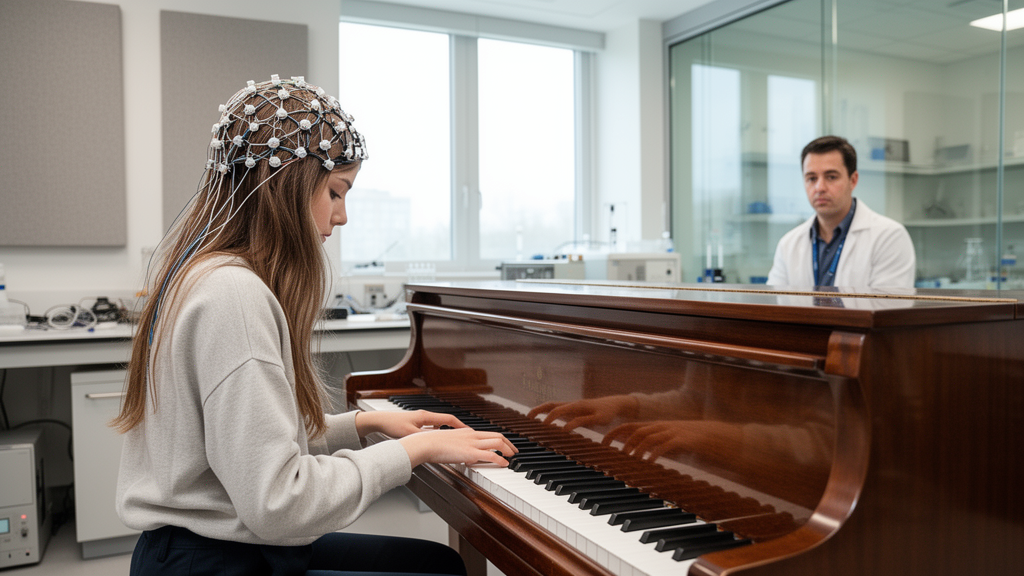
The research, conducted by Edith Cowan University, Curtin University and Deakin University, also found that newly formed motor memories were not protected from interference: seeing a different visual sequence shortly after learning reduced performance for both musicians and non-musicians, whereas hearing a different sequence of sounds alone had little effect. The participants, around half of whom had formal musical training, learned a 10-step sequence presented through visual cues on a screen paired with matching sounds. After a short break, they encountered a different sequence before being tested again on the original sequence.
The investigators assessed whether exposure to mismatched visual or auditory information could disrupt the newly learned movement pattern. The supplied report does not provide effect sizes, detailed statistical results or the precise measures used to quantify “anticipatory responding” and “predictive control,” so the magnitude of the musician advantage cannot be determined from the release. Both groups performed worse after viewing a sequence containing different visual information.
In contrast, exposure to a different sequence of sounds alone had little effect. This pattern indicates that the newly acquired motor memory was vulnerable to interference through the visual channel used in the learning task, while the auditory interference produced substantially less disruption. The findings separate two effects associated with expertise: musicians appeared better able to anticipate upcoming elements in a sequence, but their newly learned memories could still be altered or weakened by relevant competing visual information.
The published paper, “Musical training increases anticipatory responding and predictive control in sequence learning,” appeared in Psychological Research on 2 July 2026. The university release describes the work as an observational study, even though participants also completed a controlled sequence-learning task with experimentally introduced interference. The results may be relevant to situations in which a newly learned movement sequence is followed by other visually demanding activity, including music education, sports training and rehabilitation.
However, the experiment does not demonstrate that any particular practice schedule improves educational, athletic or clinical outcomes. Its participants learned a laboratory sequence rather than rehearsing musical repertoire or receiving rehabilitation, and the report does not specify whether they were recruited from or tested at all three participating universities, describe them as healthy, or establish how long the interference effect lasted. The authors said the findings suggest that protecting fresh motor learning may depend on managing the sensory channel on which the task relies rather than assuming that silence and stillness are beneficial in every context.
They also said researchers are now using brain measures, including electroencephalography, to investigate how musical training influences predictive processing in the brain. Those additional measurements were not part of the reported finding, and their results are not presented in the supplied evidence. Overall, the study supports an association between formal musical training and improved anticipatory responding in sequence learning, while also showing that visual distraction can interfere with fresh motor memories in both trained and untrained participants.
Subject of Research: Associations between musical training, sequence prediction and visual interference in motor-memory learning
Article Title: Musicians’ brains stay one step ahead, study finds
Article References: Musicians’ brains stay one step ahead, study finds. Original publication (Bibliographic details unavailable.)
Image Credits: AI Generated
DOI: Not provided
Keywords: musical training, sequence learning, motor memory, predictive processing, visual interference, anticipatory responding, musicians, skill learning, brains, stay, step, ahead
Cite Scienmag News
Courtney Benton. (October 25, 2026). Musical training associated with earlier prediction in sequence learning. Scienmag. https://scienmag.com/musical-training-associated-with-earlier-prediction-in-sequence-learning/
Courtney Benton. "Musical training associated with earlier prediction in sequence learning." Scienmag, 25 October 2026, https://scienmag.com/musical-training-associated-with-earlier-prediction-in-sequence-learning/. Accessed 25 October 2026.
Courtney Benton. "Musical training associated with earlier prediction in sequence learning." Scienmag. October 25, 2026. https://scienmag.com/musical-training-associated-with-earlier-prediction-in-sequence-learning/


