


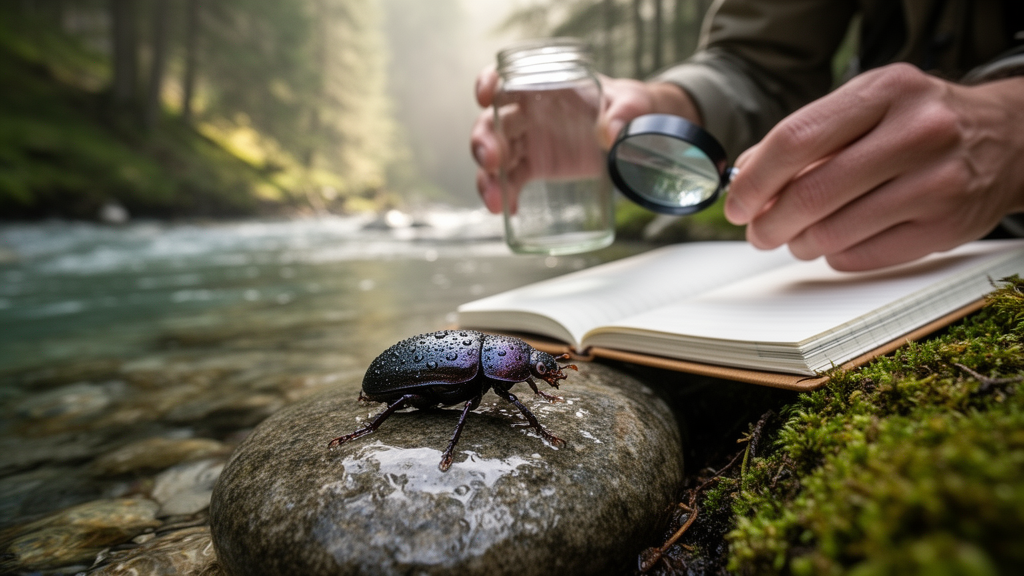
An exhaustive review of museum collections, private collections and published records identified 105 species of the beetle superfamily Hydrophiloidea in Switzerland, reported seven species for the first time in the country and classified 16 previously mentioned species as doubtful or unsupported. The study is the first annotated, synthetic checklist of the Swiss Hydrophiloidea since Stierlin’s 1900 treatment, according to the authors.
The review covers five families represented in Switzerland: Georissidae, Helophoridae, Hydrochidae, Hydrophilidae and Spercheidae. Epimetopidae is the only Hydrophiloidea family absent from the country. Worldwide, the superfamily includes more than 3,300 species, most belonging to Hydrophilidae, and its members are chiefly associated with freshwater, although the families and species span aquatic, shoreline, soil and terrestrial habitats.
To compile the national inventory, the authors examined Hydrophiloidea material held in 22 Swiss museum collections. They also used material from three foreign institutions in Manchester, Bolzano and Stuttgart, records supplied by 14 named private collectors and the authors’ own collections, and relevant publications. The resulting dataset contains 30,434 occurrences. Specimen records are presented with locality, date, collector, identifier and deposition information where available, while published records retain the locality wording used in the original source.
The authors applied a documented procedure for deciding whether reported species should be included in the Swiss fauna. Records required sufficiently reliable evidence, such as unambiguous labels and traceable collections. For genera in which male genitalia provide the most reliable identification, including Laccobius and Chaetarthria, only dissected males were counted as verified records; records based solely on females were excluded as unverifiable. Doubtful records were flagged according to problems including unverifiable sources, incorrect identifications, uncertain localities, problematic collections and ecological or geographic inconsistencies.
The accepted fauna comprises 76 Hydrophilidae species, 21 Helophoridae, four Hydrochidae, three Georissidae and one Spercheidae species. The 16 taxa placed in square brackets should not yet be regarded as members of the Swiss fauna because their Swiss documentation is insufficient. These include species supported only by old literature without surviving specimens, records from problematic collections and historical entries that proved to concern other species. Several excluded taxa may nevertheless be found in Switzerland if better evidence emerges.
Seven species were reported for the first time in Switzerland: Cercyon alpinus, C. castaneipennis, C. tatricus, Helophorus montenegrinus, Megasternum immaculatum, Pachysternum capense and Paracymus scutellaris. The C. alpinus records came from old museum material found in Alpine localities, where the specimens had been overlooked or confused with other Cercyon species. C. tatricus, previously known from the Carpathian Mountains and the Eastern Palaearctic, was documented in the eastern Swiss Alps, mainly at 1,800–2,200 metres above sea level.
Records of H. montenegrinus came from Ticino, including material collected in 2018, 2021 and 2023; the species is mainly distributed in the Mediterranean region of Europe. P. capense, native to sub-Saharan Africa and now nearly cosmopolitan, was represented by three specimens collected in southern Ticino in 2015. These are the first Swiss records, while earlier records were reported from Greece, Italy, France, Hungary and Romania. P. scutellaris was documented from one specimen collected in mosses in Geneva in 1961. The checklist also resurrects M. immaculatum following its 2014 separation from M. concinnum, although the authors note that not all Swiss specimens were dissected and that taxonomic revision of the group is needed.
Some accepted species have exceptionally restricted documentation. Helophorus tuberculatus is represented by one specimen collected in a Jura peat bog in 1969 and lives in damp moss rather than directly in water. Laccobius thermarius is known globally from only two thermal localities, including its type locality in Baden, Aargau, where the springs now serve thermal baths; its continued presence in Switzerland is uncertain. Georissus substriatus has several collection records but had not been observed in Switzerland for 40 years. The authors also retained all Swiss records in the H. aequalis–H. aquaticus group under an aggregate because the two species are virtually inseparable without karyotype examination.
The checklist documents a fauna interacting with substantial wetland loss: the authors report that 80%–88% of Swiss wetlands were destroyed over the last century and that 90% of wetland habitat types are on the Swiss red list of habitat types. They state that aquatic beetles may have been heavily affected, while noting that several species appear to be declining and that some, including Hydrophilus aterrimus and L. thermarius, may already be extinct. These are presented as conservation concerns rather than demonstrated population outcomes, and no Swiss red list currently exists for Hydrophiloidea. The authors argue that a red list based on the compiled historical data, recent records and prospective observations is needed. Valid records have been made available through GBIF, and updated distribution maps are provided through the Info Fauna cartographic server.
Subject of Research: Annotated national review of Swiss Hydrophiloidea beetle diversity and distribution records
Article Title: Annotated checklist of the Hydrophiloidea of Switzerland ( Coleoptera )
Article References: Cosandey, V., Chittaro, Y., & Sanchez, A. (2023). Annotated checklist of the Hydrophiloidea of Switzerland (Coleoptera). Alpine Entomology, 7, 167-184. https://doi.org/10.3897/alpento.7.111147
Image Credits: AI Generated
Keywords: Hydrophiloidea, Swiss fauna, beetle checklist, biodiversity records, museum collections, taxonomic revision, aquatic insects, wetland conservation, GBIF, Annotated, checklist, Switzerland
Cite Scienmag News
Margaret Porter. (October 20, 2026). Museum and literature review yields annotated checklist of Switzerland’s Hydrophiloidea. Scienmag. https://scienmag.com/museum-and-literature-review-yields-annotated-checklist-of-switzerlands-hydrophiloidea/
Margaret Porter. "Museum and literature review yields annotated checklist of Switzerland’s Hydrophiloidea." Scienmag, 20 October 2026, https://scienmag.com/museum-and-literature-review-yields-annotated-checklist-of-switzerlands-hydrophiloidea/. Accessed 20 October 2026.
Margaret Porter. "Museum and literature review yields annotated checklist of Switzerland’s Hydrophiloidea." Scienmag. October 20, 2026. https://scienmag.com/museum-and-literature-review-yields-annotated-checklist-of-switzerlands-hydrophiloidea/


