


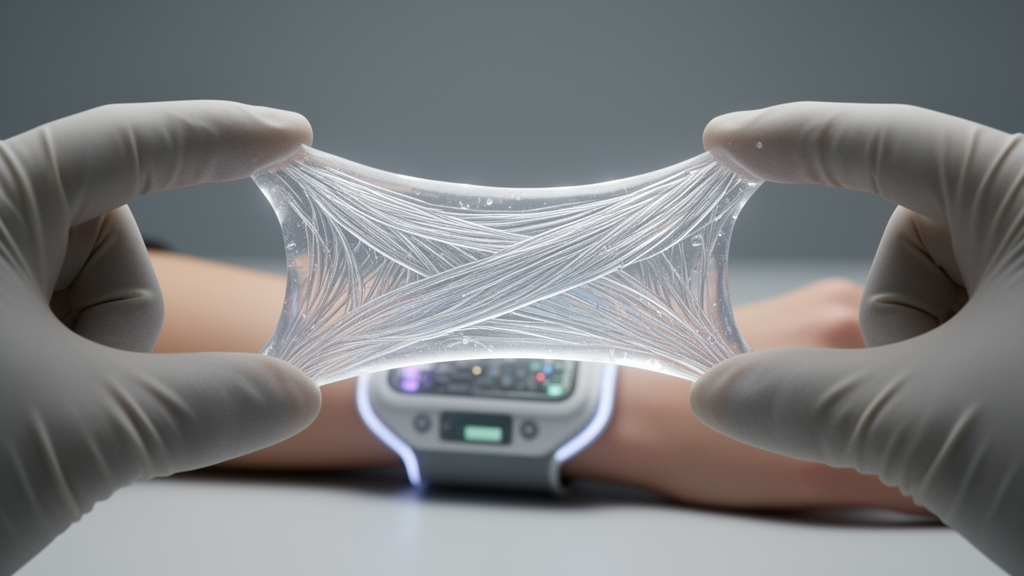
Researchers have developed a bio-inspired composite gel for wearable strain sensors that borrows its architecture from skeletal muscle and fascia, embedding an electrospun thermoplastic polyurethane nanofiber membrane between layers of a ZnCl2-ethylene glycol/poly(acrylic acid) eutectic gel. The design, reported in Advanced Composites and Hybrid Materials, addresses a persistent weakness of eutectic gels: while they offer ionic conductivity and environmental stability, their low strength and incomplete recovery under repeated loading have limited long-term use in wearable devices.
The key to the new material, called NF-Gel, lies in how the phases interact. The non-polymerizable deep eutectic solvent remains a continuous ion-conducting phase after curing, giving the composite a conductivity of 11.01 mS per centimeter. Rapid infiltration of the precursor into the nanofiber membrane causes the fibers to swell, creating an interpenetrated fiber-gel interface that locks the two components together rather than leaving them as separate layers.
The mechanical gains are substantial. A 109-micrometer nanofiber membrane, accounting for only about 5 percent of the sensor’s total thickness, raises the tensile strength elevenfold to 1.05 megapascals and increases toughness ninefold to 7.17 megajoules per cubic meter, while still preserving an elongation of 1200 percent. After an initial Mullins-type softening on early loading cycles, the composite settled into a stable cyclic response that persisted for more than 3000 sensing cycles.
As a strain sensor, NF-Gel operates across a range of 0 to 1200 percent strain, with gauge factors of 2.16, 3.846 and 1.65 in three linear regions, and response and recovery times of 0.156 and 0.231 seconds respectively. In demonstrations, the sensor detected facial expressions, joint motion and speech, achieving signal-to-noise ratios between 32.8 and 45.3 decibels.
Beyond motion sensing, the material shows a set of auxiliary properties relevant to skin-mounted devices. It adheres to diverse substrates with measured strengths of 461 to 849 kilopascals, maintains over 95 percent keratinocyte viability in cell tests, inhibits the bacteria Escherichia coli and Staphylococcus aureus, and exhibits flame resistance. A temperature coefficient of resistance of -0.46 percent per degree Celsius enables potential fire warning and fever monitoring, and the authors quantified the cross-sensitivity between strain and temperature signals.
The work illustrates how structural mimicry of biological composites, here the layered arrangement of muscle and fascia, can be translated into ion-conducting gels without sacrificing the stretchability that wearable sensors demand. Because the eutectic solvent stays continuous after curing, the ion transport pathway survives the reinforcement, allowing strength, toughness and conductivity to coexist in a single free-standing film.
The reported figures come from the authors’ laboratory characterization of the composite and its sensor prototypes, including mechanical testing, cyclic loading trials and demonstrations on human motion and speech. As with any newly reported material, performance over extended real-world wear, manufacturing scale-up and long-term biocompatibility remain questions for further study, but the combination of high conductivity, reinforced mechanics and multi-modal sensing marks a notable step for eutectic gel-based wearables.
Subject of Research: A muscle-fascia-inspired eutectic gel composite for high-performance wearable strain sensing
Article Title: Bio-inspired eutectic gel with muscle-fascia-like recovery for high-performance wearable strain sensor
Article References: Ali, M., Hussain, M., Al Afroz, E., Ashraf, H. T., Ahmed, A., Jahan, M. S., Qiu, Q., Xiao, J., Yihu, S., Raza, A., Sun, H., Ali, A., & Bin, Y. (2026). Bio-inspired eutectic gel with muscle-fascia-like recovery for high-performance wearable strain sensor. Advanced Composites and Hybrid Materials. https://doi.org/10.1007/s42114-026-02161-3
Image Credits: AI Generated
DOI: 10.1007/s42114-026-02161-3
Keywords: eutectic gel, wearable strain sensor, thermoplastic polyurethane, nanofiber membrane, deep eutectic solvent, ionic conductivity, bio-inspired materials, Mullins effect, strain sensing, flame resistance, keratinocyte viability, temperature sensing
Cite Scienmag News
Denise Maddox. (October 27, 2026). Muscle-inspired eutectic gel boosts wearable strain sensor strength and durability. Scienmag. https://scienmag.com/muscle-inspired-eutectic-gel-boosts-wearable-strain-sensor-strength-and-durability/
Denise Maddox. "Muscle-inspired eutectic gel boosts wearable strain sensor strength and durability." Scienmag, 27 October 2026, https://scienmag.com/muscle-inspired-eutectic-gel-boosts-wearable-strain-sensor-strength-and-durability/. Accessed 27 October 2026.
Denise Maddox. "Muscle-inspired eutectic gel boosts wearable strain sensor strength and durability." Scienmag. October 27, 2026. https://scienmag.com/muscle-inspired-eutectic-gel-boosts-wearable-strain-sensor-strength-and-durability/


