

Friday, October 23, 2026
Science
No Result
View All Result
  • Login
  • HOME
  • SCIENCE NEWS
  • CONTACT US
  • HOME
  • SCIENCE NEWS
  • CONTACT US
No Result
View All Result
Scienmag
No Result
View All Result
Home Science News Technology and Engineering

Multiscale Simulation Reveals Nonlinear Anisotropy in Sintered Binder-Jetted Steel Parts

October 23, 2026
in Technology and Engineering
Denise Maddox
By Denise Maddox Scienmag Editorial Profile - Mechanical Engineering
Reading Time: 3 mins read
0
Multiscale Simulation Reveals Nonlinear Anisotropy in Sintered Binder-Jetted Steel Parts

Multiscale Simulation Reveals Nonlinear Anisotropy in Sintered Binder-Jetted Steel Parts

65
SHARES
587
VIEWS
Share on FacebookShare on Twitter
ADVERTISEMENT

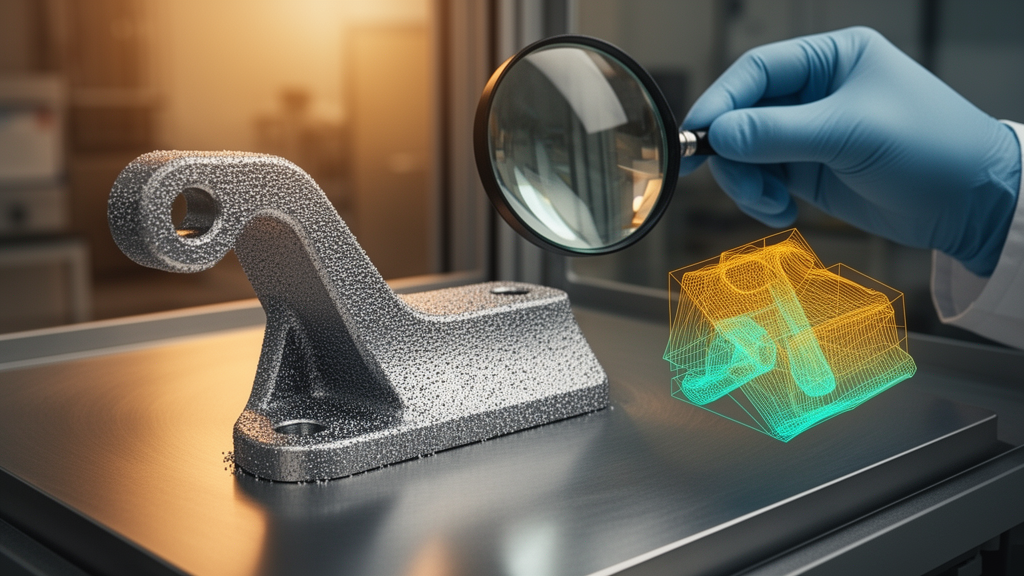
A new modeling study reports that anisotropy in parts produced via binder jetting does not act as a fixed material property during sintering: it evolves nonlinearly with structural hierarchy, and cross-scale coupling plays a critical role in determining the effective behavior of the finished component. The work, published open access in npj Advanced Manufacturing on 23 October 2026 by Thomas Grippi, Elisa Torresani, Runjian Jiang, Andrii Maximenko, Diletta Giuntini, Marc van Maris, John Kang, Nicholas Saterlee, Rajendra Bordia and Eugene Olevsky, investigates anisotropy during sintering across multiple scales using a coupled kinetic Monte Carlo and finite element simulation framework.

The process begins at the mesoscale, where the team calibrated and validated a kinetic Monte Carlo sintering model. Rather than relying on final measurements alone, the researchers benchmarked the model against experimental data obtained through X-ray computed tomography, discrete element modeling and optical microscopy. Interrupted thermal cycles allowed them to capture the evolving structure at key densification stages, giving the simulation concrete experimental checkpoints along the sintering pathway.

Once validated, the mesoscale model supplies directional descriptors such as strain rate and pore orientation. These are incorporated as anisotropic sintering stress inputs into a continuum-level sintering model based on the Skorohod-Olevsky Viscous Sintering finite element framework, tailored for 316 L stainless steel. The continuum formulation is designed to account for several material behaviors at the part scale: the influence of initial relative density, grain growth kinetics, the delta-ferrite phase transformation that occurs at elevated temperatures, and the effects of friction and gravity.

The approach links the two scales through a combination of experimental imaging, tensor-based quantification and numerical simulations, connecting mesoscopic directional dependencies to macroscopic responses of the whole part. The central results are twofold. First, anisotropy evolves nonlinearly with structural hierarchy, meaning the directionality observed at the part scale depends on how microstructural features are organized and how that organization changes during sintering. Second, cross-scale coupling is critical: the mesoscale descriptors feed the continuum model with inputs that determine effective material behavior, so the macroscopic prediction cannot be separated from the microscopic description of the same sintering process.

The study’s scope is specific. It concerns 316 L stainless steel produced via binder jetting, and its conclusions rest on experimental imaging, tensor-based analysis and numerical simulation rather than on broad mechanical testing of finished components. The published version is being shared early to provide faster access to peer-reviewed, accepted research; it is citable and carries a permanent DOI, but remains subject to further edits and will be replaced automatically by the final Version of Record. Within those limits, the work demonstrates a concrete route from microstructural directionality to part-scale sintering prediction for binder-jetted steel.

Subject of Research: Multiscale continuum modeling of sintering-induced anisotropy in binder-jetted 316 L stainless steel

Article Title: Continuum meso-macro multiscale modeling of anisotropy during sintering of parts produced via additive manufacturing

Article References: Grippi, T., Torresani, E., Jiang, R., Maximenko, A., Giuntini, D., van Maris, M., Kang, J., Saterlee, N., Bordia, R., & Olevsky, E. (2026). Continuum meso-macro multiscale modeling of anisotropy during sintering of parts produced via additive manufacturing. npj Advanced Manufacturing. https://doi.org/10.1038/s44334-026-00118-4

Image Credits: AI Generated

DOI: 10.1038/s44334-026-00118-4

Keywords: binder jetting, sintering, anisotropy, multiscale modeling, kinetic Monte Carlo, finite element analysis, 316 L stainless steel, additive manufacturing, X-ray computed tomography, Skorohod-Olevsky viscous sintering, Continuum, meso-macro

Cite Scienmag News

Denise Maddox. (October 23, 2026). Multiscale Simulation Reveals Nonlinear Anisotropy in Sintered Binder-Jetted Steel Parts. Scienmag. https://scienmag.com/multiscale-simulation-reveals-nonlinear-anisotropy-in-sintered-binder-jetted-steel-parts/


Denise Maddox. "Multiscale Simulation Reveals Nonlinear Anisotropy in Sintered Binder-Jetted Steel Parts." Scienmag, 23 October 2026, https://scienmag.com/multiscale-simulation-reveals-nonlinear-anisotropy-in-sintered-binder-jetted-steel-parts/. Accessed 23 October 2026.

Denise Maddox. "Multiscale Simulation Reveals Nonlinear Anisotropy in Sintered Binder-Jetted Steel Parts." Scienmag. October 23, 2026. https://scienmag.com/multiscale-simulation-reveals-nonlinear-anisotropy-in-sintered-binder-jetted-steel-parts/

Tags: 316 L stainless steeladditive manufacturinganisotropyanisotropy evolution during sinteringbinder jettingBinder jetting steel partscontinuumcontinuum-level sintering modelscross-scale coupling effects in sinteringexperimental validation with X-ray tomographyfinite element analysisinfluence of microstructure on sintering dynamicskinetic Monte Carlokinetic Monte Carlo sintering simulationmeso-macromultiscale finite element modelingmultiscale modelingnonlinear anisotropic behavior in metal partsopen access research in advanced manufacturingpore orientation and strain rate analysissinteringSkorohod-Olevsky viscous sinteringstructural hierarchy in additive manufacturingX-ray computed tomography
Share26Tweet16
Previous Post

Wheat’s Hidden Genome: New Framework Aims to Turn Untapped DNA Diversity into Predictive Breeding

Next Post

Single leptin gene therapy injection eases fatty liver and insulin resistance in lipodystrophy mice

Related Posts

Electric Current Spins a Helical Molecule and Boosts Its Conductance
Medicine

Electric Current Spins a Helical Molecule and Boosts Its Conductance

October 23, 2026
Dual-path neural network predicts airfoil lift and drag from shape images and flow conditions
Technology and Engineering

Dual-path neural network predicts airfoil lift and drag from shape images and flow conditions

October 23, 2026
Plant-based silver-copper oxide nanocomposite senses nitrite and curbs bacteria
Technology and Engineering

Plant-based silver-copper oxide nanocomposite senses nitrite and curbs bacteria

October 23, 2026
Green AI framework aims to make smart cities computationally sustainable
Technology and Engineering

Green AI framework aims to make smart cities computationally sustainable

October 23, 2026
Smart sensors that never forget: three learning paradigms collide in activity recognition
Technology and Engineering

Smart sensors that never forget: three learning paradigms collide in activity recognition

October 23, 2026
Hydrogen-Bond Trick Tames Evaporated Perovskites for Efficient Near-Infrared LEDs
Technology and Engineering

Hydrogen-Bond Trick Tames Evaporated Perovskites for Efficient Near-Infrared LEDs

October 23, 2026
Next Post
Single leptin gene therapy injection eases fatty liver and insulin resistance in lipodystrophy mice

Single leptin gene therapy injection eases fatty liver and insulin resistance in lipodystrophy mice

  • Mothers who receive childcare support from maternal grandparents show more optimized

    Mothers who receive childcare support from maternal grandparents show more parental warmth, finds NTU Singapore study

    27656 shares
    Share 11059 Tweet 6912
  • University of Seville Breaks 120-Year-Old Mystery, Revises a Key Einstein Concept

    1061 shares
    Share 424 Tweet 265
  • Bee body mass, pathogens and local climate influence heat tolerance

    682 shares
    Share 273 Tweet 171
  • Researchers record first-ever images and data of a shark experiencing a boat strike

    546 shares
    Share 218 Tweet 137
  • Groundbreaking Clinical Trial Reveals Lubiprostone Enhances Kidney Function

    531 shares
    Share 212 Tweet 133
Science

Embark on a thrilling journey of discovery with Scienmag.com—your ultimate source for cutting-edge breakthroughs. Immerse yourself in a world where curiosity knows no limits and tomorrow’s possibilities become today’s reality!

RECENT NEWS

  • Segmentation choices reshape spatial transcriptomics results, benchmark finds
  • Deep-sea protected areas in the Pacific mining zone are barely connected, model shows
  • Generation Z Students Want Young Mentors, Hungarian University Survey Finds
  • Single leptin gene therapy injection eases fatty liver and insulin resistance in lipodystrophy mice

Categories

  • Agriculture
  • Anthropology
  • Archaeology
  • Athmospheric
  • Biology
  • Biotechnology
  • Blog
  • Bussines
  • Cancer
  • Chemistry
  • Climate
  • Earth Science
  • Editorial Policy
  • Marine
  • Mathematics
  • Medicine
  • Pediatry
  • Policy
  • Psychology & Psychiatry
  • Science Education
  • Science News
  • Social Science
  • Space
  • Technology and Engineering

Subscribe to Blog via Email

Enter your email address to subscribe to this blog and receive notifications of new posts by email.

Join 5,151 other subscribers

© 2025 Scienmag - Science Magazine

Welcome Back!

Login to your account below

Forgotten Password?

Retrieve your password

Please enter your username or email address to reset your password.

Log In
No Result
View All Result
  • HOME
  • SCIENCE NEWS
  • CONTACT US

© 2025 Scienmag - Science Magazine

Discover more from Science

Subscribe now to keep reading and get access to the full archive.

Continue reading