

Friday, October 23, 2026
Science
No Result
View All Result
  • Login
  • HOME
  • SCIENCE NEWS
  • CONTACT US
  • HOME
  • SCIENCE NEWS
  • CONTACT US
No Result
View All Result
Scienmag
No Result
View All Result
Home Science News Technology and Engineering

Dual-path neural network predicts airfoil lift and drag from shape images and flow conditions

October 23, 2026
in Technology and Engineering
Blake Davidson
By Blake Davidson Scienmag Editorial Profile - Data Science
Reading Time: 3 mins read
0
Dual-path neural network predicts airfoil lift and drag from shape images and flow conditions

Dual-path neural network predicts airfoil lift and drag from shape images and flow conditions

65
SHARES
587
VIEWS
Share on FacebookShare on Twitter
ADVERTISEMENT

A lightweight dual-path convolutional neural network can predict the lift and drag coefficients of an airfoil by combining a picture of its shape with a pair of numerical flow conditions, according to a new study in Aerospace Systems by Mohammadreza Daemiashkezari and Seyed Reza Saleh. Once trained, the complete model of 289,870 parameters evaluates unseen configurations in approximately 3 milliseconds per case, which the authors describe as several orders of magnitude faster than conventional computational fluid dynamics. Single-input machine-learning approaches to this problem typically rely on either a geometric description of the airfoil or a set of flow parameters.

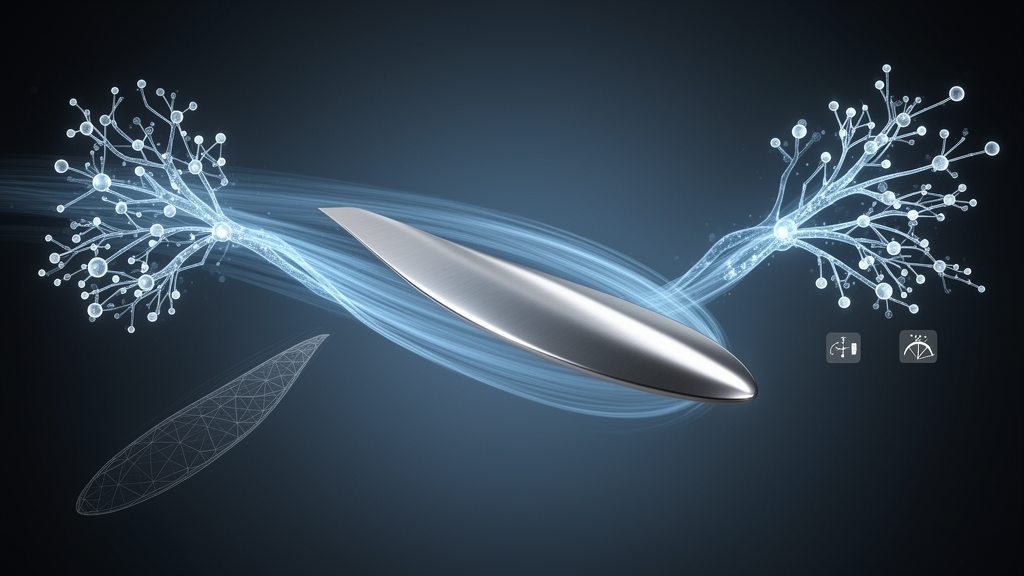
The proposed architecture instead processes both through two parallel paths. A convolutional path encodes 64×64 images of the airfoil shape, while a fully connected path encodes the Reynolds number and the angle of attack. The extracted features are merged and passed to two regression heads, so that the lift coefficient and the drag coefficient are predicted by separate output branches rather than by a single shared head.

The training data combine UIUC wind-tunnel measurements with results from the XFOIL solver, yielding 12,304 samples. The model was trained in 71 minutes on a standard workstation. The authors present the parameter count and training cost as a central point of the work: a dual-path formulation that couples image-based geometry encoding with flow-parameter conditioning while remaining small enough for training and deployment on commodity hardware.

Accuracy differs markedly between the two outputs. For the lift coefficient, the network achieves a coefficient of determination of 0.940 with a mean absolute percentage error of approximately 0.86 percent. For the drag coefficient, the coefficient of determination is 0.615, a substantially weaker result that the authors attribute to the wider dynamic range and stronger nonlinearity of the drag response, particularly near stall onset.

In conventional workflows that role is filled by computational fluid dynamics, which resolves the flow field numerically at far greater computational expense. The reported 3-millisecond evaluation time per unseen case is the speed advantage the authors highlight against that baseline. The lift branch captures a response that is represented with high fidelity in the training data, while the drag branch faces a harder regression problem within the same tested envelope.

The study's scope is limited to two-dimensional airfoil coefficients over the tested Reynolds number range of 3.92×10⁴ to 5.14×10⁵ and angle-of-attack range of −10.33 to 20 degrees. The drag prediction near stall onset remains the weakest part of the model's performance, and the reported figures describe this specific dataset and architecture rather than a general-purpose aerodynamic solver. As a demonstration, the work shows that image and numerical inputs can be fused in a compact network to predict airfoil aerodynamic coefficients at a speed suitable for rapid evaluation on ordinary computing equipment, with strong lift accuracy, moderate drag accuracy, and a small computational footprint.

Subject of Research: Dual-path CNN for airfoil aerodynamic coefficients prediction using image and numerical data

Article Title: Dual-path CNN for airfoil aerodynamic coefficients prediction using image and numerical data

Article References: Daemiashkezari, M., & Saleh, S. R. (2026). Dual-path CNN for airfoil aerodynamic coefficients prediction using image and numerical data. Aerospace Systems. https://doi.org/10.1007/s42401-026-00561-3

Image Credits: AI Generated

DOI: 10.1007/s42401-026-00561-3

Keywords: Dual-path, airfoil, aerodynamic, coefficients, prediction, image, numerical, data, scientific research

Cite Scienmag News

Blake Davidson. (October 23, 2026). Dual-path neural network predicts airfoil lift and drag from shape images and flow conditions. Scienmag. https://scienmag.com/dual-path-neural-network-predicts-airfoil-lift-and-drag-from-shape-images-and-flow-conditions/


Blake Davidson. "Dual-path neural network predicts airfoil lift and drag from shape images and flow conditions." Scienmag, 23 October 2026, https://scienmag.com/dual-path-neural-network-predicts-airfoil-lift-and-drag-from-shape-images-and-flow-conditions/. Accessed 23 October 2026.

Blake Davidson. "Dual-path neural network predicts airfoil lift and drag from shape images and flow conditions." Scienmag. October 23, 2026. https://scienmag.com/dual-path-neural-network-predicts-airfoil-lift-and-drag-from-shape-images-and-flow-conditions/

Tags: aerodynamicairfoilairfoil shape prediction using convolutional neural networkscoefficientsdatadeep learning architecture for aerodynamic performance predictionDual-pathdual-path neural network for aerodynamic coefficient predictionefficient neural network models for aerospace applicationsfast computational fluid dynamics alternativehybrid data sources combining wind tunnel data and simulation resultsimageimage-based airfoil analysis with flow conditionsmachine learning for airflow and lift/drag estimationNumericalpredictionreal-time airfoil performance prediction with deep learningregression heads for lift and drag coefficient predictionReynolds number and angle of attack encoding in neural networksScientific Research
Share26Tweet16
Previous Post

Plant-based silver-copper oxide nanocomposite senses nitrite and curbs bacteria

Next Post

CoCare Trial Protocol Tests Collaborative Care for Polysubstance Use in Primary Care

Related Posts

Plant-based silver-copper oxide nanocomposite senses nitrite and curbs bacteria
Technology and Engineering

Plant-based silver-copper oxide nanocomposite senses nitrite and curbs bacteria

October 23, 2026
Green AI framework aims to make smart cities computationally sustainable
Technology and Engineering

Green AI framework aims to make smart cities computationally sustainable

October 23, 2026
Smart sensors that never forget: three learning paradigms collide in activity recognition
Technology and Engineering

Smart sensors that never forget: three learning paradigms collide in activity recognition

October 23, 2026
Hydrogen-Bond Trick Tames Evaporated Perovskites for Efficient Near-Infrared LEDs
Technology and Engineering

Hydrogen-Bond Trick Tames Evaporated Perovskites for Efficient Near-Infrared LEDs

October 23, 2026
Three New Measures Quantify Dynamical Coherence of Quantum Channels
Technology and Engineering

Three New Measures Quantify Dynamical Coherence of Quantum Channels

October 23, 2026
Survey Maps Two Decades of Intelligent Video Surveillance Systems
Technology and Engineering

Survey Maps Two Decades of Intelligent Video Surveillance Systems

October 23, 2026
Next Post
CoCare Trial Protocol Tests Collaborative Care for Polysubstance Use in Primary Care

CoCare Trial Protocol Tests Collaborative Care for Polysubstance Use in Primary Care

  • Mothers who receive childcare support from maternal grandparents show more optimized

    Mothers who receive childcare support from maternal grandparents show more parental warmth, finds NTU Singapore study

    27656 shares
    Share 11059 Tweet 6912
  • University of Seville Breaks 120-Year-Old Mystery, Revises a Key Einstein Concept

    1061 shares
    Share 424 Tweet 265
  • Bee body mass, pathogens and local climate influence heat tolerance

    682 shares
    Share 273 Tweet 171
  • Researchers record first-ever images and data of a shark experiencing a boat strike

    546 shares
    Share 218 Tweet 137
  • Groundbreaking Clinical Trial Reveals Lubiprostone Enhances Kidney Function

    531 shares
    Share 212 Tweet 133
Science

Embark on a thrilling journey of discovery with Scienmag.com—your ultimate source for cutting-edge breakthroughs. Immerse yourself in a world where curiosity knows no limits and tomorrow’s possibilities become today’s reality!

RECENT NEWS

  • CoCare Trial Protocol Tests Collaborative Care for Polysubstance Use in Primary Care
  • Dual-path neural network predicts airfoil lift and drag from shape images and flow conditions
  • Plant-based silver-copper oxide nanocomposite senses nitrite and curbs bacteria
  • PELICAN Tool Improves Gene Recall in Bacteriophage Genome Annotation

Categories

  • Agriculture
  • Anthropology
  • Archaeology
  • Athmospheric
  • Biology
  • Biotechnology
  • Blog
  • Bussines
  • Cancer
  • Chemistry
  • Climate
  • Earth Science
  • Editorial Policy
  • Marine
  • Mathematics
  • Medicine
  • Pediatry
  • Policy
  • Psychology & Psychiatry
  • Science Education
  • Science News
  • Social Science
  • Space
  • Technology and Engineering

Subscribe to Blog via Email

Enter your email address to subscribe to this blog and receive notifications of new posts by email.

Join 5,151 other subscribers

© 2025 Scienmag - Science Magazine

Welcome Back!

Login to your account below

Forgotten Password?

Retrieve your password

Please enter your username or email address to reset your password.

Log In
No Result
View All Result
  • HOME
  • SCIENCE NEWS
  • CONTACT US

© 2025 Scienmag - Science Magazine

Discover more from Science

Subscribe now to keep reading and get access to the full archive.

Continue reading