


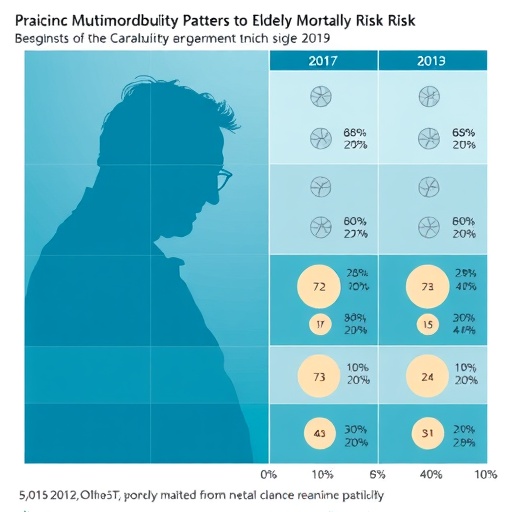
As global populations age, the complex health challenges faced by elderly individuals have come into ever sharper focus. Among these challenges, multimorbidity—the coexistence of two or more chronic medical conditions in a single individual—emerges as a critical determinant of health outcomes, particularly mortality risk. In a groundbreaking study recently published in BMC Geriatrics, researchers Zheng, Yuan, Ni, and colleagues present a detailed analysis of how patterns of multimorbidity relate to mortality among elderly residents of Shenzhen, China. This comprehensive investigation sheds light on the intricate interplay of multiple chronic diseases and offers vital insights with profound implications for elder care strategies and public health policies.
The phenomenon of multimorbidity is increasingly recognized as more than just the sum of isolated diseases. Instead, it often represents a network of interrelated pathologies that interact to exacerbate patient vulnerability. This study delves into these interactions by not only quantifying the presence of multiple conditions but also classifying their patterns within an elderly urban Chinese population. By employing advanced statistical methods to decipher the clustering of chronic diseases, the authors provide a nuanced understanding of how specific multimorbidity patterns potentiate mortality risk beyond what single conditions could predict.
Shenzhen, a rapidly growing metropolis, provides a unique demographic and epidemiological landscape for this study. The city’s elderly population faces distinctive health threats and socio-environmental factors that may influence disease prevalence and progression. This environmental context allowed the researchers to derive findings that are particularly relevant for similar urban settings undergoing demographic transitions. By focusing on such a population, the study offers insights that are both locally grounded and globally relevant, opening new avenues for personalized interventions driven by multimorbidity profiles.
The methodology adopted by Zheng and colleagues integrates comprehensive health data sourced from community health records, hospital databases, and mortality registries. The cohort consisted of thousands of elderly individuals aged 60 years and above, representing a spectrum of socioeconomic statuses and healthcare access profiles. Such a robust dataset enabled statistically powerful analyses to uncover the latent structures of multimorbidity commonly seen in this demographic. Additionally, the authors applied sophisticated cluster analysis techniques to reveal how diseases co-occur, facilitating the identification of distinct multimorbidity patterns that differentially impact survival.
The results reveal that certain clusters of chronic conditions wield an outsized influence on mortality risk, underscoring the importance of pattern recognition in clinical risk assessment. For instance, combinations involving cardiovascular diseases, diabetes, and chronic respiratory illnesses showed a synergistically elevated hazard ratio for death. In contrast, other clusters with combinations of musculoskeletal and sensory impairments presented a comparatively lower but still significant mortality risk. These differentiated patterns call attention to the heterogeneity in multimorbidity and highlight the necessity for tailored clinical pathways that address the specific constellation of diseases within an elderly patient.
An intriguing aspect of the study is its emphasis on the temporal dynamics of multimorbidity. The authors tracked the progression of disease combinations over time, elucidating how the emergence of additional conditions influences mortality trajectories. This longitudinal approach revealed that not just the baseline multimorbidity but also the rate and order of acquiring new diseases are crucial predictors of survival. Such findings challenge traditional clinical paradigms that treat chronic diseases in isolation and instead promote a holistic approach that monitors the evolving health landscape of elderly patients.
Importantly, this research integrates socio-demographic factors with clinical data to parse out how variables like age, sex, education, and income modulate the relationship between multimorbidity and mortality. The interplay between social determinants and clinical profiles underlines the multifaceted nature of health risk in aging populations. For example, elderly individuals from lower socioeconomic backgrounds exhibited higher multimorbidity levels and correspondingly greater mortality risk, suggesting that health disparities remain deeply ingrained even in rapidly modernizing societies such as Shenzhen.
The identification of high-risk multimorbidity patterns holds potential for revolutionizing public health interventions. Traditional disease management programs often focus on singular chronic conditions, leading to fragmented care and suboptimal outcomes for patients juggling multiple illnesses. The insights gained from this study advocate for integrated care models that address coexisting conditions collectively, prioritizing clusters of diseases known to amplify mortality risk. Such multidimensional care strategies could enhance resource allocation efficiency and improve quality of life for elderly individuals worldwide.
From a technological standpoint, the statistical and computational frameworks employed in the study exemplify a new era of precision epidemiology. By leveraging big data analytics, machine learning clustering algorithms, and survival analysis techniques, the researchers surpass simplistic metrics to extract complex health patterns. These methodological advances pave the way for real-time monitoring tools and predictive models that can be deployed in clinical settings to identify high-risk elderly patients early and dynamically adjust their treatment plans.
The study also touches on the implications of multimorbidity for healthcare systems facing the pressures of aging societies. As multimorbidity prevalence rises, the burden on healthcare infrastructure, caregiving services, and social support networks intensifies. Findings from Shenzhen provide empirical evidence that can inform policy frameworks aimed at optimizing the management of elderly care, including training healthcare providers in multimorbidity complexities and encouraging preventive strategies to mitigate disease clustering before critical health decline occurs.
Further, the cultural dimensions embedded within the Shenzhen elderly cohort bring valuable context to the generalizability of the findings. Healthcare behaviors, traditional medicine usage, and family support structures all intersect with multimorbidity patterns and outcomes. Understanding these sociocultural underpinnings enriches the global dialogue on aging health and supports the adaptation of intervention strategies across diverse populations, honoring both universal biological mechanisms and local nuances.
The researchers also explore the role of lifestyle factors—such as diet, physical activity, smoking, and alcohol consumption—in shaping multimorbidity trajectories and mortality risks. Their data indicate that modifiable behaviors significantly influence the emergence and progression of multimorbidity clusters. This awareness reinforces the critical need to incorporate preventive health promotion into eldercare, emphasizing early lifestyle interventions that can disrupt adverse disease patterns before they coalesce into fatal outcomes.
Alongside biomedical and behavioral insights, the study acknowledges the psychological impact of living with multiple chronic conditions. The burden of multimorbidity often extends beyond physical health, affecting mental well-being, cognitive function, and social engagement among the elderly. These psychosocial dimensions contribute to mortality risk indirectly by impairing self-care abilities and adherence to treatment. Future multidisciplinary initiatives would benefit from integrating mental health services into comprehensive multimorbidity management paradigms.
Looking forward, the findings of Zheng and colleagues highlight several promising areas for further research. While this study provides a rigorous snapshot of multimorbidity-mortality associations, expanding such analyses longitudinally across different geographic regions could elucidate universal versus context-specific disease patterns. Additionally, integrating biological markers and genetic data might refine risk stratification models, revealing mechanistic pathways underlying multimorbidity clusters and their lethal synergies.
In conclusion, this seminal work from Shenzhen marks a decisive step in unraveling the complex web of multiple chronic diseases and their combined impact on elderly mortality. By meticulously characterizing multimorbidity patterns and correlating them with survival outcomes, the authors deliver actionable knowledge essential for evolving eldercare toward more personalized, integrated, and equitable paradigms. This study not only enhances scientific understanding but also serves as a clarion call to healthcare systems worldwide to prepare proactively for the multifaceted challenges of an aging global population.
Cite Scienmag News
Beatrice Stafford. (April 27, 2026). Multimorbidity Patterns Linked to Elderly Mortality Risk. Scienmag. https://scienmag.com/multimorbidity-patterns-linked-to-elderly-mortality-risk/
Beatrice Stafford. "Multimorbidity Patterns Linked to Elderly Mortality Risk." Scienmag, 27 April 2026, https://scienmag.com/multimorbidity-patterns-linked-to-elderly-mortality-risk/. Accessed 4 September 2026.
Beatrice Stafford. "Multimorbidity Patterns Linked to Elderly Mortality Risk." Scienmag. April 27, 2026. https://scienmag.com/multimorbidity-patterns-linked-to-elderly-mortality-risk/


