


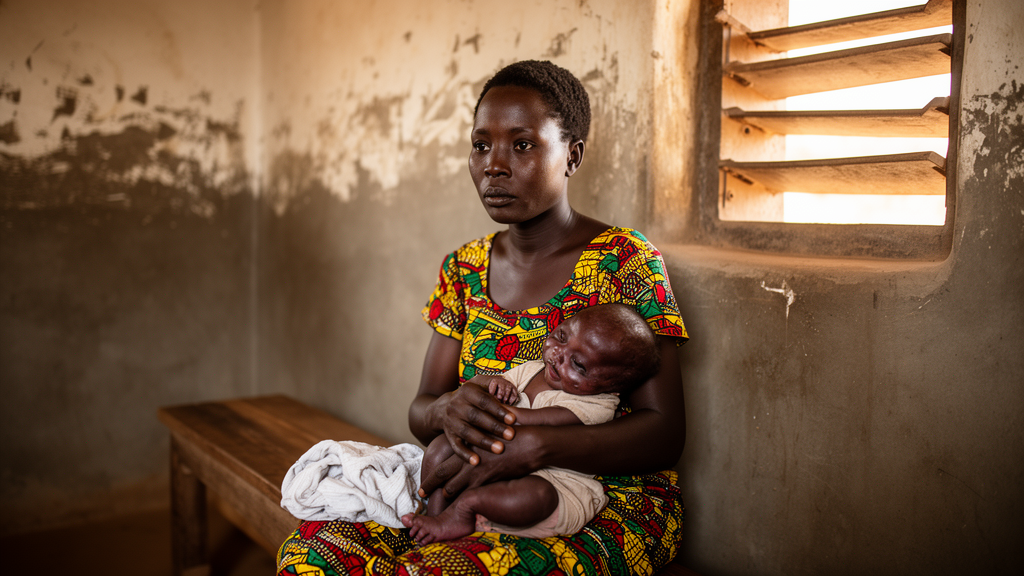
When a child is born with a congenital anomaly in Ghana’s Upper East Region, the diagnosis rarely lands on the family as a whole. It lands, almost exclusively, on the mother. A new qualitative study published in BMC Pediatrics by Awinaba Amoah Adongo of the University of Skills Training and Entrepreneurial Development and colleagues documents how mothers caring for children with conditions such as cleft lip and palate, congenital heart disease, Down syndrome, and spina bifida experience that burden through a distinctly sociocultural lens, one in which spiritual attribution, rigid gender roles, and religious conviction shape nearly every dimension of daily caregiving.
The research team conducted the study in 2022 at the Upper East Regional Hospital, using a qualitative phenomenological design known as Interpretative Phenomenological Analysis, or IPA. Unlike survey-based approaches that measure prevalence or quantify stress scores, IPA is built to excavate the texture of personal experience. Researchers conduct in-depth interviews, then systematically analyze transcripts to identify how participants make sense of what has happened to them. The method is particularly suited to questions where meaning, not frequency, is the object of study: how a mother interprets her child’s condition, what she believes caused it, and whom she blames or forgives for it.
What emerged from the analysis was a picture in which cultural belief systems function as a kind of interpretive operating system for the mothers involved. Congenital anomalies, which are structural malformations that develop in utero, were frequently attributed to spiritual causes rather than biomedical ones. This attribution was not merely an intellectual position; it had material consequences. For some mothers, the spiritual framing invited stigma from their communities, compounding the practical difficulties of raising a child with complex medical needs. For others, the same spiritual framework became a source of coping strength, a way to make sense of an otherwise inexplicable event and to find meaning in the caregiving role.
The study’s findings on gender roles are perhaps its most pointed contribution to the global literature on caregiver burden. While the challenges faced by caregivers of children with congenital anomalies have been researched extensively worldwide, the authors note that limited work has examined how that experience depends on the specific sociocultural environment, particularly through the intersecting perspectives of religion, gender, and culture. In the Upper East Region, caregiving fell predominantly on mothers, producing emotional strain that was intensified by limited spousal support. Fathers, in the accounts analyzed, were largely absent from the day-to-day labor of care, a pattern consistent with broader findings in global health research on the gendered distribution of unpaid caregiving in many parts of sub-Saharan Africa.
This gendered asymmetry matters clinically, not just sociologically. Caregiver burden in pediatric congenital anomaly contexts is associated with maternal mental health outcomes, treatment adherence, and the consistency of follow-up care that children with chronic structural conditions require. A mother who is simultaneously navigating community stigma, managing appointments and medications alone, and absorbing the emotional weight of a diagnosis without a partner’s support is operating under conditions that health systems rarely account for when they design pediatric services. The study’s authors argue that this is precisely why culturally sensitive support programmes are needed rather than generic caregiver interventions imported from other contexts.
Religious belief emerged as a third, interlocking force in the mothers’ experiences. Faith shaped how mothers coped with their children’s conditions and how they made care decisions, but it sometimes brought them into direct conflict with medical advice. The study does not frame this as a simple clash between tradition and science; rather, it documents how religious frameworks provided genuine psychological resources for endurance while simultaneously creating decision-making pathways that could diverge from clinical recommendations. For health workers in the region, this means that effective communication with mothers requires understanding the religious logic behind their choices, not simply correcting it.
The methodological choice to use IPA rather than a quantitative burden scale is significant for what it allows the study to capture. Because the analysis centers on how mothers themselves interpret their situations, it surfaces contradictions that standardized instruments tend to flatten. The same cultural belief system that stigmatized one mother strengthened another. The same religious conviction that guided one mother toward acceptance led another to decline a recommended intervention. These variations, which the researchers identified as commonalities alongside unique differences across participants, are exactly the kind of findings that population-level surveys are structurally unable to detect.
The study was conducted in accordance with the ethical principles of the Declaration of Helsinki, with ethical clearance obtained from the Regional Health Directorate under approval number GHS/UE/RS/11/001 before data collection began. Participation was voluntary, respondents were given full information about the study’s purpose, and participants retained the right to withdraw at any point. The authors declare no competing interests and note that the research received no external funding. Artificial intelligence tools were used only for language editing and readability, with all intellectual content, interpretation, analysis, and conclusions remaining the responsibility of the authors.
The research team spans multiple Ghanaian institutions, reflecting the interdisciplinary nature of the question. Adongo is based in the Department of Public Health Education at the University of Skills Training and Entrepreneurial Development in Mampong-Ashanti. Vincent de Paul Kanwetuu brings a sociological perspective from the Department of Sociology and Social Work at Kwame Nkrumah University of Science and Technology in Kumasi. Dominic Nabil Bodpii is affiliated with the School of Business at the University for Development Studies in Tamale, Robert Kuchengye Mokulogo with the University of Business and Integrated Development Studies in Wa, and James Akazili with the School of Public Health at the University of Technology and Applied Sciences in Navrongo. This composition signals that the authors view maternal caregiving not as a narrow clinical problem but as one sitting at the intersection of public health, sociology, and development studies.
The study’s implications reach beyond the Upper East Region. Congenital anomalies occur globally, and the caregiver burden they generate is a recognized challenge in health systems everywhere. But the Ghanaian findings underscore a point that global health researchers have increasingly emphasized: the experience of caregiving is not universal. It is filtered through local beliefs about causation, local expectations about who bears responsibility for a child’s wellbeing, and local religious frameworks that define what acceptance and action look like. For practitioners, the authors conclude that empathetic, culturally sensitive approaches are essential for supporting mothers within this distinct sociocultural setting. For researchers, the study demonstrates that phenomenological methods remain a powerful tool for surfacing the lived realities that shape health outcomes long before any clinical measurement begins.
Subject of Research: Mothers' lived experiences caring for children with congenital anomalies in Ghana's Upper East Region
Article Title: Lived experiences of mothers caring for children with congenital anomalies at the Upper East Regional Hospital, Ghana: an interpretative phenomenological analysis
Article References: Adongo, A. A., Kanwetuu, V. D. P., Bodpii, D. N., Mokulogo, R. K., & Akazili, J. (2026). Lived experiences of mothers caring for children with congenital anomalies at the Upper East Regional Hospital, Ghana: an interpretative phenomenological analysis. BMC Pediatrics. https://doi.org/10.1186/s12887-026-07593-w
Image Credits: AI Generated
DOI: 10.1186/s12887-026-07593-w
Keywords: congenital anomalies, maternal caregiving, Ghana, interpretative phenomenological analysis, sociocultural factors, disability stigma, gender roles, religious belief, BMC Pediatrics, qualitative research, Upper East Region, caregiver burden
Cite Scienmag News
Ophelia Keating. (October 18, 2026). Mothers in Ghana’s Upper East Region Carry the Weight of Congenital Anomaly Care Alone. Scienmag. https://scienmag.com/mothers-in-ghanas-upper-east-region-carry-the-weight-of-congenital-anomaly-care-alone/
Ophelia Keating. "Mothers in Ghana’s Upper East Region Carry the Weight of Congenital Anomaly Care Alone." Scienmag, 18 October 2026, https://scienmag.com/mothers-in-ghanas-upper-east-region-carry-the-weight-of-congenital-anomaly-care-alone/. Accessed 18 October 2026.
Ophelia Keating. "Mothers in Ghana’s Upper East Region Carry the Weight of Congenital Anomaly Care Alone." Scienmag. October 18, 2026. https://scienmag.com/mothers-in-ghanas-upper-east-region-carry-the-weight-of-congenital-anomaly-care-alone/


