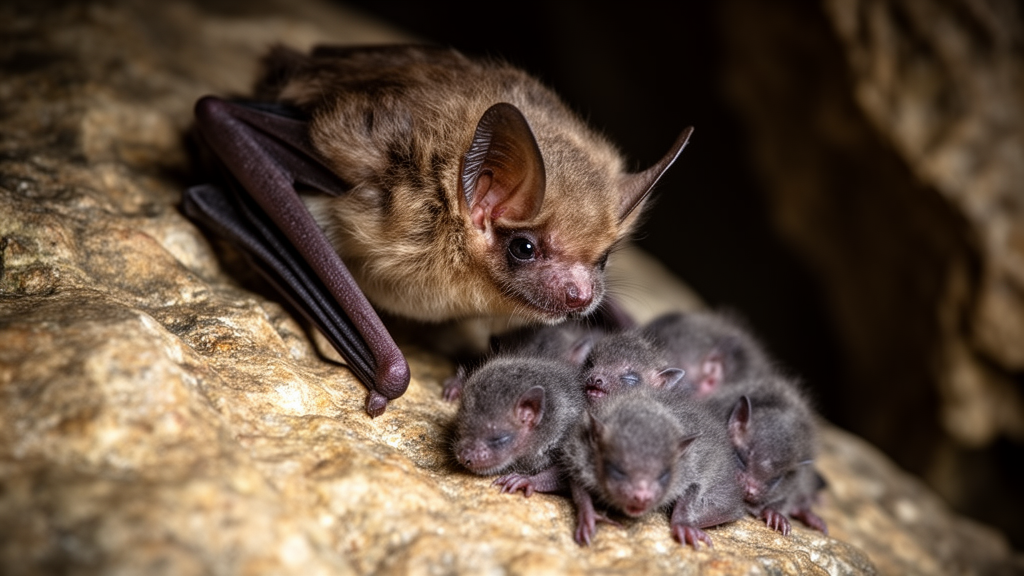
When mother Japanese house bats heard recordings of their own offspring, their hearts beat measurably faster — and the response persisted even as the pups grew and their calls changed shape, according to new research by Kazuki Yoshino-Hashizawa and colleagues at Doshisha University, accepted for publication in Frontiers in Ethology. Calls from non-family pups did not trigger the same cardiac response, revealing a physiological signature of maternal recognition in a colonial mammal.
Maternal care is essential for offspring survival in mammals, and in colonial species the challenge of identifying one’s own young is particularly acute. In Pipistrellus abramus, the Japanese house bat, mothers rely on acoustic cues to single out their pups, especially the isolation calls produced by newborns when they are separated from their mothers. What has remained largely unknown, the authors note, is the psycho-physiological mechanism underneath this recognition — whether a mother’s body responds to her pup’s voice in a way that distinguishes it from the voices of unrelated young.
To probe that question, the team turned to an indirect but sensitive physiological gauge: heart rate. Rather than relying solely on observable behavior, the researchers measured changes in mothers’ heart rate during controlled playback experiments, using the autonomic nervous system’s arousal response as an index of how salient each sound was to the listener. Electrocardiogram-based monitoring of this kind is valuable in animal studies because arousal levels shift quickly and measurably when an animal attends to socially meaningful stimuli.
The experimental design captured two very different stages of pup development. The researchers recorded isolation calls from 2-day-old pups — the cries of newborns — and echolocation calls from 30-day-old pups, whose vocalizations by that age have shifted toward the sonar-like signals bats use for orientation. These recordings were then played back to mothers after the early nursing period had passed, allowing the team to test whether maternal responsiveness survives the dramatic developmental changes in call structure.
The results were strikingly selective. Mothers’ heart rates increased significantly in response to calls from their own pups, and this held true for both the infant isolation calls and the older pups’ echolocation calls. Calls from non-family pups, by contrast, failed to evoke a significant heart rate increase. The physiological signature of recognition, in other words, tracked family membership rather than the acoustic category of the call itself.
Among all the stimuli presented, the echolocation calls of mothers’ own older pups produced the largest heart rate increase of all. That finding indicates heightened physiological arousal and, importantly, sustained maternal responsiveness despite the substantial developmental changes in call structure between infancy and one month of age. A mother’s arousal system, the data suggest, remains tuned to her own offspring’s voice even after it has transformed from an infant’s isolation cry into something closer to an adult vocalization.
One result came as a surprise to the researchers themselves. Echolocation calls from an unfamiliar adult bat also induced heart rate elevation in the mothers, suggesting that elevated heart rate can be triggered by salient social cues beyond pup recognition alone. This observation complicates a simple interpretation of the measure: a rising heart rate signals arousal and attention, but it does not by itself reveal what kind of social signal provoked it.
The authors are careful about the limits of their method. Heart rate alone cannot separate positive from negative emotional valence — a mother’s arousal to her pup’s call and her arousal to an unfamiliar adult’s call may feel very different, yet produce similar cardiac responses. Even so, the study demonstrates that Japanese house bat mothers exhibit enhanced physiological responsiveness specifically to their own pups’ vocalizations, and it establishes heart rate as a sensitive index for evaluating arousal levels and social auditory processing based on dynamic acoustic information in bats. The findings offer a measurable window into how maternal recognition operates beneath observable behavior in a colonial bat species.
Subject of Research: Mother Japanese house bats show stronger heart rate increases to biological pup calls than to non-family pup calls
Article Title: Mother Japanese house bats show stronger heart rate increases to biological pup calls than to non-family pup calls
Article References: Yoshino-Hashizawa, K., Hiragochi, M., Kobayasi, K. I., & Hiryu, S. (2026). Mother Japanese house bats show stronger heart rate increases to biological pup calls than to non-family pup calls. Frontiers in Ethology, 5, Article 1891633. https://doi.org/10.3389/fetho.2026.1891633
Image Credits: AI Generated
DOI: 10.3389/fetho.2026.1891633
Keywords: Mother, Japanese, house, bats, show, stronger, heart, rate, increases, biological, calls, than
Cite Scienmag News
Harold Sullivan. (October 23, 2026). Mother bats show strongest heart rate surges to their own pups’ calls. Scienmag. https://scienmag.com/mother-bats-show-strongest-heart-rate-surges-to-their-own-pups-calls/
Harold Sullivan. "Mother bats show strongest heart rate surges to their own pups’ calls." Scienmag, 23 October 2026, https://scienmag.com/mother-bats-show-strongest-heart-rate-surges-to-their-own-pups-calls/. Accessed 23 October 2026.
Harold Sullivan. "Mother bats show strongest heart rate surges to their own pups’ calls." Scienmag. October 23, 2026. https://scienmag.com/mother-bats-show-strongest-heart-rate-surges-to-their-own-pups-calls/